
Trees can provide much-needed shade, privacy, and beauty to any landscape. However, they can also significantly impact the local ecosystem, making it easier or more challenging for native plant and animal species to thrive. Invasive trees, in particular, can harm local forests and their inhabitants, so it’s best to avoid them however you can.
Of course, where you live often dictates whether or not a tree is considered invasive, so we spoke to two experts to get the full scoop. These pros—an arborist and a horticulturist—identified seven common varieties that you may encounter and that you’re better off avoiding altogether.
Privet
Credit:
Getty Images
Privet, a member of the genus Ligustrum, is commonly sold as a landscaping tree or shrub for its dense foliage and rapid growth. However, while it may seem like an aesthetically pleasing way to add privacy to your property, it’s best to avoid this invasive tree.
“Privet escapes from the landscape and gets into natural forests and other areas,” says Chris Roddick, an ISA-certified arborist and co-author of The Tree Care Primer. Even with careful maintenance, privet can quickly disrupt the natural environment, as birds and wind can carry its seeds, allowing the tree to rapidly take over forests and disrupt local ecosystems.
Tree of Heaven
Credit:
Getty / apugach
Matt Mattus, director of special projects at the American Horticultural Society, cites the tree of heaven as one to avoid, calling it “one of the most invasive [trees] in North America.”
The tree of heaven was first introduced in central China and Taiwan in the 1700s. It is now invasive from New England to California and is commonly found in major cities and urban areas.
“One tree can spread up to 300,000 seeds,” says Mattus. “It can spread via roots and shoots and sprouts from root pieces left in the ground.” It’s increasingly challenging, then, to eradicate tree of heaven once it takes hold.
Bradford Pear
Credit:
Getty / Chris Gordon
Both Roddick and Mattus point to the Bradford pear or Callery pear as an invasive tree to avoid, though its appearance may tempt you. “It’s beautiful because it’s in the rose family with white blossoms in the spring,” says Roddick.
However, in places where it’s particularly prominent, like New Jersey, it’s choking out all the native trees and the ecosystem, adds Roddick. According to Mattus, the tree is relatively new to the invasive species list, but many states are now outlawing its sale—even the hybrids.
Norway Maple
Getty / Alexander Denisenko.
The Norway maple arrived in North America via England shortly before the Revolutionary War. Today, it’s one of the most popular urban trees, according to the U.S. Forest Service.
Though the large leaves of a Norway maple may provide welcome shade, it’s a “fertile weed tree” that can wreak havoc in urban areas, according to Mattus: “It spreads mainly by seed, self-seeding in vacant lots, city forests, and along highways.” As it spreads, native grasses and other plants will struggle to survive due to the tree’s increased shade and shallow root system.
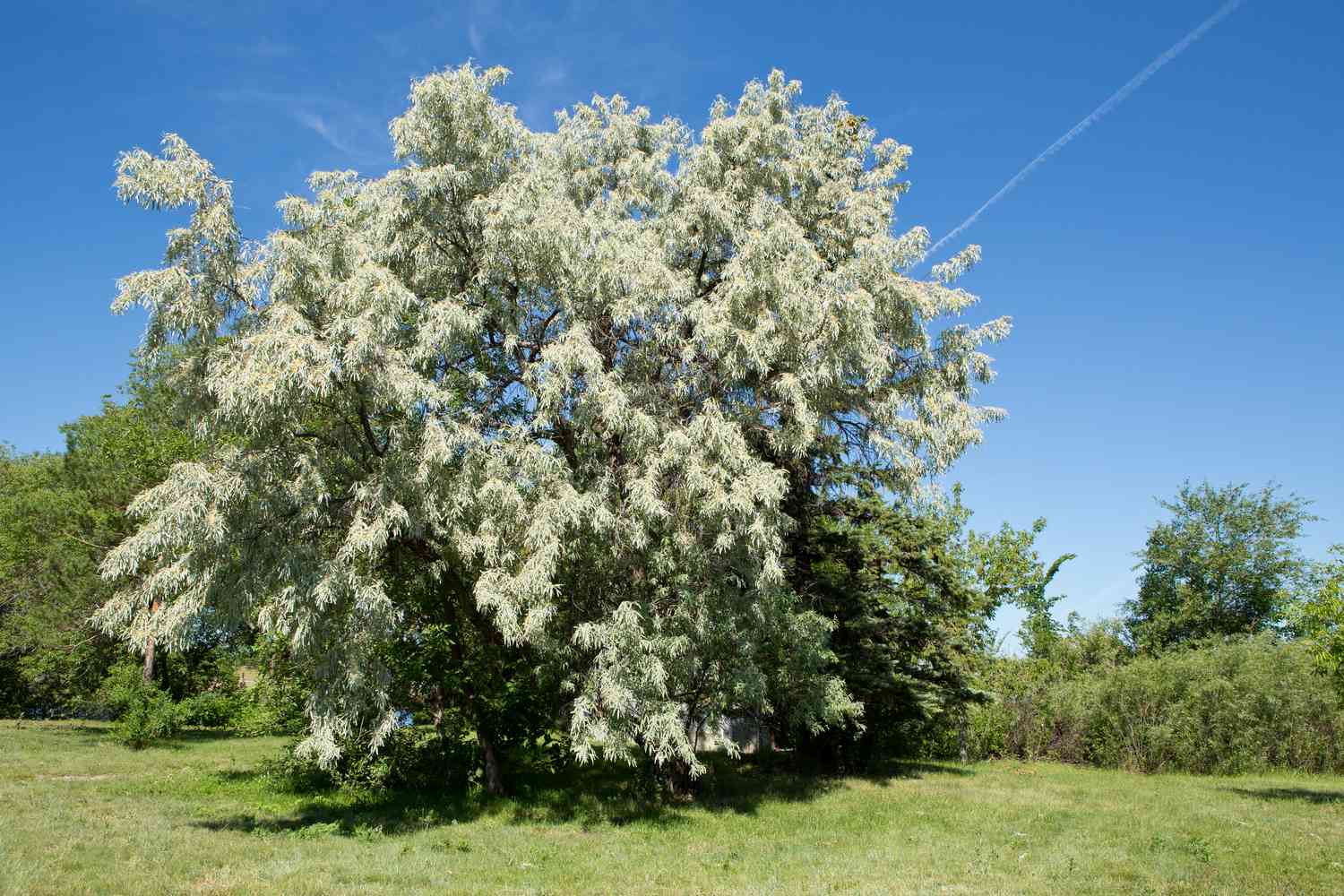
Russian Olive
Credit:
Getty / skyscapes
The Russian olive was introduced to the U.S. in the early 1900s from Eurasia and was commonly used as an ornamental tree. However, according to Mattus, it’s since spread across the country, even growing in USDA Zone 3.
The tree’s seeds are spread by their floating fruit, according to Mattus, which can make their way down waterways. Root fragments can also spread this invasive species. “It’s outlawed in many states but is often still for sale via mail-order nurseries,” he says.
Black Locust
Credit:
Getty / Kristine Radkovska
“A native tree? Yes. Oddly, while the black locust is a North American tree, it’s one that has spread beyond its original habitat of the southeast,” says Mattus.
In its native environment, the black locust can be a boon, providing edible, fragrant flowers and slow-decaying wood for fence posts or decking. It’s also a nitrogen-fixing plant that can improve the fertility of the surrounding soil.
However, it can spread through multiple methods. “Its thorny stems and rapid growth can quickly make it unmanageable,” says Mattus. This quick growth can become a problem for specific habitats.
Comments are closed.