
I grew up in Delhi in the 1980s. The garden at my parents’ home was where I spent most of my time, and where I first learnt that what looks “local” can come from far away and still become part of your life.
In spring, jacarandas from Brazil came first, soft and violet, giving way to the fiery plumage of gulmohar from Madagascar. By summer, laburnums, introduced from Europe, hung their yellow gold. The garden was filled with the familiar scents of raat ki rani and hibiscus — and its floors littered with fallen neem fruit.
Still at school, bored by classrooms, I looked forward to weekend meanderings around the parks and streets of my then sleepy city. My father guided me with heavy botanical tomes dedicated to classifications, species and habitats. Together, we learnt scientific names — my favourite was Pongamia glabra, which I loved to roll around my tongue — the shapes of leaves, their flowering cycles, the creatures they sheltered and where in the world they came from. Naming plants sharpened my attention.
It took me years to understand that our garden was not an isolated pocket of green, but part of a much larger landscape shaped by history. We lived close to the Delhi Ridge, the rocky spine of the Aravalli mountain range, which the British reworked in the early 20th century while building New Delhi. What colonial planners described as “wasteland” was transformed into a green buffer around Raisina Hill, softening the view from the Viceroy’s House, now Rashtrapati Bhavan, the official residence of India’s president.
 Tara Lal in her Delhi garden, 1985
  How had plants from South America, Europe, Africa and Asia come to coexist here? Who decided what was planted, and why?
Our garden was, in many ways, an extension of that project: a domestic spillover of the ridge itself. Native thorn forest species mingled with trees introduced for shade, spectacle and order. Rhesus monkeys moved easily between forest and home, raiding fruit trees and peanut stalls nearby. Birds nested in both spaces, and finding a shed snakeskin in the undergrowth was not unusual. The line between garden and forest was porous, and that porosity shaped how I came to understand nature.
Kew Gardens was central to the imperial network: a laboratory where countless species were redistributed as tools of economic power
Only later did I begin to ask deeper questions. How had plants from South America, Europe, Africa and Asia come to coexist here? Who decided what was planted, and why?
I didn’t have the language for it then, but I was already living inside the afterlife of botanical empire. In Empireworld, journalist Sathnam Sanghera writes about how Kew Gardens in London became central to this imperial network: a laboratory where rubber trees, tea and countless other species were studied and redistributed as tools of economic power. Much of what we now experience as “normal” in our landscapes was engineered through these systems.
Decades later, after a life in architecture and design, I found myself back in forests. There, I encountered this legacy in a more destructive form: invasive species. Invasive plants are now recognised as one of the major threats to biodiversity globally.
 Lantana camara, introduced to India in the 19th century, now dominates India’s forests, crowding out native species © Surasaki/Dreamstime
 Water hyacinth, native to the Amazon basin, is choking lakes and canals in Mexico, India and parts of Africa © Surasaki/Dreamstime
In India, Lantana camara, introduced by colonial horticulturists in the 19th century, now dominates forests, crowding out native species and altering soil and fire regimes. Water hyacinth, native to the Amazon basin, spread to Mexico, India and parts of Africa, where it now chokes lakes and canals. In the UK, Rhododendron ponticum, native to the Black Sea region of Turkey and the Caucasus, was widely planted in Victorian gardens before spreading aggressively into woodlands in Wales and Scotland, suppressing native plant life.
Here’s what makes this conversation so complex: we, as gardeners, often don’t know which plants are invasive. We love our gardens, and we should. But sometimes we don’t actually know them. We inherit gardens without inheriting their histories. So how do we begin to understand where our plants come from? What do they support, and what do they quietly displace? And once we know, what do we do with that knowledge?
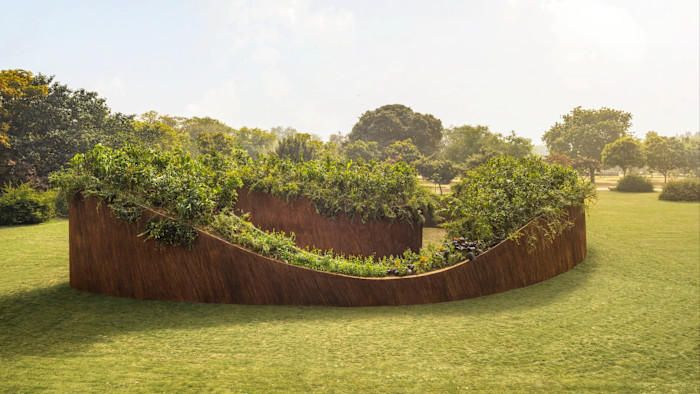
These questions sit at the heart of my work today. They led me to found Aranyani, named after the ancient Vedic forest goddess, an organisation that brings together ecological restoration, public art and storytelling. This month, we launch our inaugural pavilion, Sacred Nature, set within Delhi’s restored Sunder Nursery. The installation brings together native species and the invasive Lantana camara within a single monumental structure, inviting visitors to feel, physically and emotionally, the tensions we often overlook. During its 10-day programme, artists, thinkers, architects, philanthropists, historians, activists and students will reflect on what it might mean to decolonise our relationship with land.
Recommended

Learning about the plants in my own garden led me to where I am today. It opened my eyes to patterns, to histories and to the possibility of care. So when you step into your own garden — the space you love, and that connects you most intimately to the Earth — I hope you pause and wonder where its species come from, and how they arrived. Should they be there? Should they remain? Because ultimately, in the words of ecofeminist scholar Vandana Shiva, “the only way to build hope is through the Earth”.
Tara Lal is a conservationist and the founder of Aranyani Life
Aranyani Pavilion, Sunder Nursery, New Delhi, February 4-13, aranyanilife.com/pavilion
Find out about our latest stories first — follow @ft_houseandhome on Instagram
Comments are closed.