
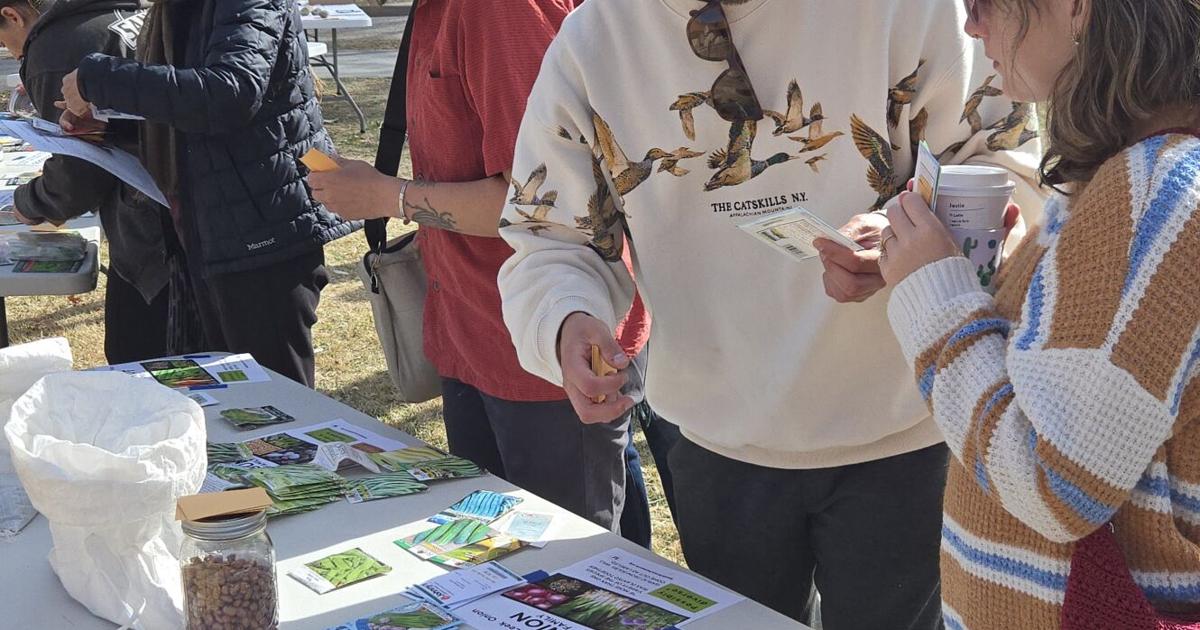
Like seeds dispersed by the wind, gardening enthusiasts came from near and far to the Seed Swap held Saturday morning at the Owens Valley Paiute Shoshone Cultural Center in Bishop.
Nearly 100 people showed up to the first-of-its kind collaborative event organized by the Bishop Paiute Tribe’s Food Sovereignty Program, Eastern Sierra Land Trust, the University of California Master Gardeners of Inyo and Mono Counties and the California Plant Society.
Visiting from Ridgecrest was Eastern Kern County Resource Conservation District board member Edward Bruns, who had made the roughly two-and-a-half hour trek to Bishop to gather some native seeds for his home garden, he said, but more importantly, to glean some ideas on how to best put on a seed swap in his desert community.
Bishop residents Mikhala Bornstein and Justin Ortiz, who are engaged and soon to be married, were there to pick up seeds for a garden they intend to plant as they start their life together.
They have about a tenth-of-an-acre lot they plan to solarize by heating the soil under plastic sheeting to kill weeds and get it ready for planting the cauliflower, lettuce, onion, chives, beans and other seeds they picked up at the seed swap, Bornstein said.
“This is like a dream come true for me,” ESLT community connections program director Gena Wood said, reveling in the harvest of seed swappers her efforts had helped yield.
“I’m so excited to see the community come together for sharing, swapping and growing,” she said. “The idea for a local seed swap originated with her, Wood said, as she thought back nostalgically on the well-established seed swap held every spring in Arcata during her college years at Humboldt State University. Wood turned to the tribe’s food sovereignty program, wanting it to take the lead because of its seed resources and expertise, she said.
Food Sovereignty Program garden and nutrition educator Masha Bluestein, who coordinated Saturday’s event, highlighted the collaborative aspect of the local seed swap.
“My favorite thing is to be working with other people in town who are excited about growing their own food,” she said.
With help from participants, Bluestein organized seeds on several tables according to plant types.
For example, the nightshade variety table held squash, zucchini, tomato, potato and eggplant seeds; another table held seed packets for herbs, flowers and grains, according to ESLT communications manager Allie Rigby.
Besides the seed tables, there was also a table with information about how to properly label seed packets and jars, and what types of seeds were allowed as part of the seed swap.
Encouraged seeds included locally saved seeds, excess-bought seeds, and open-pollinated seeds — from plants naturally pollinated by wind, insects, or self-pollination. Discouraged seeds included genetically engineered plant seeds, poisonous/noxious plant seeds, and patented varieties, which are illegal to distribute.
Food Sovereignty Program director Milo Vella, a 2021 graduate of Deep Springs College, had some help from his alma mater in the person of Ellyn Greene, the college’s garden manager since March of last year. Greene made the journey from Deep Springs Valley over the White Mountains to lend a hand together with her partner, Nick Boysel.
Greene and Boysel, who used to grow vegetables and seed commercially on a leased farm in southern Oregon, came bearing sacks full of garbanzo beans, as well as green striped cushaw squash, eggplant, and other seeds.
The UC Master Gardeners led a seed starting workshop for attendees. Wood will soon be able to lead such workshops herself: She has enrolled in the Master Gardeners program, and will be receiving training beginning this month through June, she said.
Comments are closed.