
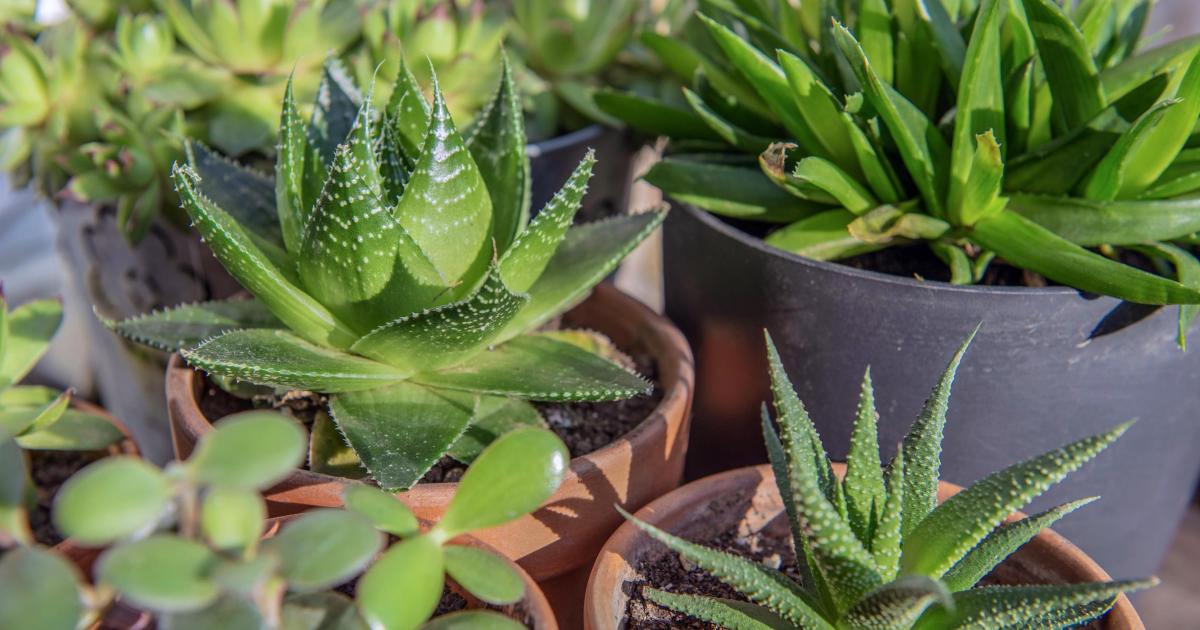
While the garden outside quietly rests over the depth of winter let’s move inside for this month’s gardening column and cheer ourselves up with indoor plants.
Over my long career in horticulture, I’ve seen houseplants go through various incarnations, from the kitsch ’70s, through to near obscurity in the ’90s and back to the height of coolness in our Instagram lives of the present day. Houseplants and indoor gardening are a real escape from the gloomy winter weather and accessible to everyone with an inside, naturally lit space. Let’s categorise them into three distinct groups. Cacti and succulents, foliage plants for structure and flowering plants for seasonal interest.
Cacti and succulents are a great place to start, with little care requirements, including watering. They are a lovely way to introduce children to indoor gardening and are available in affordable small pots that can be grown on and cared for over many years. My favourites are Haworthias, which come in a range of attractive rosettes of patterned spiked foliage, Lithops, or living stones (that avoid being eaten by animals in the wild by disguising themselves as coloured pebbles) and finally Zygocactus and Christmas cacti, which flower through the winter, on what
I can only describe as neglect. All thrive on little attention but appreciate a light and airy position, and will flower annually.
Foliage plants are a great addition to any room, as they give focus and structure to any indoor space, very like an all-year-round Christmas tree. Gone are the days of a distorted rubber plant languishing in a corner of an ’80s living room. With the advances in plant propagation, we are now offered a kaleidoscope of coloured foliage and plants of many shapes and sizes. My three recommendations for starting a foliage collection are Dracaeana ‘Lemon and Lime’, an elegant upright dragon palm with attractive striped foliage, Maranta ‘Prayer Plant’ with attractive striped leaves of green, red and dark burgundy that trail over the edge of the pot, and Kentia Palms, which were popular in Edwardian conservatories with rich, dark green fronds that add a touch of glamour to any indoor space.
Finally, we come to flowering varieties and here the range is more seasonally limited, but I think the most rewarding. For my top three I’ll go for Phalaenopsis or ‘Moth Orchid’ – a warm room-loving orchid that flowers for months at a time and benefits from dead-heading to produce more flower spikes – Bromeliads, which naturally grow on tree branches and provide brightly coloured bracts (modified leaves) around a central cluster of flowers, and the much maligned African violet that was my first houseplant obsession when I was a child.
All are easy to grow, need a liquid houseplant feed when coming up to flower and the removal of spent flowers to encourage more to grow.
Alpine plants (Image: Galina Sandalova/Getty)
PLANT OF THE MONTH
Alpines
Once you’ve been inspired by the beauty of Harlow Carr’s early flowering alpines, my suggestion is to start your own collection.
Alpines are a diverse and forgiving range of plants and ideal for
growing for February colour in your gardens. They lend themselves to small pot cultivation or traditional alpine troughs or even window boxes. Go along to a garden centre or plant nursery and see what they have to offer.
The Alpine House at Harlow Carr. (Image: Sarah Gabbatiss/The Press Camera Club)
GARDEN OF THE MONTH
Harlow Carr Alpine House
To continue the indoor gardening theme, we return to Harlow Carr this month, but to the beautiful Alpine House that should be starting to emerge from its winter rest and the flowering alpines doing their stuff. With more than 2,000 varieties flowering to choose from to display over the year, the team always has an eye-catching collection on show to delight on wet February days.
Nigel advises to create a rough plan of your garden and work out what will go in the area. (Image: : Marina Lohrbach/Getty)
QUESTION TIME
I grew too many plants last spring and wasted so many seeds. Can you suggest the best ‘rule of thumb’ method of planning what I should grow this year?
This question is a great one to ask as it really is a failing of many gardeners. We all get carried away with colourful ideas pictured on colourful seed packets. My initial comment is to not start too early in germinating your seeds – the light levels do not support strong growing stocky plants. Wait until the conditions are right.
Next, only sow what you can accommodate. I grew 200 foxgloves from one packet of seed a few summers ago and ended up planting 30. Seeds do lose germination viability once open, but they can be stored cool and dry for a couple of years, so my suggestion is that if you need 20 plants, sow 40 seeds so you can pick out 20 strong plants.
Finally, make a rough plan of your garden and work out what will go in the area. This will be a good indication of what you ‘should’ grow as opposed to what you ‘could’ grow. There is a massive difference.
When I cut back my colourful Cornus stems, is it the right time to try to take cuttings from the cut stems?
It is exactly the right time to take cuttings. I use nine-inch ‘long tom’ pots, which are twice the depth of ordinary pots so that the stems have a deep root run to root into.
I cut pencil-thick branches to get the best result and cut them six inches longer than the depth of the pot to allow for top growth and then use a good mix of one part garden soil, one part peat-free compost and one part sharp sand or horticultural grit.
Fill the pot and then scrape the bark at the base of the cuttings and then push nine stems equidistantly around the edge of the pot. For some reason, cuttings take better around the edge of containers. Then water and place the pot in a shady sheltered spot.
By the autumn you should see that the rooted ones have grown leaves, so pull out any that show no growth, and by next spring you will have well-rooted plants to go out in your garden or containers.
Comments are closed.