
It was three a.m., and my husband and I and the youngest of our three children—the only one still living at home—huddled in the dark living room, jumping out of our skins with each new explosion, each crack of gunfire.
Photo: Paul Gandy
Beth Ann Fennelly.
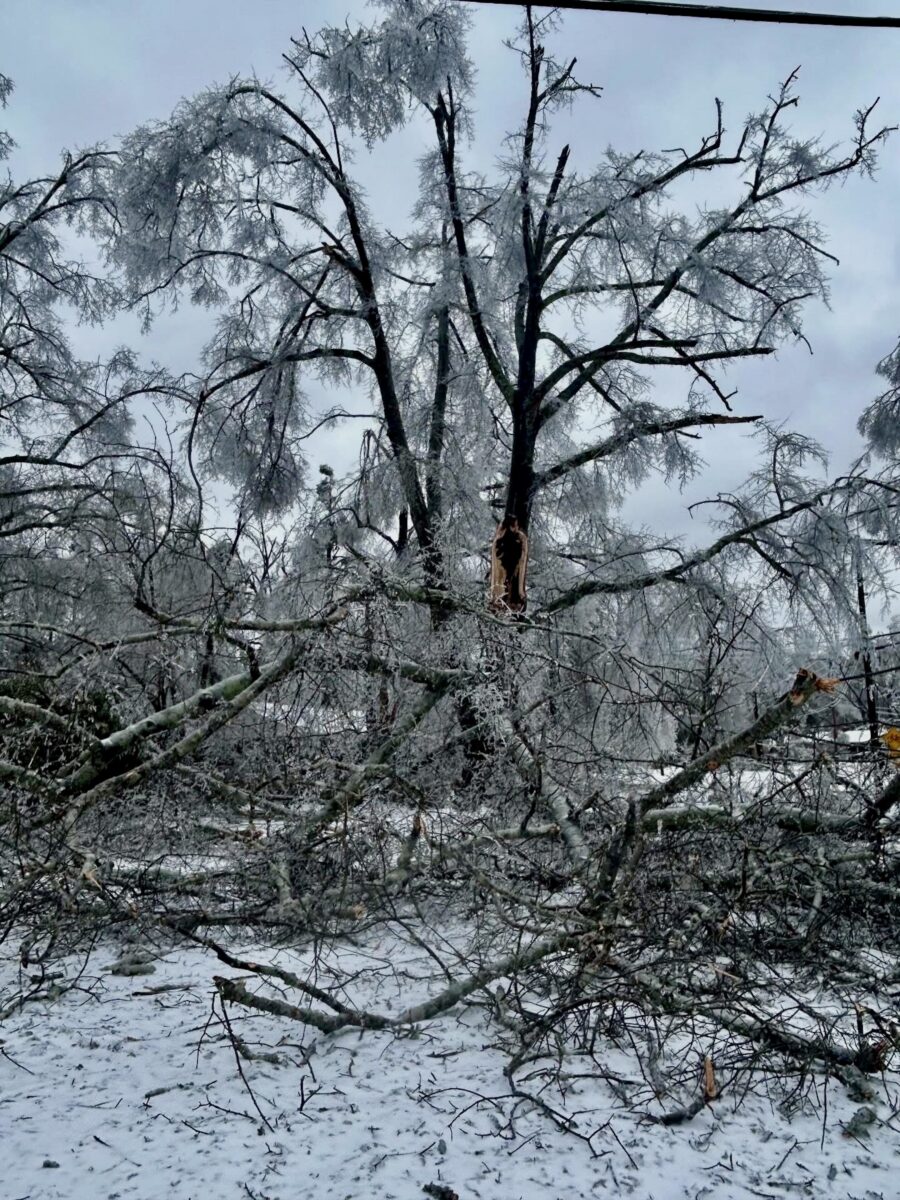
Except it wasn’t explosives or gunpowder. It was our trees blowing their heads off and smashing to the earth or thudding to our roof.
We’d been warned. We moved to Oxford, Mississippi, in 2001, but Oxonians who’d experienced the ice storm of 1994 told us how water freezing in trees expands them too rapidly. They explode from pressure, taking power lines with them. Some folks lost power for weeks.
Forecasters had predicted this ice storm to be even nastier. “Fern,” an innocuous name straight out of Charlotte’s Web, would be rife with “thunder ice,” a name straight out of pro wrestling. Indeed, sleet had been falling for hours. We’d lost power and the house was rapidly cooling.
The explosion we heard next sounded like the earth being split open, followed by a shuddering impact that shook our house to its frame. In the eerie silence that followed, a flash illuminated the street—flames shooting from a sizzling powerline, an arcing shower of sparks—and for a moment our dark yard strobed into relief, though there was no relief in it, everything nightmarish, our window crisscrossed by massive tree limbs.
No! I cried. Not her.
Do trees have souls?
Permit me to describe her: A white oak, one hundred and fifty years old. A sproutling when Ulysses S. Grant was inaugurated. How wide? Wide enough that you’d need three hide-and-seekers to hug her. A generous crown one hundred feet up, a tower of grandeur on our otherwise-ordinary corner lot.
A tree like that doesn’t belong to a property. It belongs to posterity, to history, to the neighborhood. It’s not just that her shade reduced our air conditioning costs. It’s that she shaded lemonade stands, pickup football games. All the munchkin hoodlums knew: Her acorns made the greatest slingshot ammo.
And now, as the chilly sunrise glazed the ice-coated trees with diamonds, my husband I fought our way to her, climbing over branches and ducking dangling broken limbs. Half of the white oak was standing. Half of her lay in shards, stretching from one end of our lot to the other. The pinprick air smelled like lumber.
Her undignified funeral was two days later. By that point, with night temperatures falling to single digits, we’d been sleeping in our parkas in a family scrum. Or trying to sleep—sometimes I lay awake counting the plumes of my youngest’s exhalations, worrying about our middle child, a few miles away, as we hadn’t gotten through to him on the phone. Branches and downed power lines trapped our U-shaped driveway on both ends: no escape. Then came a knock on the door. We’d heard storm-chasing tree services were starting to arrive, sniffing desperation. This was an outfit from Texas. They could free our cars, hack up the oak and the six other felled trees, all for just $5,000. My husband and I met eyes, in the crescent between hats and scarves. Tommy took the flashlight to find the checkbook. It was flecked with paint chips, he’d tell me later, dislodged from the ceiling when trees had bounced on the roof.
“Sorry for your loss.” People often say this to a mourner after a loved one dies. Now they were writing it about the oak, as I’d posted a photo on social media. For the first time the expression didn’t sound cliched. “I’ve always loved that oak,” wrote a neighbor. “She was a good friend,” wrote another. Another quoted Silverstein’s The Giving Tree. Someone suggested I take her heartwood to a carpenter to have furniture made. A great idea, but far too late; she was stacked like dozens of cords of firewood along the curb for some future when FEMA reared its head. By the time the tree service had arrived, we weren’t thinking about milling porch rockers. We were hoping our batteries and candles would last. Maybe the rocker would have been a lovely memorialization. Or maybe it would have been like what John LeCarré said about seeing his novel turned into a movie—“like seeing your oxen turned into bouillon cubes.”
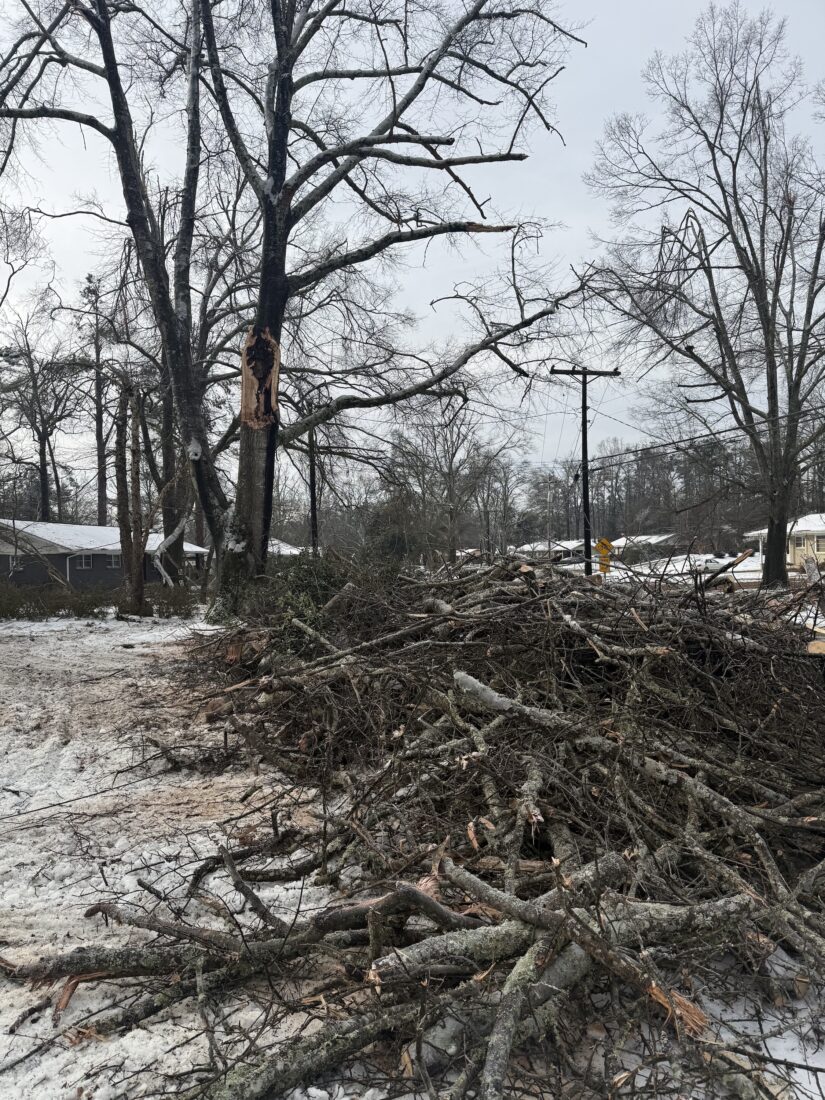
Photo: Beth Ann Fennelly
A pile of debris from the tree.
It’s day seven and counting of no power at our house, but as I write this we’re warm and safe, a mile away. Retired colleagues who learned of our plight picked us up in their four-wheel-drive SUV, ensconced us in their guest room. We’ve been gobsmacked by the miracles of hot showers and coffee.
And kindness. Gobsmacked by kindness. One thing about a natural disaster: It pulls a community together. Mississippi is “the hospitality state.” Evidence for that moniker has never been more apparent. The sometimes-snarky “What’s Happening in Oxford?” Facebook page is churning with vulnerable requests met with acts of generosity. Someone’s elderly grandfather needs firewood and food. Can anyone help? Yes, they could and did. Another poster offers to chainsaw free a family who lives ten miles out in the county. A family who scored a hotel room with hot water is offering showers to families without water. One of the few open restaurants is feeding first responders for free. A rental house of students is handing out coffee. It all makes me a little weepy, to tell the truth.
My middle child gets through on the phone, at last. He’s a sophomore at Ole Miss, where my husband and I teach. He’s living off campus with four friends and calling me from his car, where he’s cradling his dead pet, a spotted gecko, holding it to the heater vents. Cold-blooded, reliant on an electric heating pad, poor Glizzy couldn’t take the freeze. My son is despondent—allergic to cats and dogs, he’s lavished years of affection on this stupid dead ten-inch reptile. But—thank you, thank you, thank you, God—“He blinked!” Thomas yells. “He blinked!”
We exhale shakily. My mind reaches vaguely for a lizard/Lazarus pun, but I’m too worn out to find it, and he’s too worn out to laugh anyway.
He tells me a tree has fallen on his roommate’s windshield, and they’re trapped, but they can charge their cell phones in their cars. Texts are starting to get through. He’s okay.
I tell him that we’re okay, too. I don’t tell him that ten Mississippians have died from the storm. I do tell him the university has cancelled classes for two weeks. And I tell him about the tree. Once upon a time, he’d hunted Easter eggs among its roots, parked his matchbox cars there.
He’s silent for a while. “I can’t wait for things to return to normal,” he says.
They’ll return, I want to tell him, but not to normal.
The ice will melt, and the people of Mississippi will roll up their sleeves and crank their chainsaws. The logs will be cleared. But an uncanny new light will compress the violently lopped canopies. On our corner, the picnic blanket of shade our oak had tossed down will go unfurled. The bewildered birds’ questions will go unanswered. The squirrels will take new routes to work. The anthem of November will be forever altered without the north wind’s scattershot of acorns on the roof.
Do trees have souls?
Maybe it’s an unanswerable question.
Or maybe the answer’s never been more obvious.
Beth Ann Fennelly, poet laureate of Mississippi from 2016–2021, is the author of seven books, three of poetry and four of prose. Her newest book, The Irish Goodbye: Micro-Memoirs, will be published by W. W. Norton in February 2026. She lives with her husband and their three children in Oxford, Mississippi.
Comments are closed.