
Rockwall County, TX (February 2, 2026) – Spring is just around the corner, and now is the time to begin planning how to better attract hummingbirds to your garden this year. The ruby-throated hummingbird is the most common species sited in the North Texas area. They normally begin arriving in Texas between mid-March to mid-May. They are particularly visible in the North Texas area from July to mid-October when they depart to their wintering grounds in Mexico and Central America.
Because of their high metabolic rate, hummingbirds eat every 10 -15 minutes, consuming half of their body weight in nectar and small insects. The nectar provides the energy requirement for their rapid maneuvering. Catching small insects such as gnats, flies, aphids, mosquitoes and spiders in mid-air or in webs provides them with vital protein, fats and nutrients.
Hummingbirds prefer tubular shaped blooms that match the way they feed with their specialized beaks. They are particularly attracted to bright colors such as red, orange, pink, purple and yellow. Choose native and adapted plants as they can do well in our soil and without excessive water. Adding 3 inches of compost to the top 8 inches of soil will improve soil drainage.
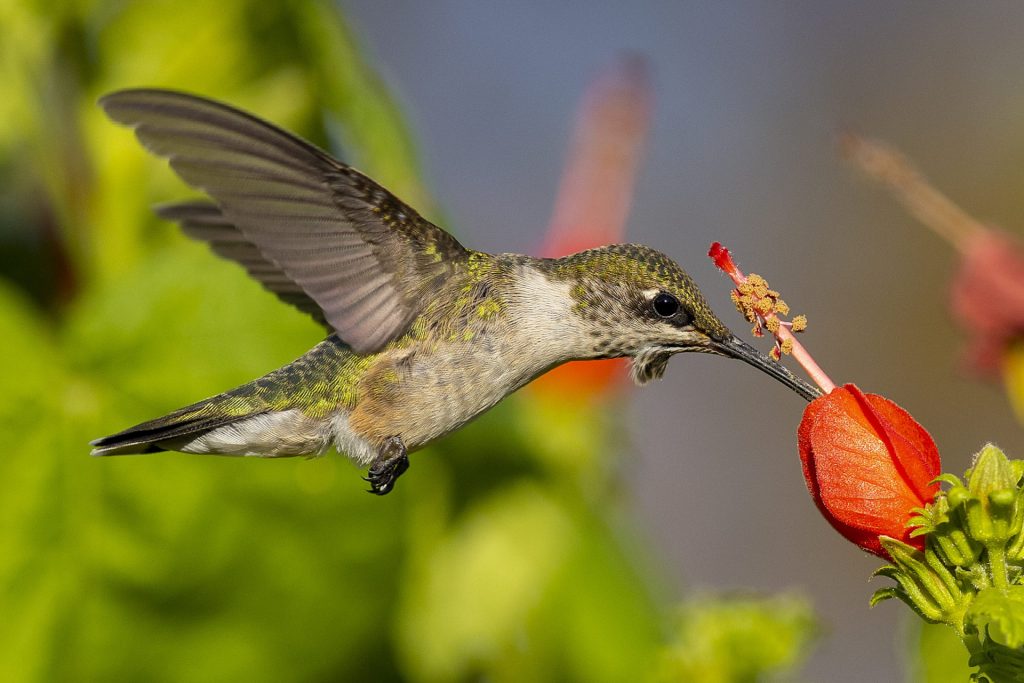 A ruby-throated hummingbird is pictured in the Gardens in College Station, Texas on Thursday, Oct. 6, 2022. (Michael Miller/Texas A&M AgriLife Marketing and Communications)
It is best to stagger bloom times to have a continuous nectar supply from early spring through the late fall. Early blooming spring plants from March through May are Columbine, Coral Honeysuckle and Texas Betony. Bee Balm blooms from late May to late July. Flame Acanthus and Trumpet Creeper Vine bloom June through September. Late spring and early summer bloomers continuing through first frost are Autumn Sage Salvia, Turk’s Cap, Lantana, Mexican Petunia, Esperanza and Firebush. Zinnias bloom in June to first frost, and Cannas bloom mid-summer to frost. A late bloomer is Mexican Bush Sage, blooming August until first frost.
Hummingbirds love hummingbird feeders, so when there are not enough blooms in your garden to provide the needed amount of nectar, use hummingbird feeders to satisfy your feathery friends. Mix 4 parts boiled water to 1 part granulated sugar and let cool before adding to the feeder. Do not add unnecessary dyes to the nectar, as hummingbirds are attracted to your brightly colored feeder rather than the color of the nectar. It is important to change the nectar and clean your feeders every 2-4 days, especially during periods of high heat to avoid developing mold which can be harmful to the hummingbirds. Therefore, fill your feeders with just enough nectar as will be consumed during that time. Try not to place the feeders in direct sunlight to avoid excessive heat. Locate the feeders where you can enjoy watching the activity from inside your home, but not so close to windows that the hummingbirds will be confused by the reflection and fly into the glass. Feeders should be placed outside two weeks prior to expected arrival and left in place for two weeks after seeing your last hummingbird to accommodate any straggling migrators.
Follow these guidelines and enjoy watching these playful and energetic little birds all summer. After they have migrated south in the fall, take time to evaluate and make notes on which plants performed best, and start planning for next year’s hummingbird cycle.
If you have further questions on hummingbirds or any horticultural topic, just Ask A Master Gardener! We’re available in person on Wednesdays, 10 a.m. until noon at the AgriLife Extension Office (915 Whitmore Dr., Suite B). Additionally, 10 a.m. to noon on the first and third Wednesdays of the month at the Rockwall County Library.
If you are not able to come by in person, call 972-204-7660 or email rockwallmg@ag.tamu.edu and a Master Gardener will respond to you in a timely manner.
By Cindy Tayem, Rockwall County Master Gardener. Photo Courtesy of The Gardens at Texas A&M University in College Station. (Michael Miller/Texas A&M AgriLife)
Comments are closed.