
Read more:
These questions and answers have been edited and condensed for clarity.
Q: What does Arbor Crest do?
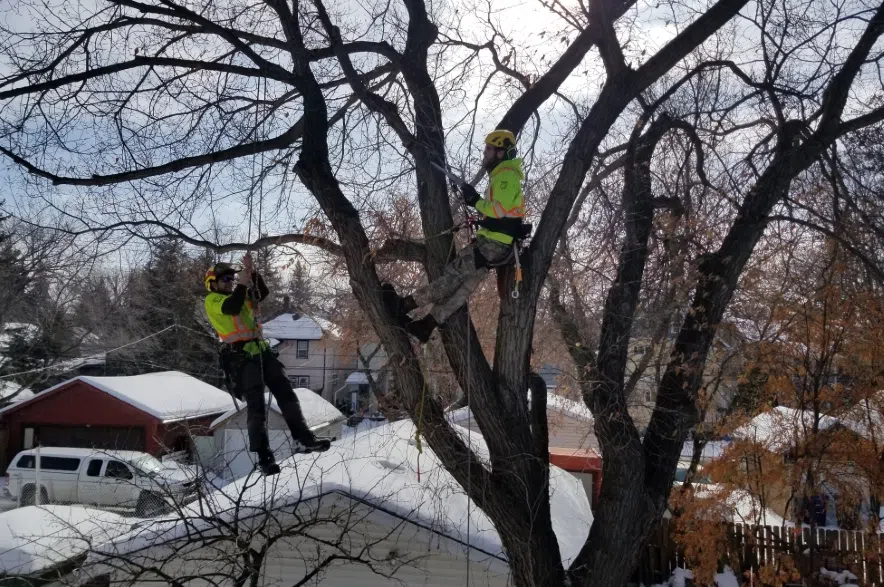
A: We’re 12-month company because we do snow removal but our primary thing is tree care and tree care pruning. We do landscaping as well.
Q: You prune trees to keep them alive and healthy but they do have a lifespan?
A: Ultimately, we’re a tree preservation company. I learned a long time ago, it’s best to keep a tree alive and work on it year after year rather than just cutting everything down.
It’s a rewarding part of the business, to see how they are growing, how pruning has affected their growth habits and see how healthy they are.
Q: How has drought in Saskatoon affected the trees?
A: Really we’ve had a drought for 15 years so there’s just not much moisture below two or three feet down. We just haven’t had enough rain.
Some trees like poplars and spruce are dying if they’re planted too close together, because they’re starved for moisture. You just see it across the prairies.
Getting irrigation to a site in some way every once in a while is really important. And mulch. Mulching new trees and keeping that mulch three or four inches thick so every time it does rain, the moisture is going to stay and help out the roots out. It makes such a big difference.
Q: What about Dutch elm disease?
A: I think it stems back to about 10 years ago. The province cut millions of dollars in funding to monitor Dutch elm disease.
Three years ago, I think there was five positive tests in Saskatoon, then last year it’s up to 41. The scary thing is it’s all over the city not just one little pocket.
It’s also in Regina, Qu’Appelle Valley, Outlook and small towns like Carrot River. It’s all over the place in the province now.
You can’t see much this time of year but when the trees are full leaf, generally around July, you’ll see the canopy will be about one-eighth dead and the leaves drooping and wilting. That’s one of the telltale signs. If you see that phone the city, or the province.
Where elm trees are planted close together if one gets it, they’re all grafted together in the roots and they’re all going to get it. The city’s not doing the straight line planting like they used to do, now they’ll mix up the variety.
Q: How can tell which leader on a tree to leave unpruned?
A: Step back from the tree and look and see where the trunk starts, draw a line straight up, and pick the centremost leader. This is the one you want me to grow tall.
Then two or three years later have a look at it and do a little bit more trimming. If there’s three at the top, shorten the two outside ones and leave that centre one alone.
Q: Can you prune a tree too much?
A: You can always prune a tree too much. The gentler you are with a tree, the better the tree responds, especially if it is an older tree.
Use the rules of one-third — don’t take more than one-third of the live material per growing season off of a tree. Don’t shape it more than one-third. Less is more.
Q: My pine tree has spider mite on the bottom third of the tree. Can I use malathion?
A: Generally I tell people to start with water instead of spraying going right to malathion.
There’s different stages you can do with spider mite control. They don’t like being wet. In the spring do a good pruning, taking out the old dead wood and thinning it a little bit.
Spider mites also like to be sheltered so they’re generally going to be on the south side of an evergreen tree, and a thick evergreen tree is what they like best.
In spring, get a high pressure hose and wash the tree off. All the old needles will come out and you’ll knock some of those spider mites out as well. Do that over every couple of weeks for a month or two.
If it’s still progressing, make sure that it’s spider mite, because it could be a whole bunch of things. Take the branch and a white piece of paper and shake the branch over it. If you see little red dots scurrying around, that’s spider mite.
Make sure you ID the pest properly before you start spraying. Malathion isnot available to the consumer but an arborist has it and different products that are similar.
Don’t spray soap on it, that will kill an evergreen because it clogs the cuticles. Usually the three stages of treating a pest is water and then soaps and dormant oils before you go up to chemical but you can’t spray soaps on evergreen unless you wash the soap off, which is a task.
Q: My maple tree has two trunks growing at an angle from the base. Is that going to cause a problem?
A: We call those character trees and everybody needs a character tree in their yard.
With two predominant stems coming right from the base you could shortening one stem to let the otherfind its dominance. It might be a three, five or seven year process to do it properly instead of just cutting the one stem off.
Q: When’s the best time to prune a crab apple tree?
A: Right now. Prune them when they’re dormant. They get a thing called fire blight that can kill the tree. This time of year you can see the structure of the tree as you’re not looking through leaves.
Q: I’ve got galls on my 40-year-old green ash tree. Do they eventually fall off?
A: There’s an ash flower gall mite that causes galls. Pull those off early, they look like almost like warts on the leaves. Prune them off so they don’t spread. If a tree is too tall to prune, a tree pruning company can go to any tree.
Q: How do I revive a wilting African violet with browning leaves?
A: Prune off as many of those brown leaves as you can. Bottom water it by putting it in a bowl and letting it soak water up from the bottom. Stick your finger into the soil and make sure it feels dry to the touch about an inch and a half down before you water.
African violets don’t like to have any water on their leaves so bottom watering is the best way to do it and having good drainage in the pot is really important.
Pick up some African violet food or regular plant food and start feeding it in middle of February when you’re watering it.
Q: When’s best time to start over my overwintered cana lily bulbs inside?
A: Mid-February. The key to success is getting the soil temperature warm so that they can start sprouting again.
Put them into a pot, make sure that you’ve cleaned off any sort of rotted parts, any of the roots that are molding, and put them in an area where the soil’s nice and warm.
They need some sunlight and keep them consistently watered, but you don’t over-water them.
Read more:
Comments are closed.