
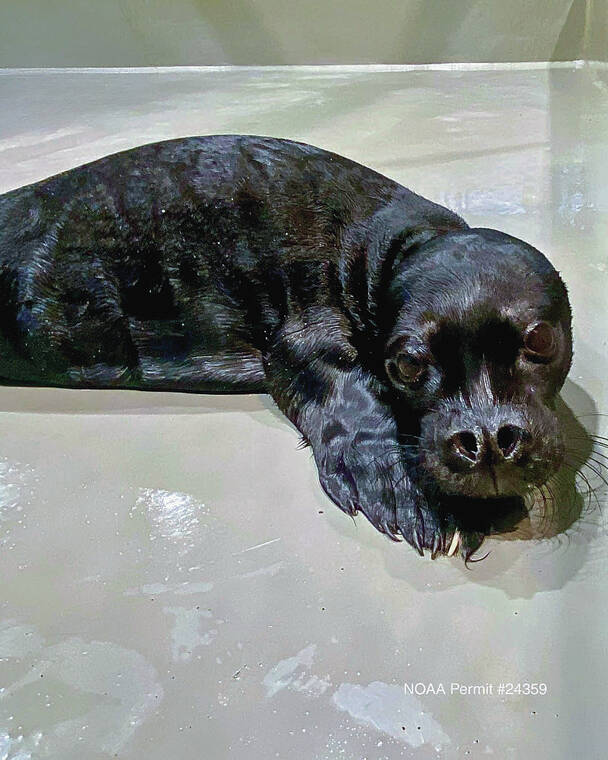
A newborn Hawaiian monk seal plucked from the shores of Hawaii island last month is now gaining weight at Ke Kai Ola, a monk seal hospital in Kailua-Kona.
Monk seal RU72 was just 3 days old when experts decided to intervene, and admit her into the care of the specialized hospital run by The Marine Mammal Center. She is the center’s youngest monk seal patient ever to be admitted.
It was an unusual move, but experts decided to admit RU72 after seeing that her mother, Waimanu, did not appear to be nursing the pup.
Waimanu, a well-known seal on Hawaii island, had given birth to at least three other pups previously that had died before weaning. She also has had challenges nursing past pups. After she gave birth to RU72, experts observed the pair closely.
“We opted to give them time as a pair to bond and figure things out,” said Dr. Sophie Whoriskey, the center’s associate director of Hawaii Conservation Medicine. “Waimanu showed a lot of strong mom behaviors. She was protective and stayed with her pup, and was seen vocalizing and bonding with her pup, but she rarely positioned herself to allow her pup to nurse.”
So the center, in consultation with the National Oceanic and Atmospheric Administration, decided to bring the pup in. She was in good overall condition upon admittance, the center said, and vocal and active.
“She’s a healthy pup that just wasn’t getting the resources she needed to survive in the wild,” said Whoriskey.
The pup has since gained weight and is thriving on a fish-mash diet that is tube-fed multiple times daily.
According to Whoriskey, RU72 is spending plenty of time in the rehabilitation pools, and socializing with the other two seals in Ke Kai Ola’s care. She is also spending more time resting and sleeping, which is normal behavior at this early stage of her life.
She is also molting out of her black coat.
Hawaiian monk seals are born with black fur, which upon weaning begins to turn to dark gray or brown on their backs. Seals will undergo a molt about once per year to shed the top layer of their fur and skin.
As she starts growing teeth, volunteers will help RU72 learn how to catch and eat whole fish, as well as how to forage from crates stuffed with fish meant to mimic coral. Eventually, the goal is to release her back into the wild, but that is still months away, the center said.
Volunteers are also monitoring mother Waimanu after the separation, and said she has been seen resting and swimming in the same general area, and appears healthy.
The Hawaiian monk seal is one of the most endangered seal species in the world, according to NOAA, with a population that had been declining for about six decades.
That trend has since been reversed, and the population today is increasing, but still only about a third of its historic size. NOAA marked a milestone in 2021, when the population surpassed 1,500 for the first time in more than 20 years.
The estimated population in the wild is now at about 1,600 seals — with nearly 1,200 at Papahanaumo- kuakea Marine National Monument and 400 in the main Hawaiian Islands.
NOAA researchers say an estimated 30% of Hawaiian monk seals are alive today due to recovery efforts, which include rescuing malnourished and sick seal pups, reuniting mom-and-pup pairs, and dehooking seals entangled in fishing hooks and lines, among other interventions.
Since Ke Kai Ola opened in 2014, the center has rehabilitated dozens of monk seals, mostly malnourished pups from Papahanaumo- kuakea, that have since been released back to the wild.
Continued threats the seals face include shark predation, entanglement in fishing gear, habitat loss, contaminants, diseases, attacks by unleashed dogs, and human-seal interactions, including intentional killings by humans.
TMMC has also embarked on an H5N1 vaccine trial with two pups under its care to see whether vaccines can help produce antibodies and protect the seals against the deadly avian influenza virus.
NOAA recommends viewing seals from a distance of at least 50 feet on shore and in the water; 150 feet for mom-and-pup pairs due to the protective nature of mother monk seals. Although monk seals give birth year-round, peak pupping season occurs between March and August.
HAWAIIAN MONK SEALS
>> Status: Endangered. Monk seals are protected by Hawaii state law and the federal Endangered Species Act and Marine Mammal Protection Act.
>> Keep a distance: NOAA recommends viewing seals from a distance of at least 50 feet both on shore and in the water; 150 feet for mom-and-pup pairs.
>> To report seal sightings or sick or injured monk seals, call NOAA’s marine mammal hotline at 888-256-9840.
Comments are closed.