
By Terry Twigg
(February 1, 2026) — Ah, Valentine’s Day, when offering ‘just the right thing’ seems like a test of love. A dozen red roses are safe, but not exactly original. And anyway, in Connecticut in February, the only roses you can find are overpriced, grown half a world away, lavished with pesticides, and probably cut weeks ago to meet a single day’s demand. Not very earth-friendly.
Why not visit a local nursery instead? There are so many houseplants ideally suited to carry your message of love to your favorite gardener, not just for a short week in a vase, but throughout the winter and beyond. Top contenders:
Hoya (Hoya kerrii). This beauty, which is nicknamed the ‘valentine plant,’ has perfectly heart-shaped, bright green, thick succulent leaves. It’s a charmer.
String of hearts (Ceropegia woodie variegata). Hang this succulent in bright indirect light, and enjoy trailing stems of very rounded but still recognizably heart-shaped leaves, in very Valentine-y shades of green, pink, and cream.
String of pearls (Senecio rawleyanus). Another trailing plant, this one with strands of round green ‘pearls.’ Perfect for the person born with a green thumb but lacking the ‘jewelry gene.’
Many varieties, some vining, some more upright, in many different sizes, but all with heart-shaped leaves. Tolerant of low indoor light, famously easy to grow, even for beginners.
The many varieties of anthurium offer double romance, boasting both heart-shaped leaves and big, glossy, heart-shaped ‘spathes.’ A spathe is a modified leaf that looks almost like a petal, and anthuriums produce them in romantic shades of white, pink, and red. They provide a long-lasting show in indirect light.
Somewhat resembles philodendron, and similarly easy to care for. Don’t tell anyone its nickname is ‘devil’s ivy.’
Heart fern. This plant has heart-shaped leaves on wiry black stems. It looks nothing like our idea of a fern but it is, in fact, a member of the ribbon fern family. Look for the telltale spores on the undersides of the leaves.
A very unromantic word of warning: All except the first two are classed as toxic to people and pets, though generally not fatal, unless eaten in fairly large quantities. If your home includes pets or small children prone to sampling greenery, you may want to place your plants in a closed room or out of reach (although, is there such a thing as out of reach for a curious cat?).
True, houseplants aren’t for everybody. Maybe you travel frequently, and don’t want the bother of finding someone to water plants while you’re away. Maybe your windows don’t have the right exposure. Maybe you don’t want even the smallest risk, however unlikely, of poisoning family or animals. Never mind. Give your favorite gardener the promise of growing valentines in the warm weather to come:
Fancy-leaf caladium. Tropical plants with heart-shaped leaves ranging from 8 to 15 inches, occasionally even larger. Many varieties are broadly streaked or blotched with red, white and pink. Since they’re from a hot climate, they won’t survive a winter outside, but they more than make up for that by bringing their fast-growing bright colors to shady areas and—a big plus—deer and rabbits generally aren’t interested.
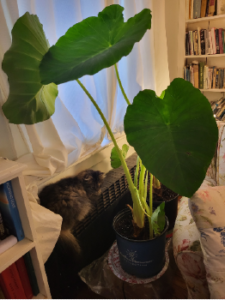
For those looking to make a grand gesture, try this tropical plant. It’s called ‘elephant ears’ for a reason (photo above). Colocasia esculenta, the most commonly sold variety, produces leaves 2-4 feet wide and 3 feet long on plants that grow 3-6 feet high in a single season. Since my cats ignore them, I’m able to grow some indoors for an upcoming wedding. Roots planted in mid-December, placed on heated seed mats and snugged up against the radiators, are about 40 inches tall, with leaves almost 24 inches long. Already.
If you want to really make a statement, give Colocasia gigantea (I’m fairly sure its name doesn’t need translating). This massive plant produces heart-shaped leaves 5 feet long and 4-5 feet wide, on stems 6 inches wide at the base and 8 to 10 feet high. And it will reach this size in a single summer, starting with a 6-inch plant. Nothing says love like a leaf the size of a beach umbrella.
Interestingly, even though all parts of Colocasia are toxic, the roots are an important food source in the Pacific Islands. Thorough cooking neutralizes the calcium oxalate crystals, making the plant safe to eat. Deeper research finds recipes instructing cooks to wear rubber gloves while peeling the roots, lest the toxins cause irritation and bleeding on your hands. I think I’ll pass.
If none of these appeal, make or buy a heart-shaped topiary. Order a white oak or dogwood tree for spring planting; both are native and will encourage the uplifting sound of bird song outside your window. Make your Valentine’s Day gift a living, breathing bit of natural beauty that will be here long after the snow has melted.
Photo by Terry Twigg
Comments are closed.