
Breadcrumb Trail Links
OpinionColumn
Those of us in the horticulture and floriculture business cringe when we hear someone say they cannot keep houseplants alive.
Published Jan 30, 2026 • Last updated 16 hours ago • 2 minute read
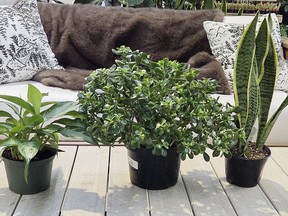 Chinese evergreen, jade and Mother in Law’s Tongue are some of the easier indoor plants to grow, writes gardening columnist John DeGroot. (John DeGroot photo) HandoutArticle content
Those of us in the horticulture and floriculture business cringe when we hear someone say they cannot keep houseplants alive.
Advertisement 2
This advertisement has not loaded yet, but your article continues below.
Article content
My response to those naysayers is usually, “If you can keep lettuce in the fridge, you can keep tropical plants on the windowsill.”
Article content
Recommended Videos
Article content
If you are new to tropical plants, or want to be, I recommend starting small. Rather than spending big dollars on mature plants, try your hand on a few smaller plants.
Picking up a plant on impulse at the grocery or box store won’t cut it either, because you will easily forget to tend to a single plant.
I recommend a small investment of five or six plants in pots that are four or five inches in diameter. Smaller pots tend to dry out too quickly.
Choose your pots and saucers as carefully as you choose your plants. Containers are decorative, and ought to fit your home and taste.
Holding off on the pots is also fine but be sure to provide each plant with a saucer that can deal with excess water.
Advertisement 3
This advertisement has not loaded yet, but your article continues below.
Article content
Don’t despair if one or two of your plants decides to go south. Keep in mind that tropical plants prefer to grow in tropical climates, and we are lucky to convince them to grow in the north.
Be sure to keep your new plants away from direct sun, especially west sunny windows. In our home, we find the best performers are in our north facing room and the east windows.
Keep an eye on watering. We water most of our plants once a week, and we water sparingly.
When we are done watering, we will go around to empty the saucers if any plant had too much to drink.
You will find that plants require more water in spring and summer when days are longer. Plant growth slows down in the darker days of winter.
Repot plants if the roots are pot-bound or show signs of stress. Don’t bother repotting unless the plant asks you to.
Advertisement 4
This advertisement has not loaded yet, but your article continues below.
Article content
When repotting, add only one or two inches to the container size because the soil in larger pots stays damp too long. Use a soilless growing medium and be sure to use pots that have drainage holes.
Start with plant varieties that are no-brainers and easy to grow.
Mother-in-law’s Tongue (sansevieria) is an obvious choice for first-timers because it needs hardly any water.
Jade plant (crassula ovata) is a trustworthy succulent that requires very little water or attention.
Chinese evergreen (aglaonema) is a lush, well-behaved plant that thrives in low light conditions.
Golden pothos (epipremnum aureum) is a rapidly growing vine or trailer with colourful heart-shaped leaves.
Begin with these plants that thrive under abuse and neglect, and you will be hooked on the joys and benefits of lively tropical plants in your home.
Read More

GARDEN CLIPPINGS: Deep freeze will help farmers with pest control

GARDEN CLIPPINGS: Tree bark takes on different forms, colours, textures
Article content
Share this article in your social network
Comments are closed.