
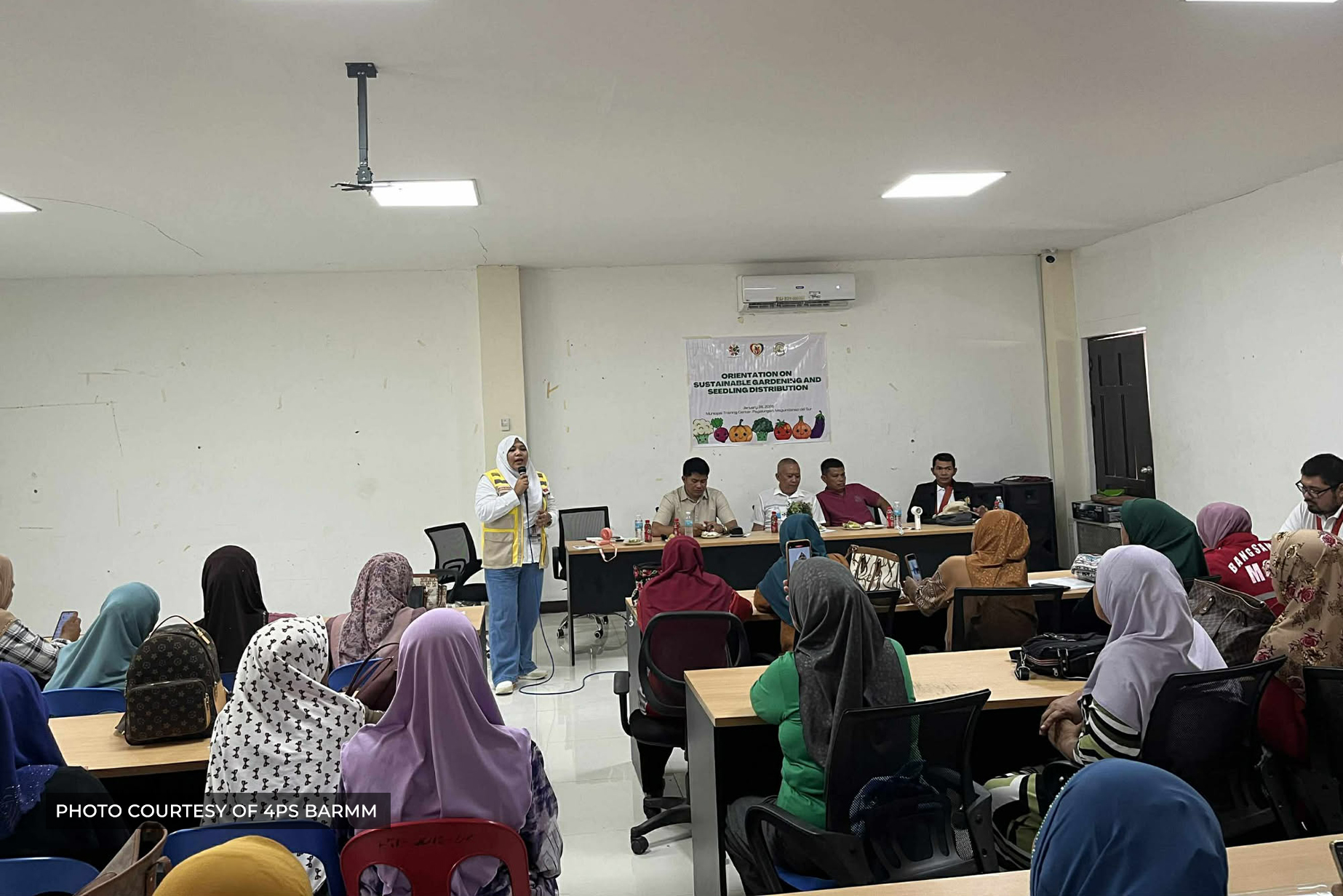
COTABATO CITY — Sixty-three members of the Pantawid Pamilyang Pilipino Program (4Ps) in Pagalungan, Maguindanao del Sur were oriented on sustainable gardening and provided with vegetable seedlings on Jan. 26 as part of the government’s effort to boost food security and promote healthy lifestyle.
The activity aimed to equip participants with knowledge on proper and sustainable planting methods, promote nutritious eating, and encourage communal gardening as an alternative food source for families and communities.
The orientation was spearheaded by the Ministry of Social Services and Development (MSSD)–4Ps Pagalungan Office in coordination with the municipal government.
After the session, participants received vegetable seedlings—including squash, cucumber, eggplant, tomato, and green chili—provided by the Ministry of Agriculture, Fisheries, and Agrarian Reform (MAFAR).
Pagalungan MSSD 4Ps Case Manager–Team Leader Johana Kamir emphasized that gardening is among the activities monitored and required for compliance by 4Ps beneficiaries.
“Sa pamamagitan ng mga libreng seedlings na maaaring itanim sa kanilang bakuran, nababawasan ang gastusin sa pagkain at natitiyak ang suplay ng masustansyang pagkain para sa pamilya,” she added.
[Through free seedlings that can be planted in their yard, food costs are reduced and the supply of nutritious food for the family is ensured.]
Meanwhile, Municipal Councilor Abdul Mamasabulod, together with other local government officials, expressed support for the program.
“Mas mainam na piliin natin ang gulay kaysa sa processed foods at sobrang karne upang masigurong malusog ang ating mga pamilya,” he said.
[It is better for us to choose vegetables over processed foods and excess meat to ensure that our families are healthy.]
As a next step, the office will regularly monitor the communal garden, provide additional gardening inputs, and further strengthen coordination with MAFAR for necessary technical support.
The 4Ps is the government’s conditional cash transfer program that provides financial assistance to poor households to support children’s education, health, and nutrition. In BARMM, the program is implemented by MSSD in coordination with local government units and partner ministries, ensuring beneficiaries comply with health, education, and family development requirements while being linked to complementary livelihood and food security initiatives. (Myrna Tepadan/BIO with reports from 4Ps BARMM)

Comments are closed.