
Mother Nature’s Garden: Getting to know your plant
Published 2:57 pm Friday, January 30, 2026
The weather has been mild, so I headed out to search for my favorite native plant, the skunk cabbage (Simplocarpus foetidus). It’s a distinctive plant that never ceases to amaze me. No matter how many times I observe it, I always learn something new.
Taking time to quietly examine plants is an important activity. Look all around to see where the plant is growing. Is it in a shady or sunny area, in the woods or an open area? What is the moisture level of the soil? Is it growing in water?
Walk around the plant so that you can see it from more than one angle. Observe how it grows.
Is it tall or short? Does it have lots of branches, a central stem, or multiple stems arising from the ground? Is the plant solitary or does it form colonies? And don’t forget to note the time of the year.
And now for more detailed observations. What is the shape of the leaves? Round, ovate, heart shaped and more? Do the leaves have smooth (entire) edges or “cut” ones? Do the leaves have lobes? What is the pattern of the veins? How are the leaves attached to the stem? In an alternate or opposite pattern? In clusters? Only at the end of the stem or all along the stem? What is the color of the leaves?
There are so many details to see and mentally record.
If the plant is blooming, then there are more details to observe and questions to ask. Things such as color, shape, symmetry, number of petals, size, position, time of bloom (some flowers only open at night or in the afternoon), insects visiting the blooms and scent. For some plants, the fragrance of the blooms is very specific. What about fruit or seeds that appear after flowers have been pollinated?
As for the skunk cabbage, in our area, depending on the weather and the location of the plant, it begins to bloom in December, January or February. It’s an obligate wetland plant, meaning that, when you find one, you’re in a wetland. It’s often found growing in very shallow puddles of water (the crown can’t be constantly submerged in water), along streams or in wet, mucky areas. There may be just a few solitary plants or there may be a large colony. The skunk cabbage grows in both shady and partly sunny areas.
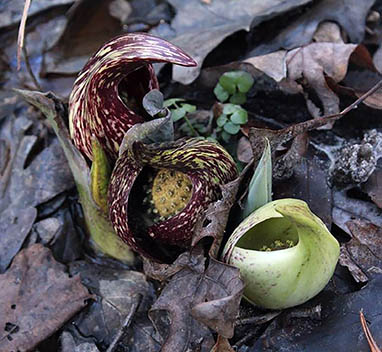
And the appearance of the plant and blooms? Well, both are distinctive. What you’ll find is a fleshy, spiral-shaped mottled maroon and yellow or green structure that’s about four-to six-inches tall. This is the spathe, a modified leaf that wraps around the spadix, a club-like structure on which there are tiny yellow flowers that emit the skunk cabbage’s distinctive scent that is surprisingly like that of a disturbed skunk.
Carefully insert a finger into the spathe and you’ll have another surprise. The interior temperature is considerably higher than that of the exterior air. The skunk cabbage is thermogenic, meaning it generates heat, which protects the flowers, intensifies their carrion-like, skunky smell to attract pollinators and probably also provides a warm refuge for pollinators.
Keep observing this amazing plant. You may find a short, pale green shoot emerging from the muck beside the spathe. It is a tight roll of all the plant’s leaves that will emerge later when the weather is warmer. The leaves unfurl from the inside to the outside. At maturity, they are bright, yellowish green and can be two- to three-inches long and over a foot wide. By June, these huge leaves start to disintegrate. The skunk cabbage goes dormant until the following year.
While it’s beneficial to observe all plants in different seasons, it’s especially important for the skunk cabbage. This plant merits slow, thoughtful observation. Taking photos from different angles and of the interior of the spathe is a good way to capture details that might otherwise be missed. Making a quick sketch of the plant is another way to enhance observational skills. The sketch doesn’t have to be perfect; it just needs to capture the essential details.
Careful observation of a plant will reveal many wonderful things and enhance your appreciation of it. And that is especially true of the skunk cabbage.
Dr. Cynthia Wood is a local master gardener.
Comments are closed.