
If you go for a deciduous tree as your selected shade tree, the tree will adjust to the light and warmth needs of winter.
During the winter months, when the last thing you want to do is block out the sun, a deciduous shade tree will have lost its leaves, allowing light to pass through.
In situations where you need the tree to also provide privacy from neighbours or remove an object from view, an evergreen may be a better choice.
There is a great selection of trees that will provide excellent shade. The skill is choosing one that meets your needs and requirements.
Things to consider are what size you would like, what space is available, whether you want it to flower and whether you would like good autumn foliage colour for seasonal interest.
These need to combine with practical factors such as soil type, exposure to wind, frost, cold and coastal salt spray to ensure successful growth.
The deep rich green of the Liquidambar and Liriodendron (tulip tree) are a couple of my favourites, with the spectacular yellow of the golden elms.
These are fairly large trees and are best suited to properties with plenty of room for them to grow.
For a smaller town section, consideration needs to be made of the shade a tree may create for a neighbour, so smaller-growing trees or those that respond well to pruning are a better choice.
Flowering cherries (Prunus) are a very popular option, with many varieties that have different growth habits.
This means you can usually find one that will grow to suit the space you have available.
Kanzan is a taller-growing variety with spectacular double pink flowers and a vase-shaped form, while Pink Perfection has similar flowers but a more spreading habit, making it a better shade tree if width is needed.
Jim’s Delight is a smaller variety, reaching around 3m high, making it ideal for tight spaces.
It has single pink blossom in early spring and attractive autumn foliage as the leaves turn red and orange.
A top-selling flowering cherry is Shimidzu Sakura.
It has an excellent spreading, umbrella-shaped growth habit and grows about 4m high by 5m wide.
As well as being an excellent shade tree for summer, it puts on a spectacular show in October with deep pink buds opening to double white flowers tinged pink.
It also has a good display of autumn colour with leaves turning orange and yellow before dropping.
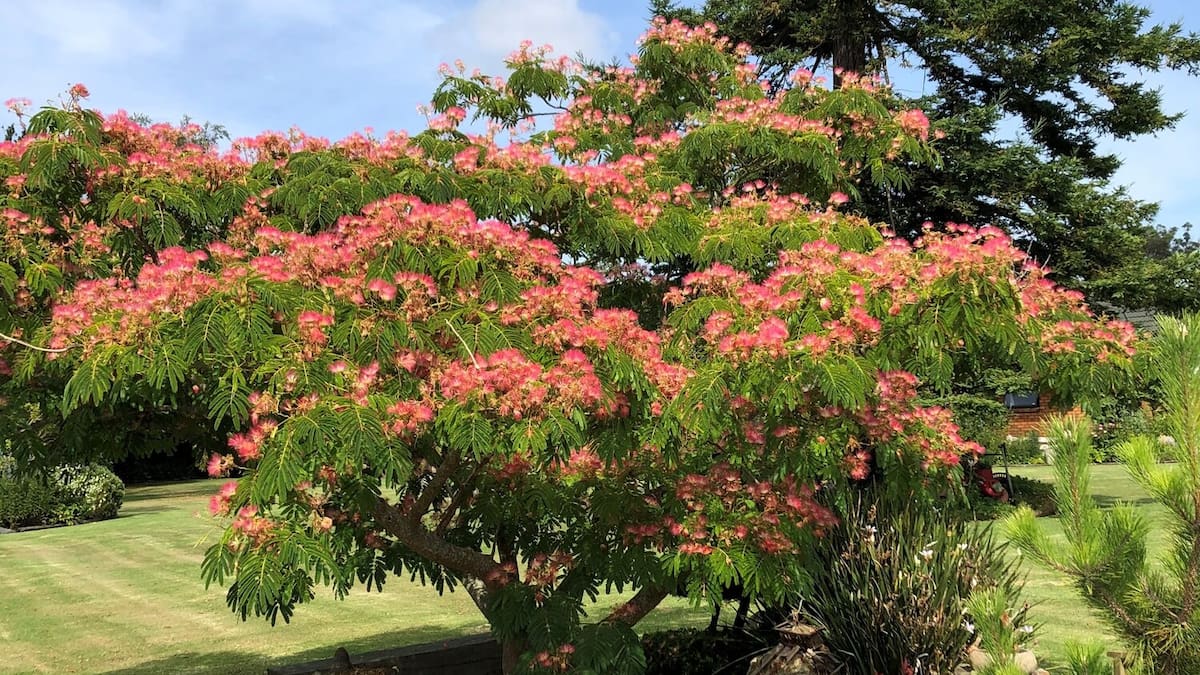
Another excellent shade tree is the silk tree (Albizia julibrissin).
When in flower, they are easily spotted around the city with masses of fluffy pinky-red flowers covering the trees.
Hotter summers seem to improve flowering.
Silk trees have soft ferny foliage which provides good dappled shade from their naturally spreading branches.
If left to grow, they reach around 6m tall by 5m wide, but they are easily pruned to a smaller size and grow quickly, allowing shade to be established in three to four years.
Driving around the countryside, magnificent Jacarandas can also be seen in flower with their cool blue-purple blooms.
These too can be kept smaller with pruning.
Fruit trees can also make good shade trees.
A plum tree at the bottom of the garden can be an excellent choice, with a mass of white blossom in spring and an abundant crop of fruit around Christmas.
The added bonus is their fast growth rate, allowing shade to be established quickly, and the ability to prune them to size.
Why not make your shade tree productive and choose a plum or another fruit tree?
Other fruit trees that make good shade trees are cherries. While the blossom is not as spectacular as flowering cherries, the bonus of growing your own fruit is an option worth considering.
Evergreen shade trees tend not to change through the seasons and, apart from flowers and sometimes berries, offer a similar look year-round.
If you want to use your shade tree as a year-round screen for privacy, then an evergreen tree is a better option.
Many larger native trees make spectacular shade trees such as pūriri, karaka, pōhutukawa and tītoki, but in a town section these will usually grow too big for the space available.
There are also good evergreen trees for smaller sections.
Leptospermum Copper Sheen forms a good shade tree when its lower limbs are pruned.
It has a lovely weeping habit with coppery-burgundy foliage, becomes covered in white flowers in summer, grows quickly, responds well to trimming and can even be grown as a hedge.
So if you are feeling the summer heat, consider finding a good spot to plant a suitable shade tree.
Gareth Carter is the general manager of Springvale Garden Centre in Whanganui.
Comments are closed.