
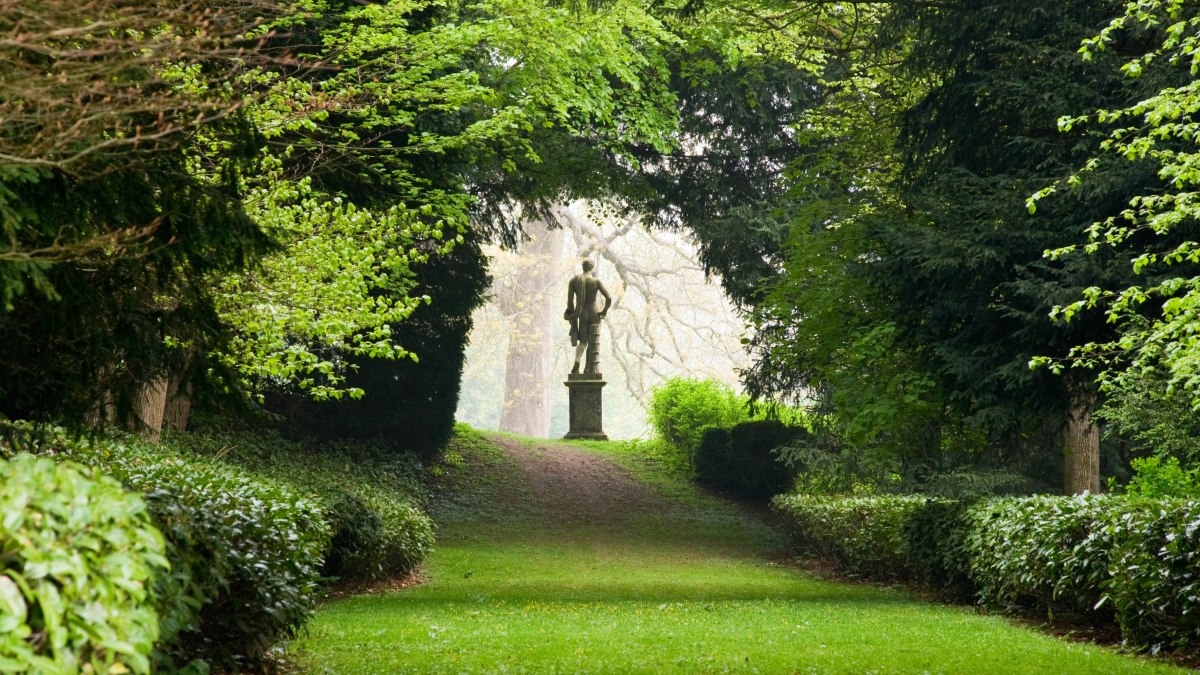
There are certain moments, when you visit gardens as much as I do, that you know will stand out in your mind forever. They are rare. I had one this week when I went for the first time to Rousham in deepest Oxfordshire, to see the garden that William Kent designed in 1738. It is, it must be said, not the easiest to find. The first sign I spotted was the one pointing you down its drive.
It’s not a particularly grand entry but it is impressive, lined with lime trees, and with fields on either side containing longhorn cattle. You can see the house, with its crenellated parapet. I drove into the courtyard and parked. There was one other car. It’s an honesty system for tickets, which are £10 each. “No children under 15, no dogs, no pushchairs” the board says.
This is a self-guided tour but felt much more like an adventure as I headed round the house and saw a large swathe of bowling green that seemed to stop at the horizon. It was an infinity lawn: a statue marks its end and, such is the drop that beyond I could see only the swollen River Cherwell and green hills opposite. It was a quiet view on a soft day of grey mist that matched the grey skies and river waters.
• The best gardening podcasts
The words that popped into my head were: “Now this is England.” There are many Englands, of course — busy London streets, magnificent estates like Chatsworth, tiny villages — but this England that I was seeing at that moment is one in which time seemed to have stilled itself. I stood for a long moment and felt that this was not just a view but almost a portal.

A view from Rousham House across the bowling green; the statue, by Peter Sheemakers, is of a lion attacking a horse
ALAMY
As someone who grew up in America, I see time differently, as you would growing up in a country that, in 1738, amounted to a raggle-taggle strip of states along its east coast. But in 1738, in England, George II was on the throne, Handel’s opera Serse was premiering and the first cotton-spinning machine was patented. That same year, the architect and landscape designer William Kent had been commissioned by General James Dormer to develop his garden at Rousham.
The garden has remained in the Cottrell-Dormer family and, remarkably, is more or less unchanged since Kent stood there himself, looking down at the same bend in the river. It is one of the most influential gardens in England, though it would not be seen as a destination spot for those with a dog or young children. There is no tearoom or sustenance of any kind. There is no shop or guidebook or, indeed, any human to be seen. I love a scone as much as anyone, but scones served in gardens come at a price and that is busy-ness. There is no busy-ness at Rousham. It felt as if it were here just for me.
• Top gardening trends for 2026
Rousham is a favourite of the gardening great and good, and has been in the news because of a proposed development of 9,000 homes at Heyford Park, which is three miles away. Monty Don, Alan Titchmarsh, Tom Stuart-Smith and the like are united against the size of the development and are campaigning for the authorities to put “robust constraints” on the plans. The roads are now small, as is the railway station. Heyford bridge, built in 1255, is a key viewpoint from the garden. It is one-way now and the new traffic load would surely require another bridge.
For the moment, though, all of that is just a dark thundercloud on the horizon. The Cherwell floodwaters forced me to reroute my exploration of the woods, which are populated by statues and nymphs. What fun it was to come upon a pyramid (designed by Kent) or to happen upon Mercury himself, taking off on what looked to be an important mission. Kent’s octagonal pool leads, via a rill, down a path towards the river. Near the bottom, overlooking the ancient Heyford bridge, is a statue of Apollo, a god who is, among other things, the patron of prophecy. I do wonder: there is a magic in the air here now, but what does the future hold?
Rousham Gardens are open daily from 10am to 4.30pm (dusk); rousham.org
• Read more from Ann Treneman
Your questions
I have a daphne bush flowering majestically at the moment. This has been in situ for at least 15 years and is getting too large. When would be the best time to prune it and not lose the flowers in 2027?
Angie Richardson
Daphnes flower on old wood and so any pruning needs to be light touch. It is to be done immediately after flowering. Prune anything dead, diseased or damaged. For shaping, don’t hard prune, however tempting that may be. Why not give it a light trim for this year and see how it fares?
Send your questions to gardenquestions@thetimes.co.uk
Comments are closed.