
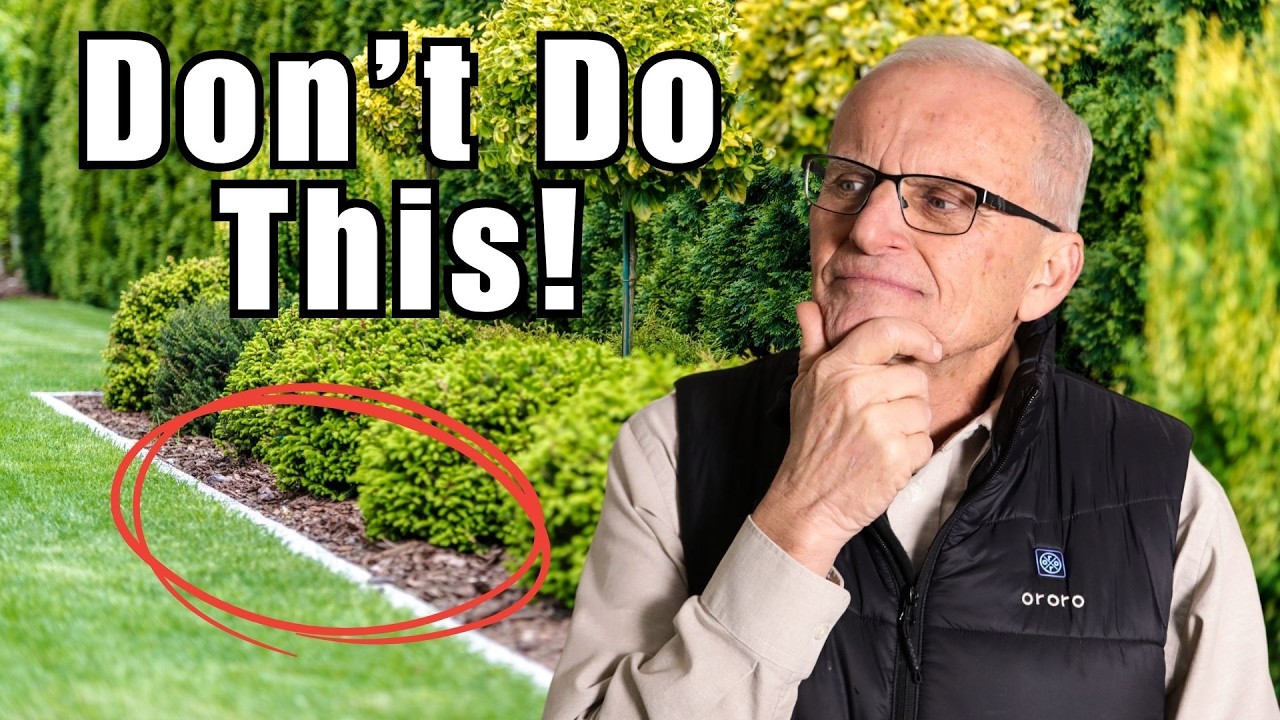
Learn the most valuable landscaping lessons from 60 years of experience; covering soil health, weed control, lawn care, design tips, and more for a thriving, low-maintenance garden.
WEBSITE.
🌱https://www.johnandbobs.com
SMART SOIL PRODUCTS.
🪱Blend (combo of top products) https://www.johnandbobs.com/products/blend
🦠Penetrate (beneficial bacteria) https://www.johnandbobs.com/products/penetrate
🌿Nourish-Biosol (organic fertilizer) https://www.johnandbobs.com/products/nourish
🐛 Enviro-Repel 40 (organic pesticide) https://www.johnandbobs.com/products/enviro-repel-40
FREE DOWNLOAD.
⬇️Beginner’s Guide To Soil-Based Gardening https://confirmsubscription.com/h/y/E6502D5E173B1AD8
FOLLOW US.
📘FB https://www.facebook.com/johnandbobs
📸 Insta https://www.instagram.com/johnandbobs
💃TikTok https://www.tiktok.com/@johnandbobssoil
48 Comments
I moved from NYC heading to the Sunshine State in 2013. I never thought I would see what's called having a real life in gardening. Discovering the hidden grace of nature for us to survive leads me to see God's hands everyday. So much to learn and appreciate.
But the more I discover, the more it makes me feel ashamed how the giant corp never stopped to ruin this planet. Playing God has consequences. Going against Mother Nature bites back.
La
These rocks at 5:03 would never have stopped our Bichon Frise (a tiny dictator and a full-time job), even as a puppy. When she dug, she somehow managed to move rocks as big as her head. She always found a patch of soil and came back with her paws and face completely caked in mud—cue two or three showers a day. Any new plant I put in the ground was immediately uprooted when my back was turned. She would even dig large holes straight through the lawn. As an avid gardener, I eventually had to rehome her with a family with two kids and two other dogs. She’s happy. I’m happy. The garden is happy. No more cute little dogs for me. Love your channel. Subscribed.
Wow!!! Ty!!!
At 1:41 That must be a male garden. All I seen is the most boring heap of brown dirt. Based on that alone, I'd never hire you. "We thought" this house lent itself well for straight lines." From my perspective: "we thought" wrong.
"Bad Nematodes" sounds like a street gang. Or maybe a rock band. Okay, maybe not, but I was bored!
Sir, I saw a mole (Talpidae) in your diagram of a complex soil system, at roughly minute 1:18…is it therefore beneficial to have moles in the garden? Thanks for the information.
He isn't new to this, he's true to this! 😂
He lost me at straight lines.
you are not passionate about bees insects ecologically important plants….nature is making habitats for living creatures….not STRAIGHT LINES….mimicking nature pleases the eye….ponds sandariums…bog plants….you have no insect plants…mulch from bark and pine is bad for the soil…rocks as mulch….oh dear….less lawns…ecologically unfriendly…..trying to eradicate weeds….totally wrong….often weeds are very valuable flora for insects…..I DON'T THINK YOURE A USEFUL ADVISOR FOR A PASSIONATE GARDENER…..i'm a British gardener by the way
Все по существу сказано!
Enjoyed that, thanks! I can confirm that having your own compost heap and making your own mulch is the very greatest gift you can ever give your garden. Fruit, veg and plant matter. Also working with plants that don't require excessive watering (except for the establishing stage) is another win to keep the weeds down. Have fun everyone!
Creeping red fescue (Festuca rubra) is native to Europe
Bermuda grass (Cynodon dactylon) is native to tropical and subtropical regions of Africa, Asia, Australia, and Southern Europe
North America hosts a vast array of native grasses, sedges (genus Carex, Cyperus), and rushes (genus Juncus, Luzula), including iconic prairie grasses like Big Bluestem (Andropogon gerardii) and Switchgrass (Panicum virgatum), versatile sedges such as Pennsylvania Sedge (Carex pensylvanica) and Golden Sedge (Carex aurea), and useful rushes like Common Soft Rush (Juncus effusus) used by Native Americans for weaving and crafts, all thriving in diverse habitats from woodlands to wetlands
If you care about wildlife and want to bring it back and enjoy being a part of it instead of being apart from it plant native plants. The birds will thank you.
LEAVE THE LEAVES
mother earth is anothe body like ours
🥱😴
Flowers want water. So difficult not to water. Will not switch to desert plants. Just flowers.
Tomato plants are thriving in hot weather such as Fresno especially during the summer. What are beautiful flowers at 9:38 time stamp? Are they climbing roses or camellias?
Beautiful video sir!
God doesn’t like straight lines
I save my own poop for mulch
Two simple rules: No chemicals, no plastics.
Thanks!
I made a terrible mistake. About 15 years ago I planted 4 crepe Myrtle’s in my backyard dispersed evenly along my back fence and 3 around my patio for privacy and shade. They are huge and so messy. The flowers fall in summer like snow and the sap drips in summer and leaves in fall so much I can’t stand it. I hate to cut them down. They are thriving and alive.
Thank you!
Glad to see you found your passion and I enjoyed your general advise from Texas. We are a land of extremes here though. Moisture can be abundant at times and droughts also be extensive. Heat in the summer? no need to bring that problem up, Texas in known for it.
I don’t want to use ‘products’ on my garden if I can help. If we believe in enabling the soil, why not use household vegetables and fruit peels to create compost that enriches the soil. We don’t even have to do so much…my mother just dug small holes on the earth next to flowering plants and added banana peels etc to the the soil and closed them up.. we got so many flowers on that plant and the organisms that break down matter thrived in the soil. Less products, more common sense please
Recommended reading: McCall's Garden Book by Gretchen Fischer Harshbarger. Some techniques in the book haven't aged well, but mostly still relevant today.
New Sub: 60 years of experience ! Heck yeah, sign me up! Serious, experienced gardenere here & Im looking forward to learning more with you! Greetings from Virginia Beach, VA, zone 8b 🎉
This was pretty useless. Avoid interfaces – but nothing on how or with what. Blossom end rot – but we don't know, could be anything. Like… why do this at all?
Cool blue socks.
Can we get away from grass pls…it substains nothing, use clover instead.
This is soooo outdated! Garden for joy, for birds and butterflies, pleasure of being outside. What you show is aseptic, unlovely and of little use beyond real estate photos
Proper 'Ph' of the soil is what can help with nutrient uptake in plants.
Kill your lawn.
Plant native.
What can you overseed St. Augustine with? I'm also in zone 9 (Texas)
Landscaper from South Africa. Thanks for all the tips
Not really a fan of some of this…the garden that he said had straight lines looked like a wasteland with no design whatsoever. Peat, a big NO, environmentally. Didn’t mention using native plants which is imperative for water savings.
🎉🎉 🙏 from Punjab India 🇮🇳
So how in the world do you cut your lawn with nothing edging your beds? I mulch and it looks so nice for only one mowing and the bed is covered with clippings.
One thing I have always loved is the contrast between straight lines and more organic/ natural lines. Curved mulch/ flower beds meeting straight hard lines can look great.
The only place I use weed fabric is with stone. I don't want the stone mixing into the dirt. Makes it hard to move it when you need to and also messier.
The processes that create fertile topsoil are compromised when you cover an area w/ gravel. Some plants do better than others when confronted w/ a surface layer of large rocks or gravel, but rocks generally provide little or no water holding capacity or nutritional value for plants. They do heat up the soil in hot weather and get your growing medium closer being a biological desert. Most trees and shrubs will perform better in soil that is not covered w/ rocks. If your aesthetic sensibilities can only be satisfied by putting down a surface layer of rocks, some plastic plants and plastic edging might be just what the doctor ordered.
Oh…. well… if a substrate of rocks DOESNT help drainage, how should you use planters?
This was the longest ad I've ever watched
7:23 kind of hurt my soul.. That poor grass
I learned nothing from this.
John and Bob, I'm a Fresno local and will be purchasing a new construction home in the Riverstone community. I will have a rather large dirt lot. I'd like to improve my soil and grow grass from seed. Any helpful resources/books/tricks/tips would be greatly appreciated. This video was insightful, thank you for sharing.
I've started gardening, I've made so many mistakes which I've not realised and keep making them, but I'm getting there.