

Hairpin banksia (Banksia spinulosa ‘Schnapper Point’). A broadleaf evergreen shrub
growing in full sun or bright shade to 4-5 feet wide and 2-4 feet tall. It has narrow, shiny
leaves with tiny, soft teeth on the margins and silver undersides. According to Wikipedia, “The distinctive inflorescences or flower spikes occur over a short period through autumn
and early winter. A spike may contain hundreds or thousands of individual flowers, each
of which consists of a tubular perianth made up of four united tepals, and one long, wiry
style.” Native of Australia. (Courtesy Tom Karwin)

Flame pea (Chorizema ‘Bush Flame’). A dense, evergreen shrub 3 feet tall and wide, with heart-shaped leaves that emerge in bright green and mature to dark green. From fall
through early spring, it develops arching sprays of orange and pink pea flowers. It may have some bloom almost year-round. This Australian native is a member of the pea plant family (Fabaceae). This hybrid of C. varium and C. ilicifolium was introduced in 2002 by the UCSC Arboretum’s Koala Blooms collection. (Courtesy Tom Karwin)
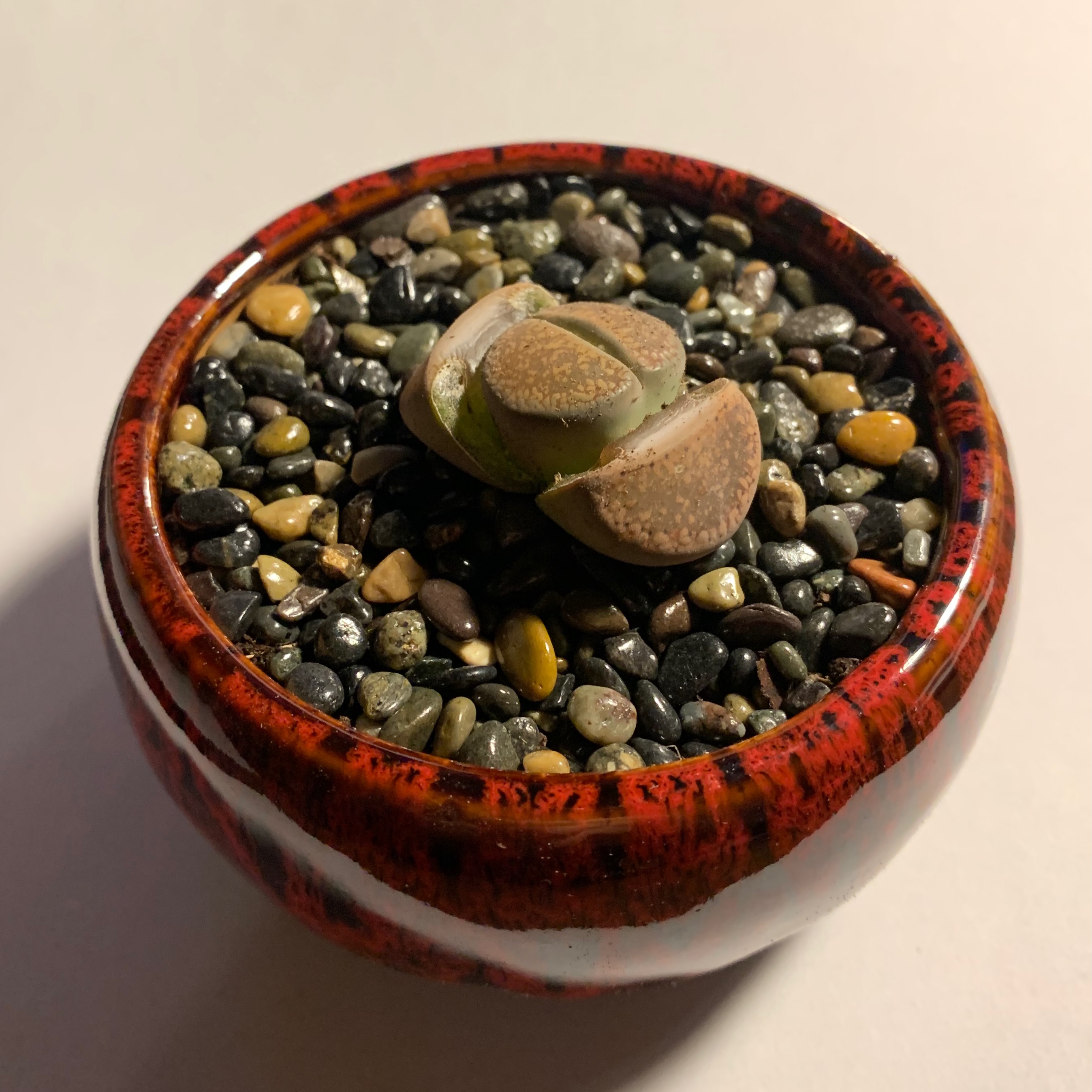
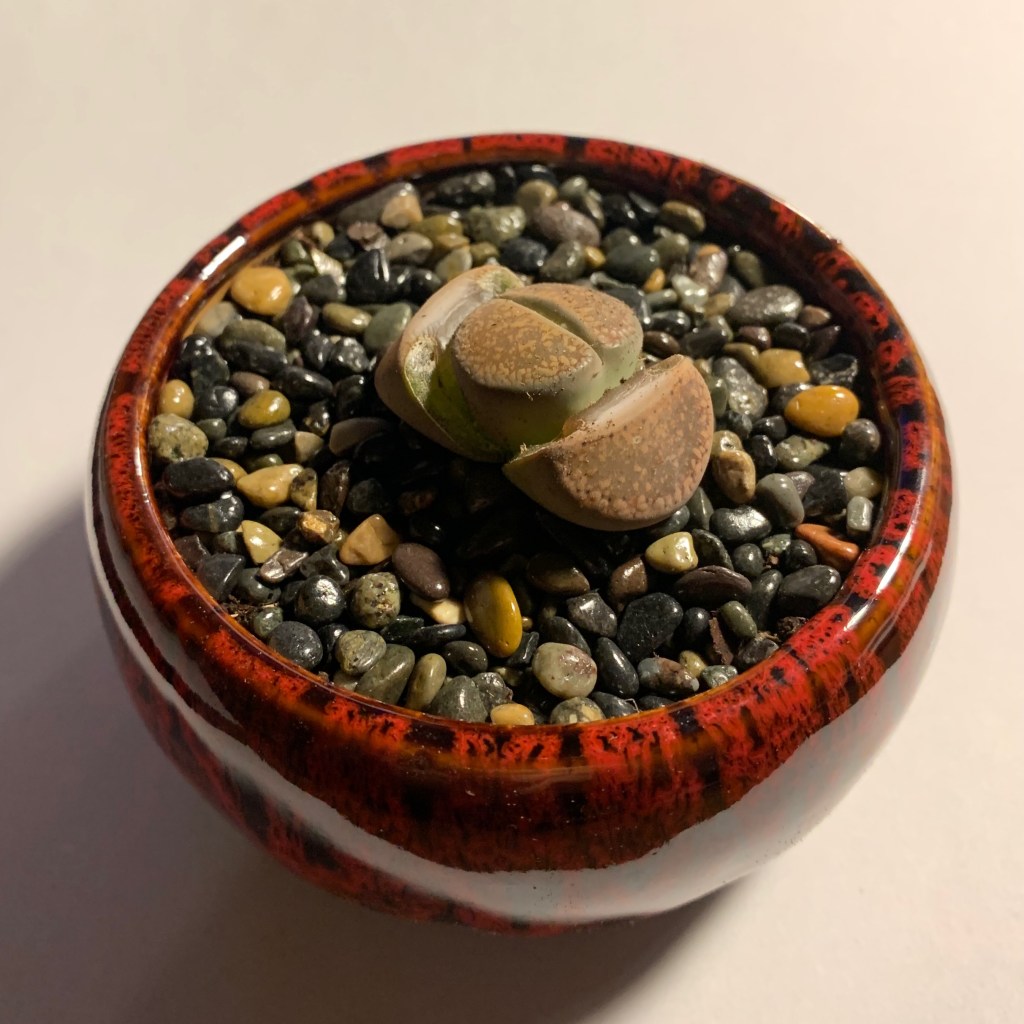
Living stone (Lithops aucampiae). A small succulent with brown-red bodies consisting
of two fleshy leaves with darker markings at the tips. In time, the plant can develop a cluster of up to 12 bodies, each 2.2 inches tall and 1.5 inches wide. The leaves are
divided by a fissure from which new leaves and flowers appear. In the fall, 2-inch-wide daisy-like bright yellow flowers appear. Native of South Africa. I bought this plant for the fifth 4-inch wide container on my desk table. (Courtesy Tom Karwin)
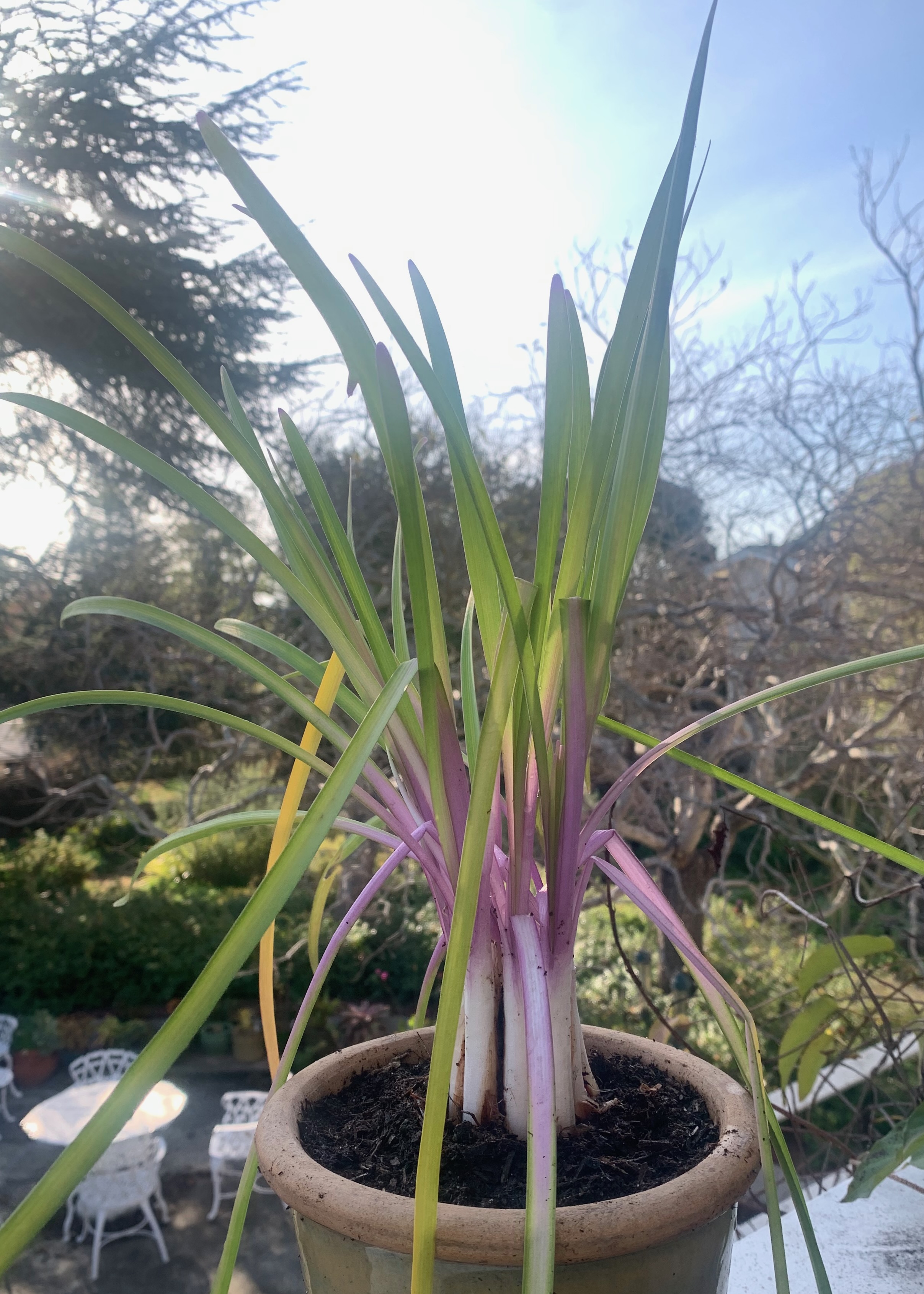
Flamingo society garlic (Tulbaghia ‘Flamingo’). This clumping evergreen perennial has tuberous roots and ¼-inch-wide, 1 to 2-foot-tall flexible, chartreuse green leaves with a brilliant violet pink near its bases. From spring to fall, slender 18-24 high stalks emerge with 10 to 20 lavender flowers blooming in the summer. The genus name honors Ryk Tulbagh, the early governor of the Cape of Good Hope in South Africa. This selected cultivar, ‘Flamingo,’ was introduced in the United States in 2019. This native to South Africa is a member of the amaryllis plant family (Amaryllidaceae). (Courtesy Tom Karwin)
Show Caption
1 of 4
Hairpin banksia (Banksia spinulosa ‘Schnapper Point’). A broadleaf evergreen shrub
growing in full sun or bright shade to 4-5 feet wide and 2-4 feet tall. It has narrow, shiny
leaves with tiny, soft teeth on the margins and silver undersides. According to Wikipedia, “The distinctive inflorescences or flower spikes occur over a short period through autumn
and early winter. A spike may contain hundreds or thousands of individual flowers, each
of which consists of a tubular perianth made up of four united tepals, and one long, wiry
style.” Native of Australia. (Courtesy Tom Karwin)
Expand
Our recent columns have focused on uses of artificial intelligence to select plants, address plant problems and design garden landscapes. AI resources can be useful in the garden and more effective in the future, but current AI tools for landscape design lack the depth needed for successful gardening.
For example, our trial of the AI tool, DreamzAR (dreamzar.app), quickly generated a workable design, but it did not address the full range of garden variables and recommended plants from a limited inventory of common plants.
Thoughtful gardeners can achieve a more satisfactory landscape design by pursuing a more thorough approach and, especially for larger projects, drawing on the knowledge and skills of a landscape designer.
For this column, we outline a systematic approach to landscape design and the potential contributions of a well-qualified designer.
Today’s image gallery
This column features new garden plants for my garden. Our gardens are preparing for the spring season, so this is a good time to acquire new plants. While many gardeners shopping at garden centers appreciate plants in bloom, installing plants before they bloom provides time for them establish roots in your garden’s soil and environment, and to succeed.
Aspects of landscape design
The design process can vary in specific circumstances. Our analysis of the significant variables yields the following five basic elements.
1. Site analysis and environmental insight: This element includes modeling site climate, microclimate and exposure, and interpreting soil and water conditions.
2. Plant selection and horticultural intelligence: Develop a shortlist of plants and review seasonal performances and dormancy patterns (phenology).
3. Design development and visualization: Generate concepts and explore iterative designs.
4. Drafting, documentation and specification: Develop plant lists and schedules and outline maintenance plans.
5. Project management and workflow optimization: Plan deadlines and task sequencing, and develop plant palettes.
Using AI to empower this process
The garden designer (either the garden owner or a design contractor) needs more than one AI tool to work through this process. A generative AI chatbot, such as ChatGPT — which I use — can serve as the primary tool. Specialized tools will be needed for certain tasks, and the garden owner can provide essential information.
Pursuing element No. 1 requires local observations of the site’s sun path, wind/fog patterns, drainage behavior and other factors, as well as external data, such as soil lab results and weather records.
The designer can use a chatbot primarily while pursuing element No. 2 (plant selection) by prompting it to generate key factors for specific plants, including lifespan, form, wind tolerance, coastal performance, maintenance philosophy and seasonal interest periods.
For example, here is my prompt to ChatGPT: “Provide a plant shortlist for a 500 square feet site with full sun exposure, a slight slope, moderate wind, and a Mediterranean climate on California’s Central Coast. List long-life, evergreen native California perennial plants in sizes ranging from 1 to 5 feet high, with a variety of foliage textures (succulents, conifers, leafy). Organize the list by interest during spring, summer and fall, and outline year-round maintenance needs.”
In response to this prompt, ChatGPT generated a plant list organized by spring, summer and fall interest, offered “mix and match” textures for the targeted planting area, and outlined a site-specific, year-round maintenance schedule for watering, weed management, pruning and pest and disease control. The chatbot also suggested a practical plant density for this target area: one plant per 6 to 12 square feet, with a total of 40-80 plants.
The designer can use the chatbot for each of the other elements: No. 3 design development, No. 4 drafting and documentation and No. 5 project management and workflow.
For developing and drafting designs, the designer can use specialized, computer-based tools. Here are examples that some professional landscape designers employ: Image AI (Midjourney, DALL-E, Adobe Firefly, Runway), CAD-AI/parametric tools (SketchUp, Rhino/Grasshopper, Vectorworks Landmark) and hybrid photo tools (Photoshop Generative Fill, Lumion, Twinmotion). Typical gardeners, including myself, are better prepared to draft designs on paper and pencil than to use these advanced tools.
The role of contracted landscape designer
Artificial intelligence can empower experienced and dedicated home gardeners to design their landscapes.
AI can also empower a well-qualified professional landscape designer to make valuable contributions to the design process. These contributions might include trends in residential landscaping, knowledge of regional design, familiarity with site-appropriate plants, aesthetic judgment informed by past projects and responses to the home gardener’s priorities.
In addition, the landscape design contractor can inform the gardener about installing, cultivating and maintaining the landscape design. Even very capable home gardeners can grow their botanical knowledge and skills with the support of a well-qualified landscape designer.
Projections of the future of artificial intelligence technology include a reduction of employment in knowledge industries. In residential gardening, however, AI’s impact can empower both the home gardener and the landscape design contractor.
This week in the garden
Explore uses of AI for selecting plants, solving address plant problems and developing garden settings. Internet browsers are increasingly providing easy access to AI tools without technical expertise or cost.
Enjoy your garden!
Tom Karwin is a past president of Friends of the UC Santa Cruz Arboretum and the Monterey Bay Iris Society, a past president and lifetime member of the Monterey Bay Area Cactus and Succulent Society, a Lifetime UC Master Gardener (certified 1999-2009), past board member of the Santa Cruz Hostel Society and a current member of the Pacific Horticultural Society and other garden-related societies. To review the archive of recent On Gardening columns, visit santacruzsentinel.com and search “Karwin.” Visit ongardening.com to review columns from 2012-2020 (and eventually) from the following years. Please send comments or questions to gardening@karwin.com.
Comments are closed.