
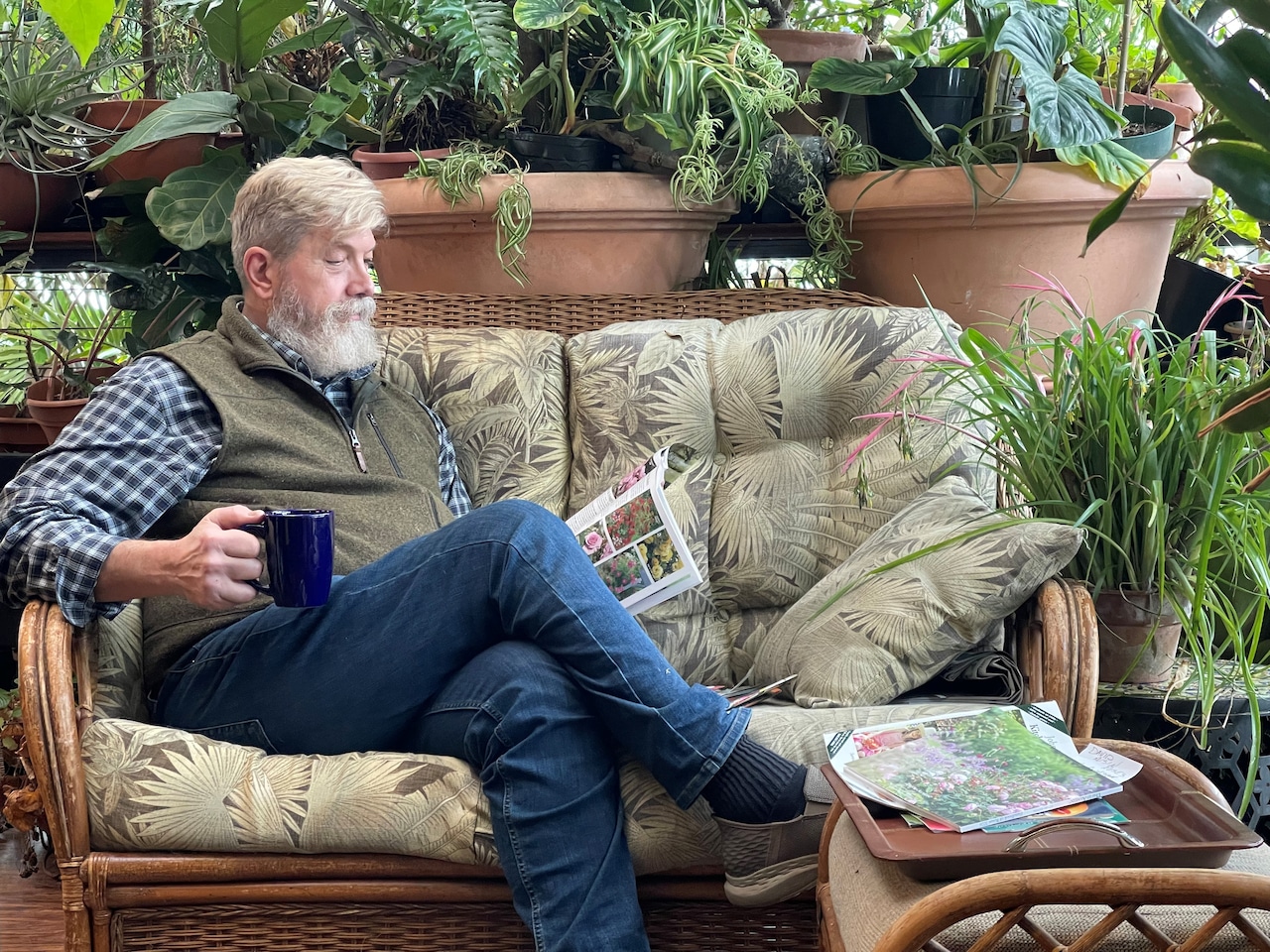
Plant lovers, now is the time to enlist a specific type of blossom to lift your mood. With cabin-fever season in full swing and the sun setting way too early, many of us could use a boost. Master gardener and Green Thumb Guru Ed Sourdiffe, this month’s Garden Talk expert, recommends fragrant flowers. for lifting spirits. “For the most part,” Sourdiffe said, “people have forgotten about the world of wonderful and varied fragrances that flowering plants provide and instead focus on their beauty alone.” Studies have shown that gentle, naturally produced fragrances improve your mood and reduce stress, he explained.
To say that Sourdiffe knows plants is an understatement. Known as the Green Thumb Guru, Sourdiffe is a garden educator who has designed and landscaped private and public gardens, including the historic gardens at Hancock Shaker Village. In between responding to Garden Talk interview questions via email, he was busy filming gardening segments for the local lifestyle show Mass Appeal, where he’s the resident horticultural expert.
Here are Sourdiffe’s recommendations for the best, sweet-smelling flowers to grow, where to find them and a fun way to raise humidity levels for your plants.
Q: You grow many fragrant, flowering houseplants at home. Tell us a bit about them.
Sourdiffe: I have a large collection of citrus trees in my conservatory ranging from lemons to kumquats to various oranges. They range in size from 24- inch specimens to some of my biggest being 12 feet tall. These are perhaps my favorite of my flowering indoor plants. They flower at various times throughout the winter with the most intoxicating fragrance, and as a bonus, with the right care, give you delicious fruit.
I’ve had houseplants for decades, since I was a young child. The impetus was my early dislike for the winter months. The seemingly endless dark, the cold and the sterile nature of winter where the is no natural outdoor plant growth or color. Also, the lack of the scents of summer — the mowed lawns, the fragrance of flowers in my grandmother’s gardens, the roses and even the scent of soil. Growing indoor plants gave me a little bit of summertime throughout the darkest months.
Q: Which scented, flowering houseplants do you recommend growing?
Sourdiffe: I recommend:
1. Citrus — lemons, oranges kumquats etc. (No, you don’t need a conservatory.)
2. Passion Flower, in particular the Blue Bahama. These are more high light flowers so they need southern exposure windows.
3. If you like the smell of bananas, try the Banana Shrub which has magnolia -type flowers with the heavy scent of ripe bananas. It does well in less bright light.
4 and 5: For lower light levels, try Night Blooming Jasmine and the Hoya or wax plant. The Hoya is a succulent, so it is perfect for the forgetful waterer.
A note about buying a Citrus plant:
Sourdiffe says sometimes Citrus is available at local garden centers — even the big box stores carry some in the summer on occasion. Usually, these plants are on the smaller side, but most Citrus plants flower and fruit even when small. Online, you will have a greater chance of getting a larger plant and a better deal. If you haven’t purchased from a website before, remember to check out the shop’s ratings before buying.
Q: What’s your advice on watering, humidity and misting these lovely pots of aromatherapy?
Sourdiffe: All of these plants, like most house plants, prefer less water in the winter and usually no fertilizing until spring comes and you see new growth. Maintain good humidity for them and moderate temperatures with no drafts.
To increase humidity for your plants, no matter what type, a tray of pebbles with water under the plants works well. Just remember to make sure that the water is below the pebbles, so the plants are not sitting in water. They would not like that. The evaporating water bathes the plant in more humid air. Misting may or may not work to increase humidity, the jury is still out on that one.
Grouping plants is a tried-and-true method for increasing humidity for the plants in the group. Plants transpire through tiny leaf pores as part of their life process. So, they end up releasing water vapor into the air. This humidifies the air around the plants, creating a moister microclimate. A humidifier also works if the air is particularly dry from a woodstove or heating system.
Q: I understand you have a fun, creative way to increase humidity that people may not have considered for plants.
Sourdiffe: Yes, incorporate a small, indoor water feature to the area, such as a tabletop fountain. You will be surprised by how much water evaporates from it. Another benefit is that the falling water catches and traps dust from the air. (Be sure to clean the dust from the vessel from time to time.)
Having said all this, if you find that your house is comfortable for you, most likely the plants will be comfortable too. Finally, Citrus leaves are a bit waxy, so they can handle a bit of dry air with no ill effects.
Q: What do you think about grow lights?
Sourdiffe: I do use grow lights but mostly use natural light due to the fact that I have a conservatory which is mostly glazed. However, the new LED grow lights (my personal new favorite is a 200-watt LED one that covers 3 square feet of growing area), allow anyone to grow anything anywhere.
Q: What if a plant’s not blooming?
Sourdiffe: If you find a flowering plant isn’t flowering for you then some of its needs aren’t being met. For the most part, it’s probably not getting enough light. Move it to a southern window or add artificial light. Also, do some research and see what cultural requirements might be missing. Some plants prefer to be pot bound to bloom well; others do not. Some have length-of- day triggers for flowering. Drafts also can cause a plant to drop its flowers if it has budded, so beware of drafty areas. The fun part of growing houseplants is figuring out what is going wrong with a plant and trying to fix the problem, then watching the plant thrive for you.
Q: Could you tell us about the conservatory you mentioned?
Sourdiffe: I am very lucky to have been able to build a 20- by 30-foot, multilevel conservatory (see photo) as an addition to our cabin in the Berkshire hills. Most of my tropical house plants reside here. However, I do have plants spread throughout the cabin especially the ones I want to keep a close eye on or the ones that are in bloom. My largest plant is a 27-foot white Bird of Paradise, followed closely by a large Foxtail Palm. My smallest plants perhaps are the smallest of my Tillandsias or air plants. These measure about one and a half inches tall. The variety of plants I grow, both fragrant and not so fragrant, include bananas, citrus, succulents, jasmine, passion flowers, Ficus, bonsai and many, many more tropicals.
Q: What’s your favorite aromatic house plant?
Sourdiffe: It would be hard to pick my favorite fragrant house plant, but I would say that Orange Jasmine might be one. It’s easy to care for, has a reblooming nature, and the intense scent of orange blossoms it produces can fill an entire room.
Q: Do you have a fragrant plant wish list?
Sourdiffe: My current wishlist fragrant plant is the Heaven Lotus (Gustavia augusta). It is amazingly fragrant and has white lotus- like flowers with pink tinges to the petals. Its center is composed of bright sunshine yellow filaments for another pop of color. It is a larger plant with great looking leaves, and will grow to 5 feet tall. Its bloom time is late winter through spring, at a time when we most need fragrance and a hit of color in our lives.
Sourdiffe is hosting several classes this spring, including at the Agawam Public Library on May 12 at 6:30 p.m. Other classes will be offered at the Becket Athenaeum on Jan. 31 and the River Valley Co-op on Feb. 26 (live webinar), with registration available on both websites. Spring garden workshops will also be presented by the Master Gardeners of Western Massachusetts in March.
Comments are closed.