
Photo: PETER FRANK EDWARDS
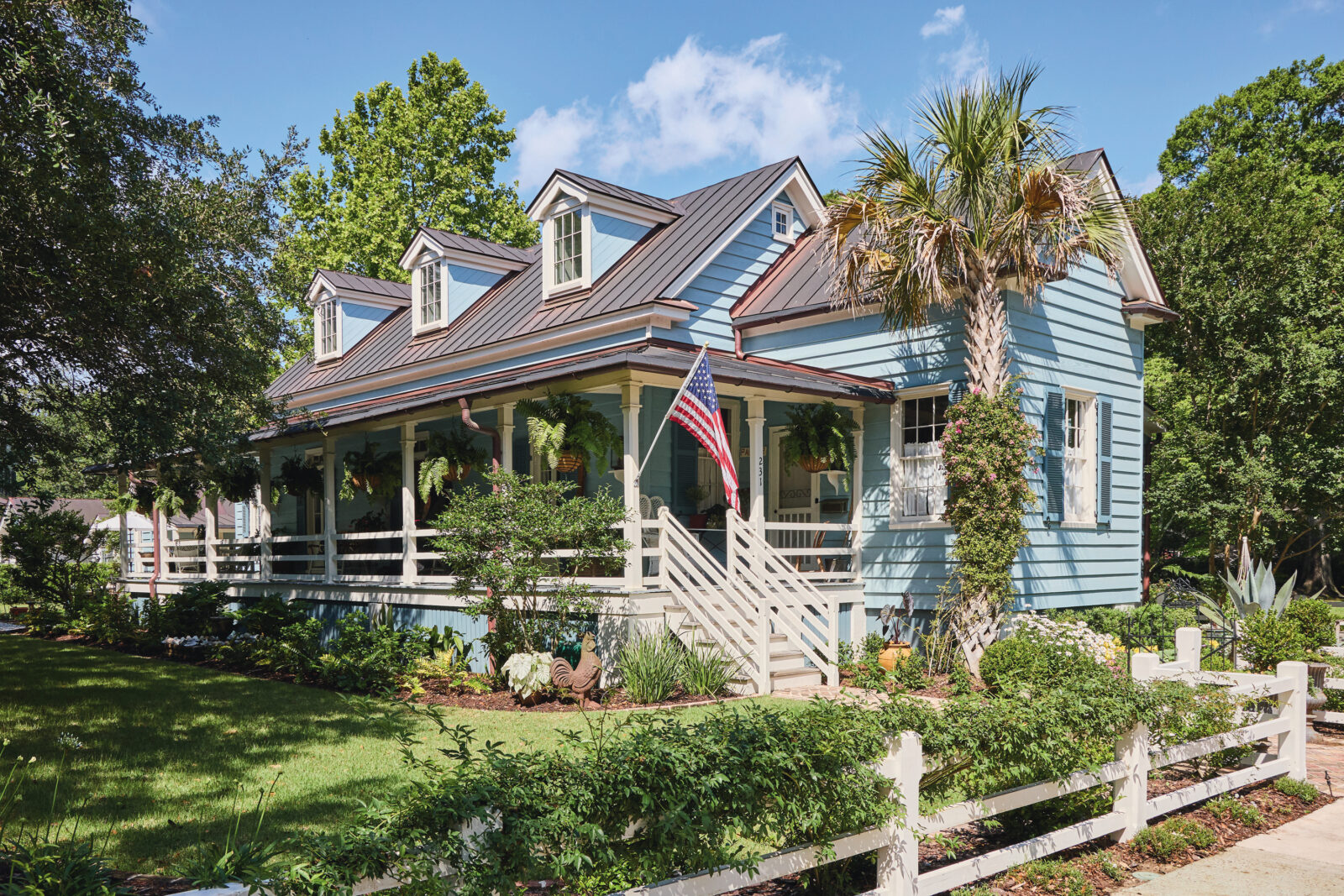
“Little Blue,” in the Old Village neighborhood of Mount Pleasant, South Carolina.
The little blue house with a metal roof and long porch had always captivated the artist Elizabeth Middour. Situated just around the corner from the three-story home where she and her husband, Steve, spent twenty-one years raising their two children in the Old Village neighborhood of Mount Pleasant, South Carolina, the home sat in profile to the street, a petite, weathered cottage among stately early-to-mid-1800s manses. Middour had even gone inside a few times, when the retired schoolteacher who lived there in the early 2000s held Christmas gatherings—mini concerts of former students playing harps in the parlor. One day, Middour sketched the house for a painting.
“We always wanted to live in this cottage,” Middour says. “On morning walks, we’d say, ‘That’s the one.’” When the Middours’ son and daughter headed to college and the couple decided to downsize, they talked with the cottage’s then-owner, who had left the place mostly unused and empty for seven or eight years. By 2020, “Little Blue” was theirs.
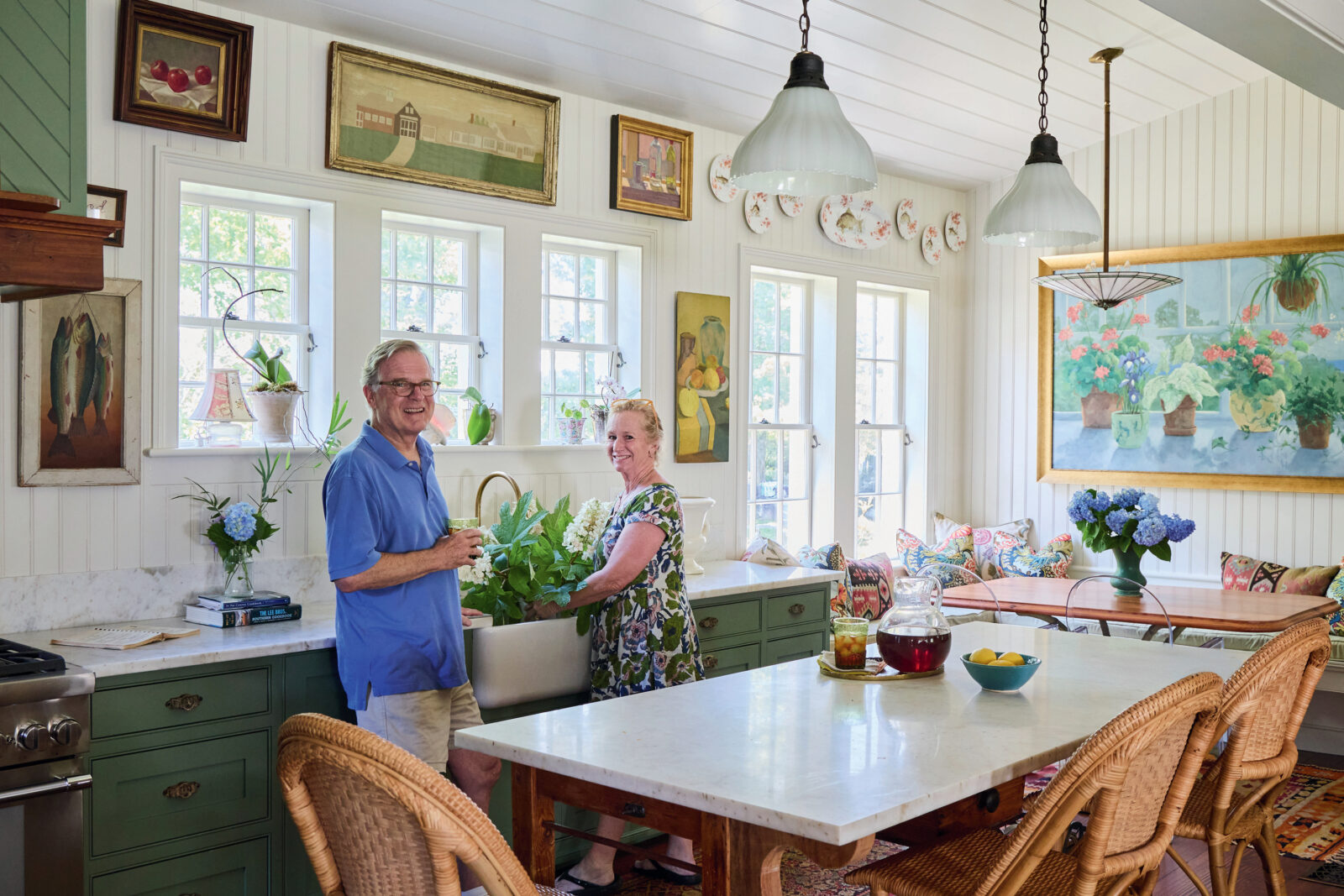
Photo: PETER FRANK EDWARDS
Steve and Elizabeth Middour in the kitchen.
After sitting vacant for so long, the property needed an overhaul, so they tapped Ross Ritchie of Loyal Architects in Charleston to carefully revamp the interior, removing vinyl flooring and rethinking the drop ceilings and galley kitchen. Room by room, they created natural light–filled spaces with arched doorways and wood-paneled walls, complements to Middour’s collected artworks and natural objects—and to her and Steve’s saltwater sensibilities (the couple met when Steve made a landside stop on Hilton Head Island during a sailing trip). One decision was easy: They’d keep the blue exterior, matching the color to a chip from the decades-worn paint.
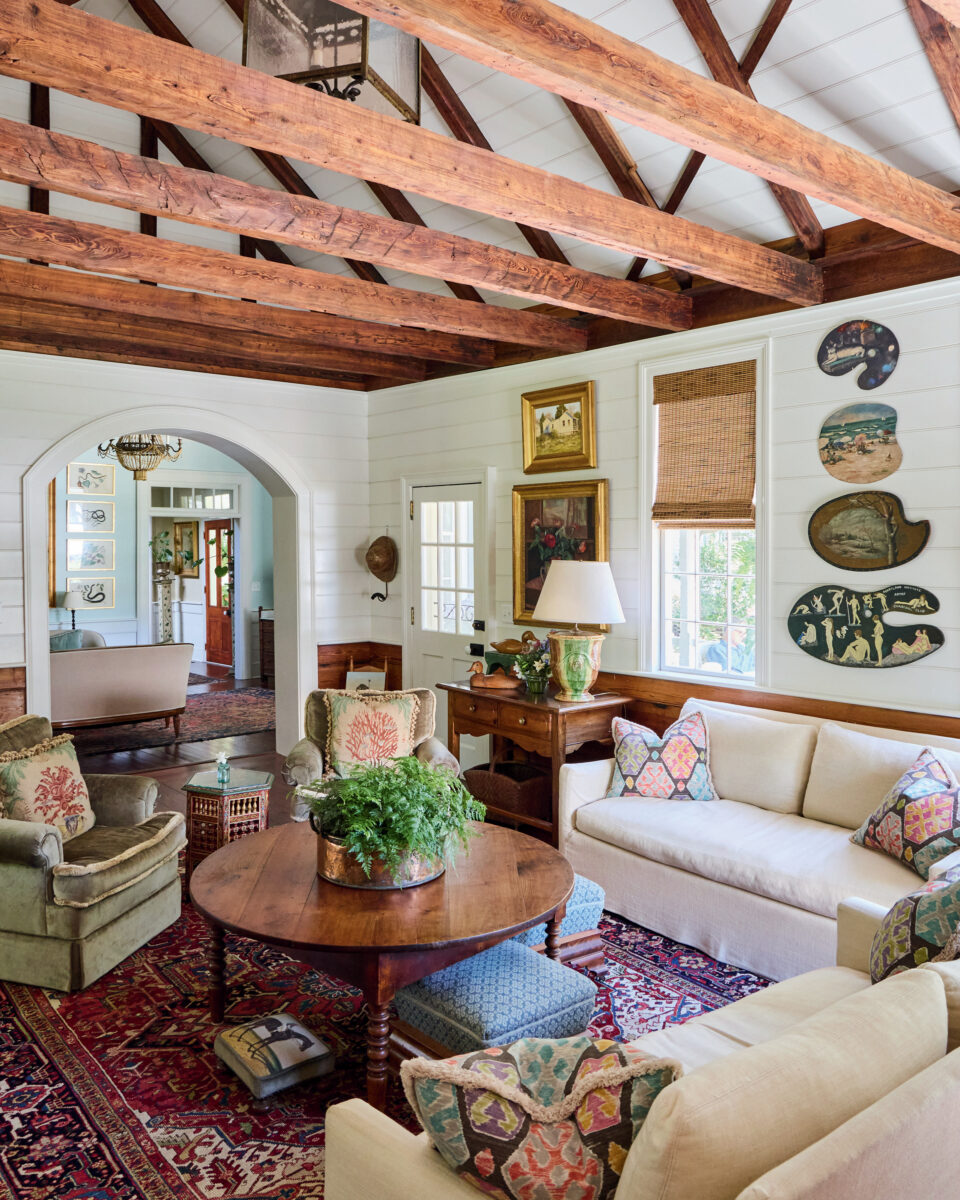
During the demolition and renovation, Ritchie discovered that the residence originally comprised two structures, including a portion that dates to the 1820s or earlier. Handwritten Roman numerals found on beams in the great room hinted that one of the structures may have lived a past life as a shop or a school. Inspired, the team maintained and introduced as many historical accents as possible, including paneling, wainscoting, and the timeworn slant of the original wood floors.
While preserving the house’s basic footprint, Ritchie’s team added a staircase, converting the attic into a bedroom, bath, and reading nook, and another five hundred square feet to the living space. Dormers along the roofline brought enhanced height, window light, and a view toward Charleston Harbor’s passing boats. On the first floor, they reworked two more bedrooms, the open-to-the-rafters great room with its large water-facing window, and a kitchen of green-painted, furniture-style cabinetry.
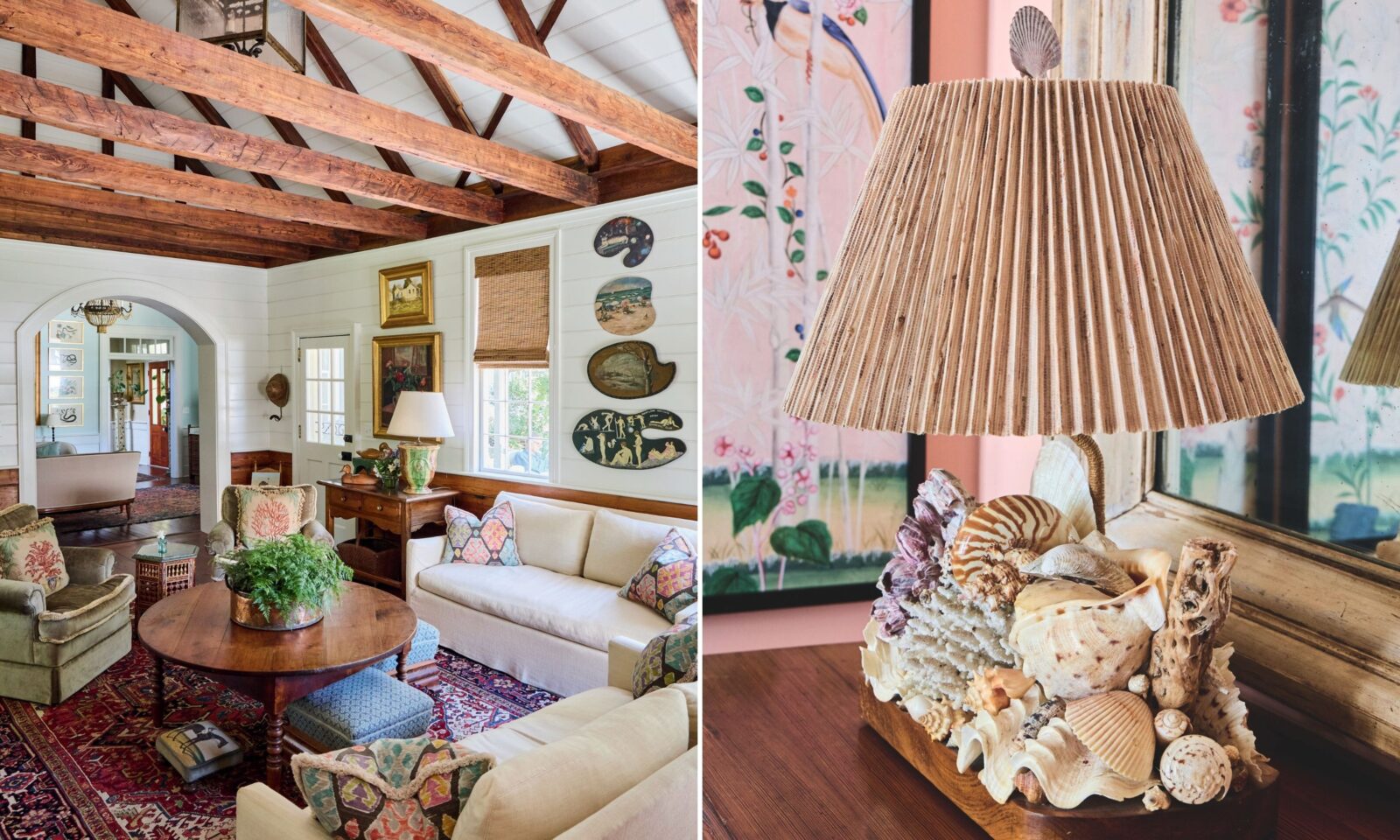
Photo: PETER FRANK EDWARDS
Exposed rafters, antiques, and artworks warm the den; a handmade lamp adorned with seashells.
In the formal living room at the center of the house, built-in bookcases flank a fireplace with an arched opening; Middour had found the mid-1800s wooden mantel leaning unused in a friend’s basement in North Carolina and bought it from her on the spot. The piece inspired the Middours and Ritchie to incorporate other arcs into the house, including a rounded ceiling in a hallway and an arched opening between downstairs rooms. Softer curves echo throughout, including in several oval-edged painter’s palettes arranged on a wall, a tabletop collection of glass paperweights from Middour’s grandmother, and large conchs and other seashells in the house and garden, collected by Middour since her girlhood on Hilton Head.
Carving out a dedicated space for Middour to paint was essential. Her studio, accessible through an exterior door on the porch, contains her in-progress still lifes, portraits, and landscapes. The images offer glimpses into her marsh-lined neighborhood: just-picked sunflowers in a clay pot, a skiff on a boat trailer, a dock’s worn, tilting boards zigzagging into the spartina grass.
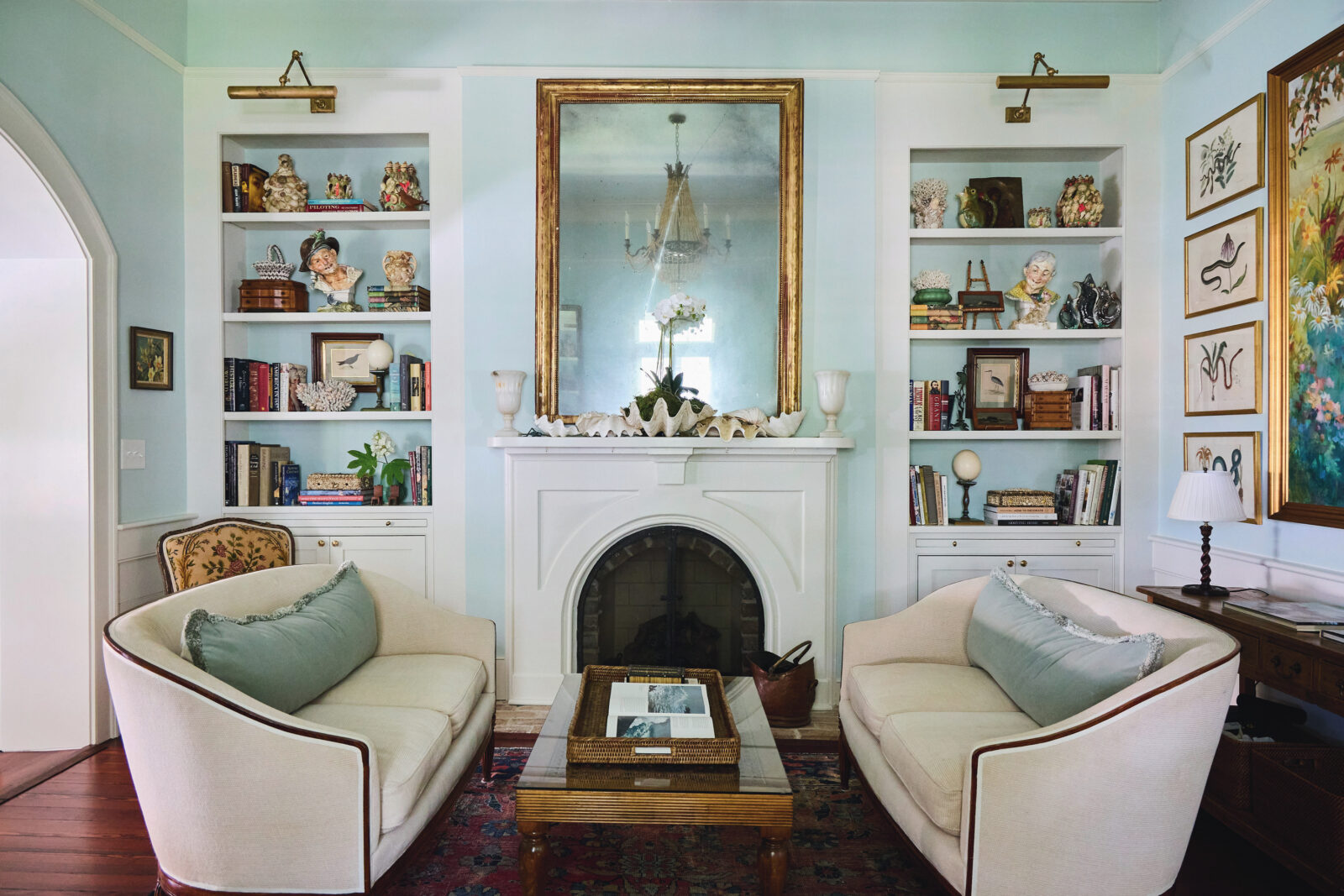
Photo: PETER FRANK EDWARDS
A crack in the mirror hung above the mantel adds to the character of the living room.
“I like things that show age and life,” Middour says, as much about her subjects as the decor she’s compiled throughout her home. She prefers searching for furnishings—boxes covered in shells, antique kilim rugs she refashions as pillow covers, pairs of pendant lights—at live auctions and antique stores, rather than turning to online sources. “I look for things that speak to me, and that I understand.”
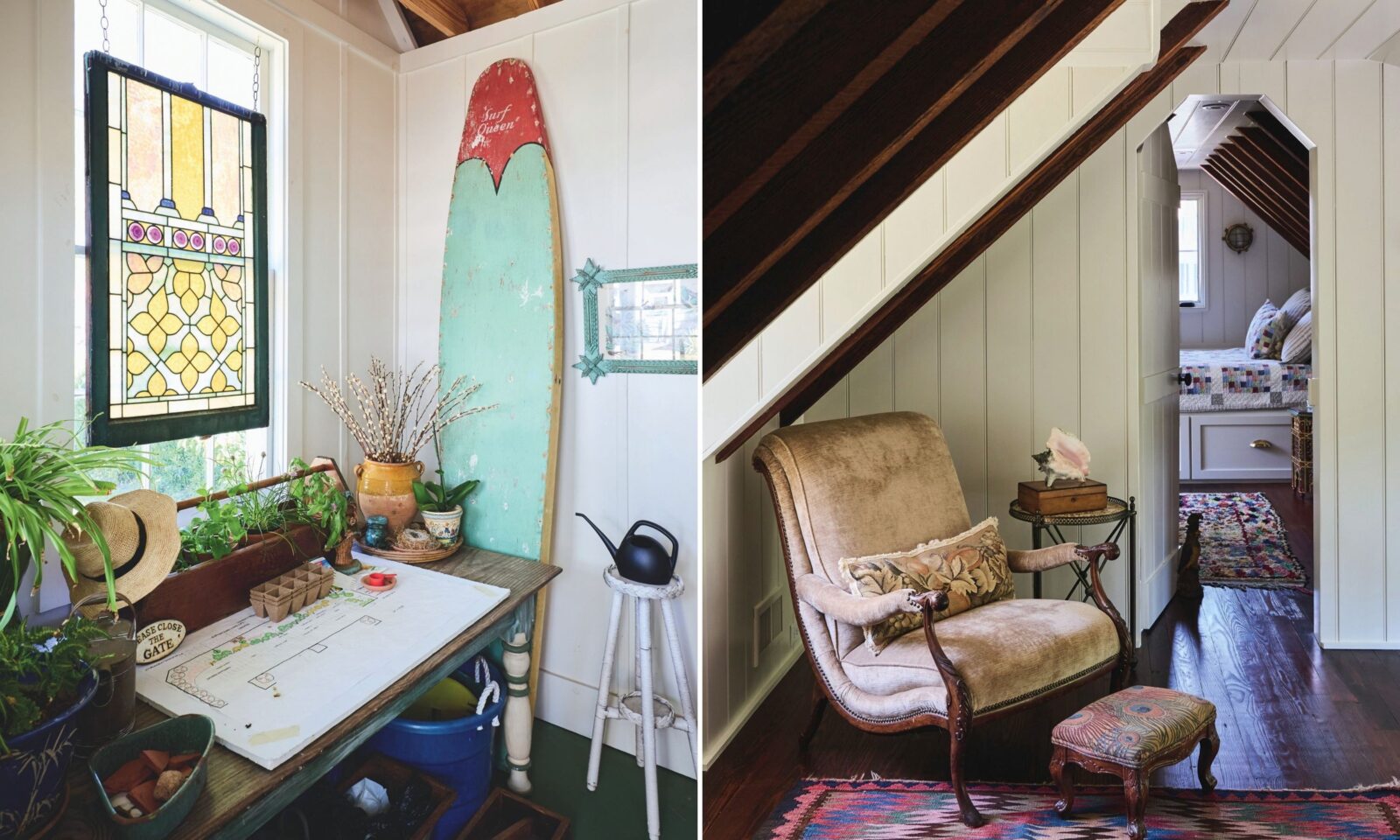
Photo: PETER FRANK EDWARDS
A 1950s wooden surfboard made on nearby Isle of Palms in the garden potting shed; the upstairs sitting area outside a guest bedroom.
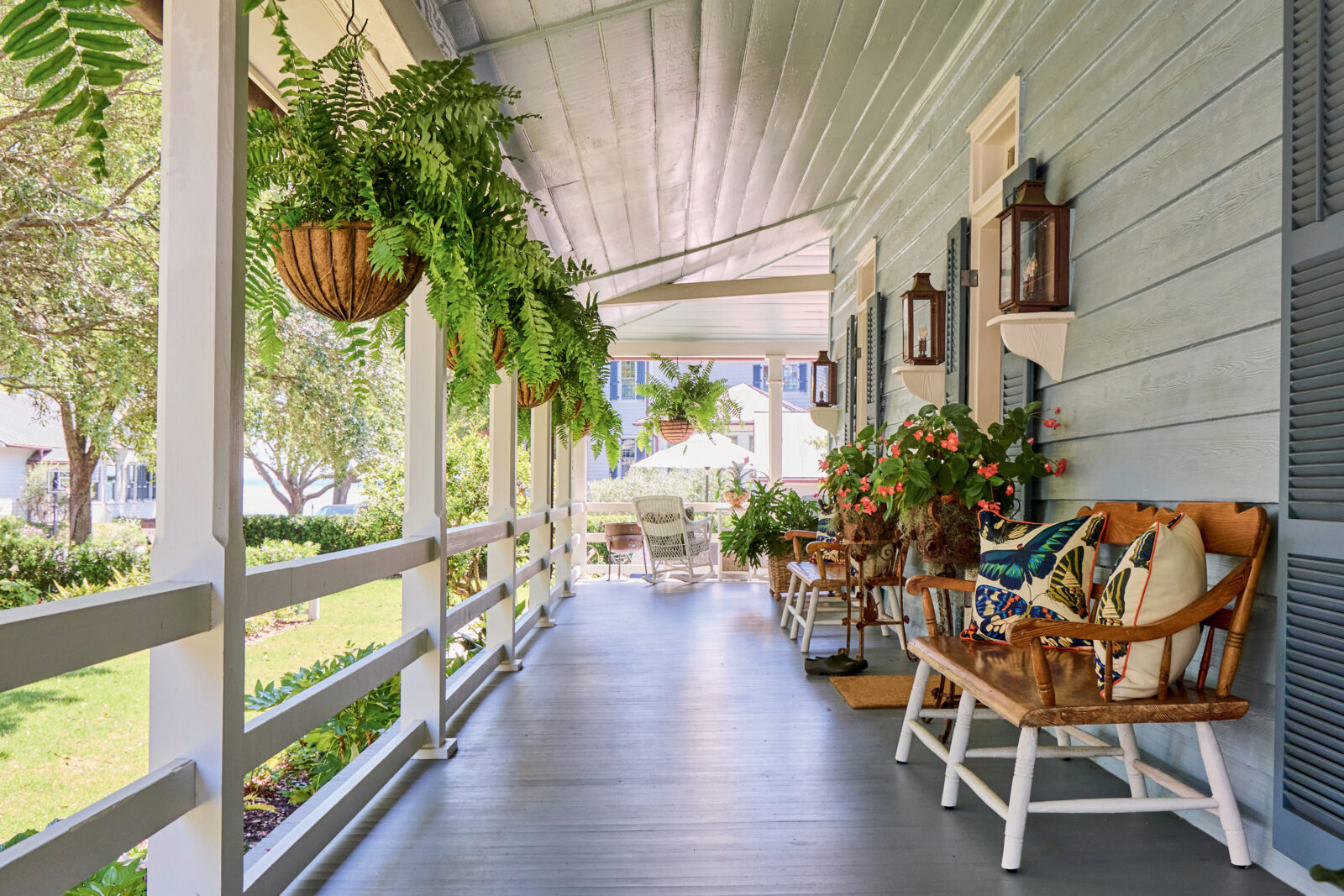
Photo: PETER FRANK EDWARDS
The porch.
That goes for the art she collects, as well. Her mother, Gretchen Ramsey, was an accomplished artist too, and one of Ramsey’s large floral paintings fills the wall above the breakfast table. Paintings of nearby Shem Creek and of a lone peach tree by the Asheville artist Richard Oversmith hang in the great room, and works by the Charleston painters Hilarie Lambert and West Fraser adorn bedroom walls. Prints of serpents by the eighteenth-century English naturalist and painter Mark Catesby enliven the living room. “I never collected the bird prints,” Middour says. “I just like the snakes.”
Though the cottage contends for the title of smallest home on the block, the Middours have found it an endlessly interesting place to be, with its collections of paintings, books, and objects, and dreamy vistas of the harbor. “Everything takes my mind somewhere else,” Middour says. “I can study it all, and never get tired of it.”
Comments are closed.