
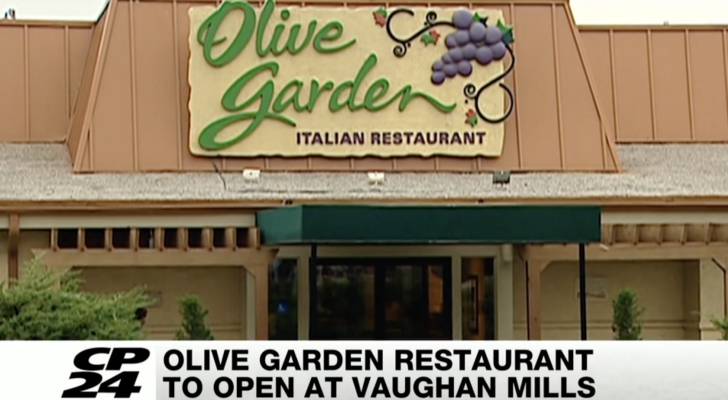
 Olive Garden
After more than 20 years since a quiet exit back in the ‘90s, Olive Garden is planning a comeback in Ontario. The Italian-inspired chain, known for its bottomless breadsticks and selection of pasta dishes, will open new locations at Vaughan Mills in Vaughan and in Ottawa’s Westboro neighbourhood in the summer of 2026.
The move comes under the guidance of Recipe Restaurant Group International, Canada’s largest full-service restaurant company. Recipe purchased all eight existing Olive Garden restaurants in Western Canada from U.S.-based Darden Restaurants and now has the rights to expand the brand nationally.
“With these upcoming openings, we’re taking an important step in expanding Olive Garden’s footprint into new Canadian markets,” Frank Hennessey, CEO of Recipe, told CTV News (1). “This expansion reflects our confidence in the brand, the strength of our partnership with Darden, and our ability to execute thoughtfully and strategically across Canada.”
Olive Garden first arrived in Canada in the 1990s, opening a handful of restaurants in Ontario. They offered the same casual Italian dining experience that had made the chain a hit in the United States, but the expansion never fully took hold. While line ups were long for the first few years, by the late 1990s, all Ontario locations had closed, leaving only a small presence in Western Canada.
The reasons were typical of early cross-border expansions. Supply chains were less efficient, tastes varied regionally and competition from established Canadian casual dining brands made growth difficult. For a while, Olive Garden was simply out of reach for most Canadians east of Manitoba, remembered mostly for its breadsticks and salads.
Now, more than two decades later, the brand is back with a much more deliberate approach. Recipe’s plan relies on measured growth, strong operational experience and a portfolio that includes Swiss Chalet, Harvey’s, Montana’s, East Side Mario’s and other well-known Canadian brands. That network gives the company the ability to manage supply, staffing and service standards in ways the original owners could not.
Retail analyst Bruce Winder told CTV News that the Olive Garden brand should brace for challenges.
Story Continues
“There’s a nostalgia and legacy there so it’s something people are interested in. They are coming during a really tough time and I think they have to be very careful,” he said, pointing to rising costs of food, labour, utilities, rent and insurance.
Even with that caution, the appetite for familiar brands has not disappeared. People who remember Olive Garden from the 1990s, or who have visited locations out west or south of the border, are curious to see how it performs this time around.
Read more: Keeping over this amount of cash in your bank account is a serious mistake — how much do you have stashed in there?
Olive Garden’s return also highlights the risks American brands face in Canada. Target’s Canadian expansion is a glaring example of what can happen when an American brand misjudges how their business will work north of the 49th parallel.
Between 2013 and 2015, Target opened 133 stores across the country but struggled with supply chain problems, pricing missteps and customer dissatisfaction. The company closed all Canadian locations within two years, leaving disappointed Canadians and billions in losses behind.
Unlike Target, Olive Garden is not rushing into hundreds of stores. Recipe is starting with two key markets, allowing them to refine operations and service before expanding further. This careful approach is designed to avoid the pitfalls that sank other U.S. chains in Canada. Lessons learned — hopefully.
The timing of the expansion is notable. Ontario’s food service industry is under pressure, with restaurants balancing higher costs for labour, ingredients, utilities and rent against a consumer base that is increasingly cautious about discretionary spending. That alone makes any expansion challenging, even for an established brand with a loyal following.
There is also a broader backdrop at play. Olive Garden is returning at a moment when Canadian consumers are more conscious of where their money goes, shaped by ongoing economic uncertainty and a renewed emphasis on supporting domestic businesses. The “Elbows Up” movement has added a layer of scrutiny for popular American brands re-entering the Canadian market, particularly in sectors where local alternatives are plentiful.
For Olive Garden, nostalgia remains a powerful asset. Many Canadians remember its generous portions, simple menu and casual vibe from earlier decades. And who doesn’t love unlimited breadsticks and soup or salad? That familiarity, combined with Recipe’s operational experience and Canadian ownership structure, may help soften some of the resistance that can greet U.S. brands arriving at a sensitive moment.
The first two locations in Vaughan and Ottawa are only the beginning. Recipe has said additional restaurants are in various stages of planning. If the early openings perform well, Olive Garden could gradually expand across Ontario and into other regions, re-establishing itself as a regular fixture rather than a novelty.
In that sense, Olive Garden’s return is a study in patience and persistence. A brand that struggled during its first Canadian run is coming back with lessons learned, a stronger local partner and a more cautious rollout. Whether that will be enough in today’s economic and political climate remains to be seen, but the effort itself underscores a broader truth in Canadian retail and dining: a retreat does not always mean the end of the story.
We rely only on vetted sources and credible third-party reporting. For details, see our editorial ethics and guidelines.
CTV News (1)
This article provides information only and should not be construed as advice. It is provided without warranty of any kind.
Comments are closed.