
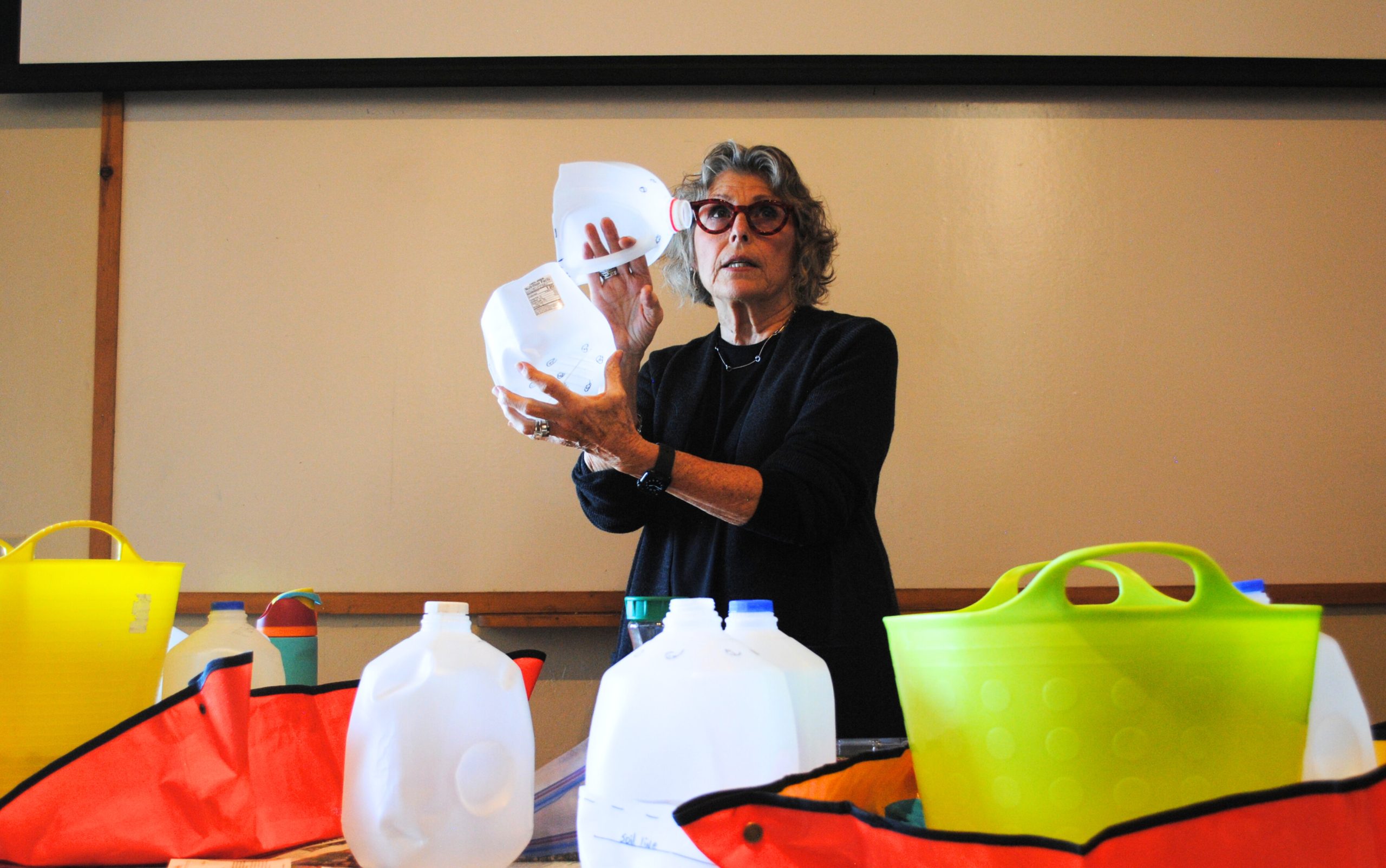
Karen Kidd holds up a gallon jug prepped for winter sowing – cut nearly in half with a hinge at the handle and holes poked in the top and bottom. Photo by Eleanor Corbin.
Even when the wind whips at my face and the snow crunches below my boots, my mind can’t help but wander forward to the end of May, when I’ll plant a small vegetable garden in containers on my apartment balcony.
Many a green thumb spends the off-season prepping and planning what they will grow when the days start to warm up.
With the winter sowing technique taught by veteran gardener Karen Kidd at the Jan. 12 edition of the Crossroads at Big Creek Growing Together education series, plant lovers can begin to plant seeds as early as December and expect healthy, plentiful sprouts in spring.
“What better to do on a snowy day?” she posed.
Winter sowing imitates a process many seeds undergo in nature called cold stratification, where the freeze and thaw cycle of winter helps break down the seed’s outer coating.
The technique taught by Kidd transforms translucent gallon jugs into miniature greenhouses. The controlled environment, she explained, reduces the risk of seeds being washed away, trampled or eaten.
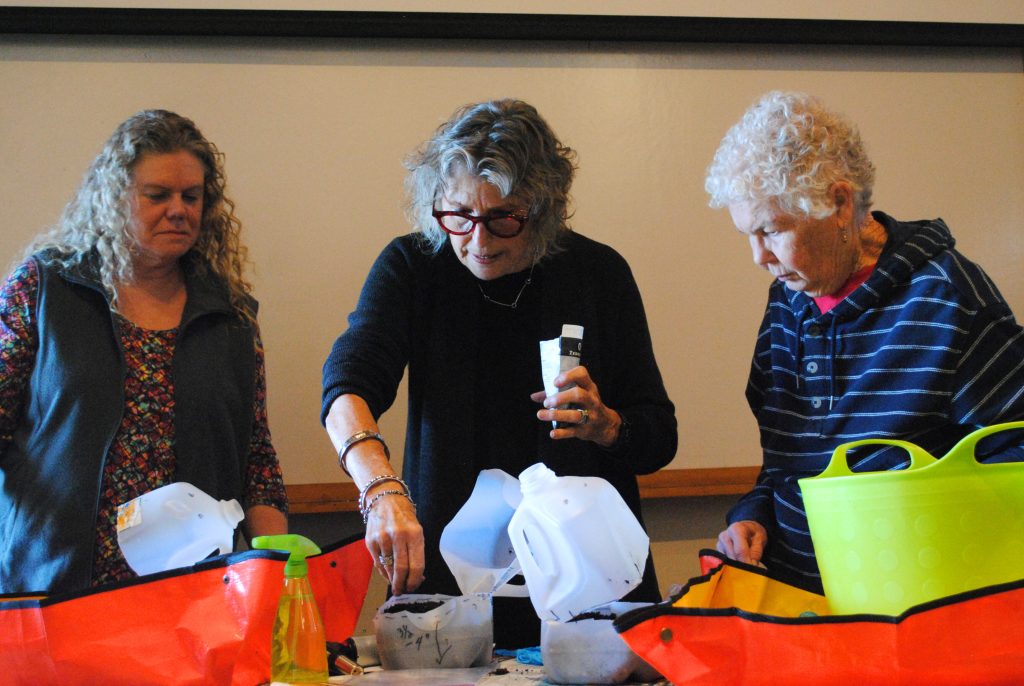 Attendees Pam Kraase (left) and Mary Ellen Smith (right) watch Karen Kidd plant shallot seeds. Photo by Eleanor Corbin.
The plants best suited for winter sowing are cold-hardy and easily transplanted, Kidd said, such as spinach, kale, and mustard. Other plants, like beans, will rot in cold, moist environments or can become misshapen if transplanted, like root vegetables.
Winter sowing is especially effective with native plants like black-eyed susans and cornflowers, because they typically undergo cold stratification naturally, and plants that require a long growing season, like scallions and shallots.
In Kidd’s experience, this method often results in a high rate of germination, so she often uses winter sowing when she wants to grow a lot of one plant.
“I want to grow a lot of onions this year,” she said. “And [winter sowing] is a really good way to do it.”
The next edition of the Door County Master Gardener’s Growing Together education series will take place on Feb. 9 from 1:30 – 3 pm at Crossroads at Big Creek, 2041 Michigan Street in Sturgeon Bay. The topic is “Rain Gardens” and will focus on what they are, how they function and how to establish one.
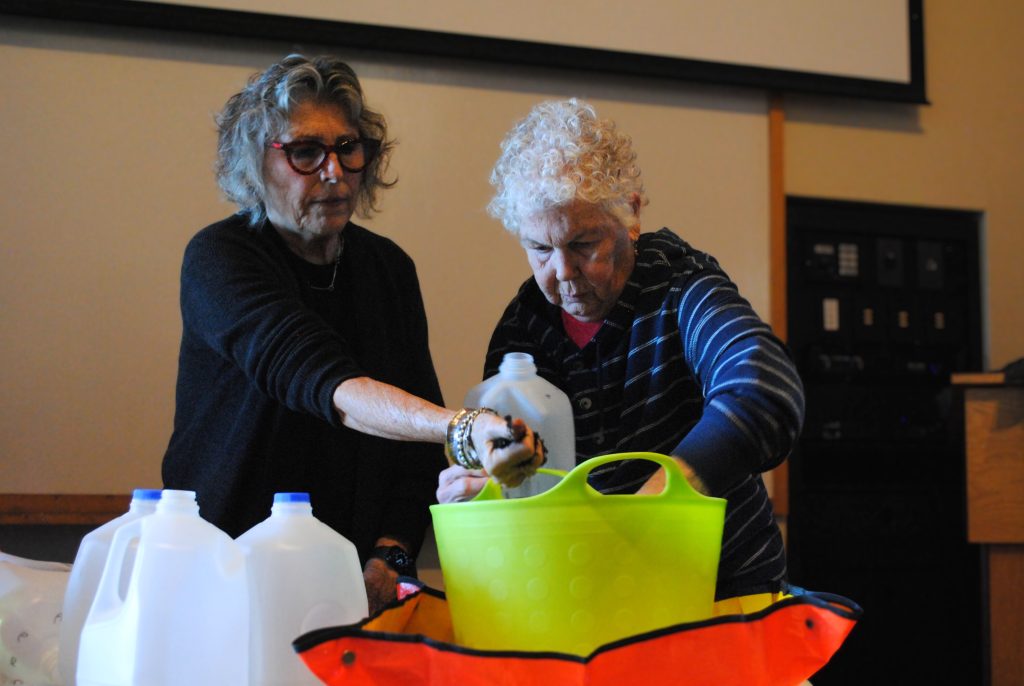 (From left) Karen Kidd helps attendee Mary Ellen Smith fill her gallon jug with soil. Photo by Eleanor Corbin.
Winter Sowing Using Recycled Jugs
This winter sowing technique was taught by veteran gardener Karen Kidd at the Crossroads at Big Creek on Jan. 12.
Supplies:
-A translucent (not clear or opaque) gallon jug
-Scissors/box cutter/something to cut the jug
-Sharpie/marker
-Soil
-Seeds
-Water
-Tape (packing or duct, preferably)
Instructions:
Poke holes in the top and bottom of the gallon for rain and drainage. (People have a few different strategies for doing this. Kidd uses a screwdriving she heated over the stove, while others use a hot glue gun, a soldering iron or just a sharp pair of scissors)
Cut the gallon nearly in half, about four inches from the bottom of the jug, leaving a “hinge” about two inches wide at the handle to connect the two halves together.
Fill the bottom half of the jug with moist soil.
Spread seeds across the top of the soil. If the seeds are particularly small, like black-eyed susan seeds, just pat the soil to make contact. If the seeds are slightly larger, like shallot seeds, sprinkle a thin layer of soil over the top. Then mist the top of the soil with water.
Label the inside of the jug with the name of the plant then seal the two halves back together using tape. Place the gallon outside where it will get rain exposure – not under any overhangs.
When the weather starts to warm up, begin to open the jug during the day, closing if it still frosts at night. Seeds will begin to germinate when the internal temperature is 50 degrees Fahrenheit.
When the sprouts reach the right size, or begin to crowd each other, it is time to transplant them.
Notes:
-Don’t make the soil too shallow. When the seeds break out of dormancy, they need a place to shoot down roots and pull up nutrients.
-Keep an eye on the jugs. If the soil inside appears to be drying out, sprinkle a bit of water over the top.
-Don’t worry if the jug becomes covered with snow, this will actually help the process and provide more water to the plants.
-Because winter sown seeds are outside for their entire lifecycle, they do not need to be “hardened off,” or acclimated, before transplanting.
-In Kidd’s experience, winter sowing can produce a lot of sprouts, many of which will need to be separated and given space.
-If seeds don’t successfully germinate, don’t throw the jug away, sprinkle the soil in an area of your garden. The seeds may still grow later.
Comments are closed.