
It has been a really busy week for us, in the classroom, greenhouse, and gardens.
The eight-week Introduction to Garden Design got under way with a packed class of enthusiastic students, all keen to get to grips with the essentials of design in order to improve their own gardens or those of their clients.
Norfolk designer and graduate of our diploma course, Sam Outing, is again teaching this popular course.
We also started the new Certificate in Practical Horticulture, the excellent ten-week course which we run every term and which get consistently great reviews.
Intro to Garden Design drawing practice (Image: Norfolk School of Gardening)
It’s designed and accredited by the Royal Botanic Garden Edinburgh and covers all of the basics of gardening and so much more.
Meanwhile, in the greenhouse, we got our first seeds sown, including aubergines and chilli peppers which need a long growing season.
However, they do need some warmth and won’t germinate in our unheated greenhouse so they are now in my study at home for the next couple of months.
hardwood cuttings (Image: Norfolk School of Gardening)
There are a few annual flowers which need to be sown early too, so it’s always worth checking the seed packets for sowing dates.
We have been planning changes in our borders and the winter garden which involved moving a lot of shrubs around.
We had to wait for them to be dormant which they are now, so we took advantage of a dry day when the temperature was above freezing and a group of us got to work.
We flattened a loam stack which we created three years ago and which had completely rotted down.
This has become the new home for lots of weigela which had got too big for the bed we had planted them in three years ago.
winter garden Jan 26 (Image: Norfolk School of Gardening)
We have also added more shrubs to the winter border: More Cornus alba and C. sanguinea ‘Midwinter Fire’, as well as an additional Lonicera fragrantissima and two more Callicarpa ‘Profusion’.
Groupings of three or more of each of these shrubs will create real impact and we are really pleased with how the winter garden is developing.
This week saw the first of the year’s Advanced Practical Gardening courses.
This is a monthly course for experienced gardeners and those who have completed the Certificate in Practical Gardening but want to learn more.
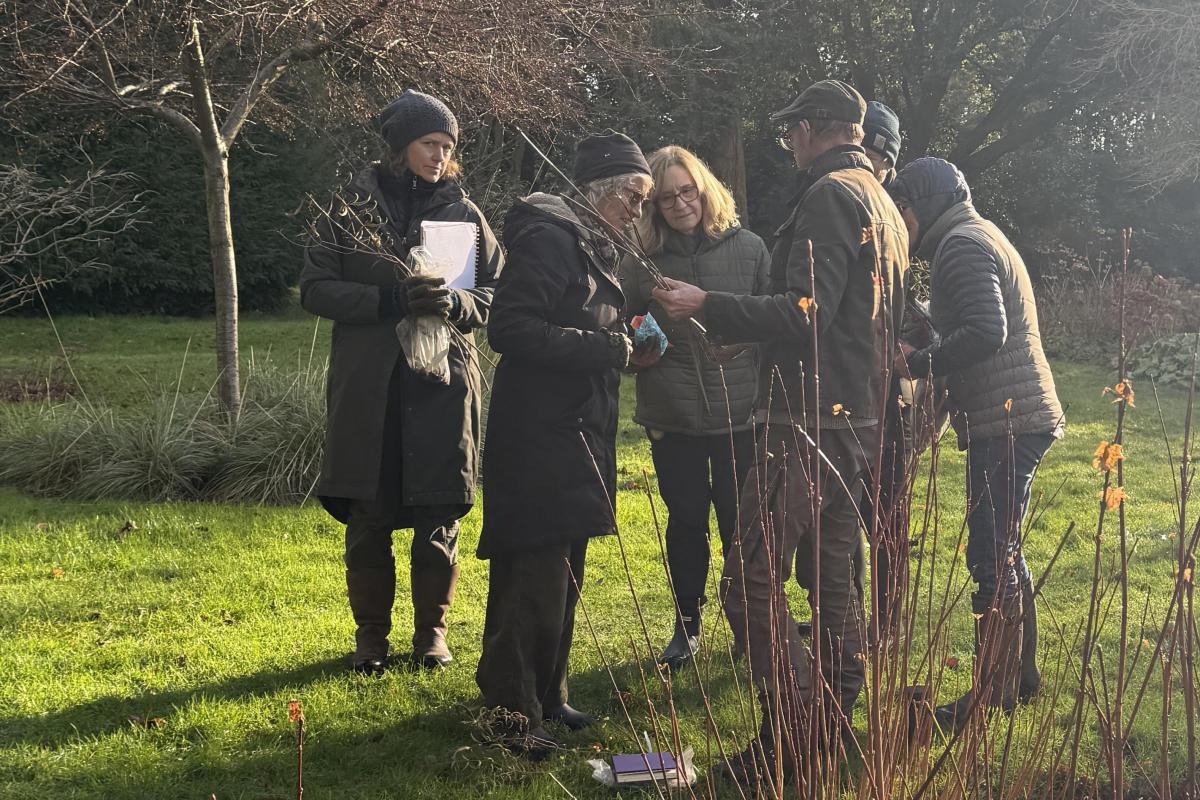
This month we took hardwood cuttings and created a bed for them, well protected from the deer and rabbits.
We also collected berries and other seeds which need scarifying and/or stratifying to encourage germination.
This is definitely the time of year to take things slowly, and that goes for plants too, which sometimes need time as well as a little help to get going.
There are some great courses coming up which still have spaces.
Let us know if you’d like to join one of these:
· Advanced Practical Gardening – 11th February
· Chainsaw Use & Cross Cutting – 25 February
· Pruning Shrubs & Roses – 4th March
· Willow & Hazel Plant Supports – 11th March
· Advanced Practical Gardening – 18th March
Helleborus foetidus (Image: Norfolk School of Gardening)
Plant of the Week
Helleborus foetidus or stinking hellebore only lives up to its name if crushed.
Otherwise, it is a really rather lovely architectural, easy-going evergreen with dark green foliage and pale clusters of nodding, bell-shaped, lime-green flowers rimmed with purple that last from January to April.
It is a native plant and very happy in a shady border or woodland garden, or beneath deciduous shrubs, where its evergreen foliage can be shown off in autumn and winter before it comes into flower.
In the right conditions it will gently self-seed and spread.
Contact us via www.norfolkschoolofgardening.co.uk or follow us on Instagram or Facebook.
Comments are closed.