
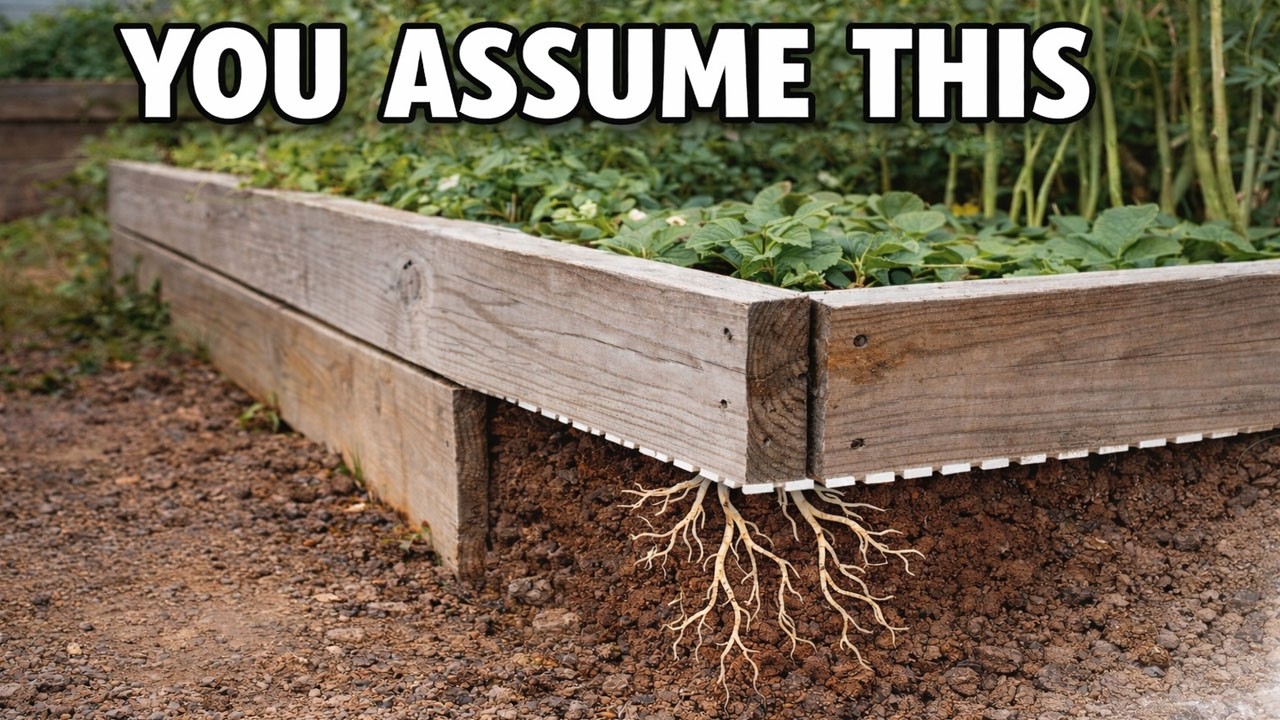
A taller raised bed does not automatically give your plants deeper roots — and that assumption limits yields in a lot of gardens.
In this video, I walk through the raised bed detail most gardeners overlook when choosing bed height.
Not soil quality. Not fertilizer. Not variety.
It comes down to usable root depth — and why bed walls don’t tell the full story.
If you’ve ever had:
– Big healthy plants with disappointing harvests
– Root crops that stay short or forked
– Raised beds that “used to work” but don’t anymore
– This is likely the reason.
I’ll break down the most common underground scenarios that limit root growth, explain why taller beds sometimes fail, and show you how to plan raised beds based on what plants actually use — not what looks good on paper.
On our blog post I have a simple, printable guide that shows why taller raised beds don’t always grow better plants — and how to plan usable root depth the right way.. https://nextlevelgardening.tv/blog/the-raised-bed-detail-most-gardeners-get-wrong
CHAPTERS
00:00 Bed Height vs Root Depth (The Mistake)
00:40 What “Usable Root Depth” Really Means
00:55 Scenario 1: Compacted Native Soil
01:42 Scenario 2: Barriers Under the Bed
02:18 Scenario 3: Drainage & Oxygen Loss
02:47 Scenario 4: Hügelculture & Unfinished Fill
04:04 How to Fill Deep Beds the Right Way
04:46 Why Root Depth Isn’t a Fixed Number
05:09 The Rule That Changes Everything
05:24 Why Plants Look Healthy but Don’t Produce
05:43 Tomato Root Depth Explained
06:13 What Other Crops Actually Need
06:37 What Failed in My Old Garden
07:26 Why Bed Depth Affects Structures Too
07:41 Can an 11-Inch Bed Work?
08:01 How to Plan Raised Beds Correctly
08:15 SkyRidge Garden Rebuild (Behind the Scenes)
22 Comments
If the soil underneath is compacted or lifeless,
a deeper bed won’t fix the problem.
👉 Root depth = bed depth + soil quality underneath
I broke this down step-by-step (with diagrams and examples) here:
➡ Read the full guide: https://nextlevelgardening.tv/blog/the-raised-bed-detail-most-gardeners-get-wrong-(and-why-bed-height-isn%E2%80%99t-the-same-as-root-depth)
♥♥♥♥♥♥♥♥
All of this sensible information as Sir Tabby of Orange calmly surveys the fiefdom from the peasant's view 😂
Have you checked to see why your left eye is drooping? I ask because that can sometimes be a symptom of a serious health issue.
😮😮😮
Question. Can we put cardboard under beds? Due to a bindweed issue & foot tall wooden beds aging, we are looking at taller metal beds. probably 17in.. The ground underneath is former lawn. We have always topped the beds with compost every year. We are lucky, its free from landfill here & actually decent quality. But, can we put, or do we NEED to put something under the bed in case we dont get all the $%@* bindweed? Thanks
I’m so glad I saw this today! Well, each of your videos really. I needed some motivation! I’ve had to create all new garden beds over the fall. My southeast facing garden that used to border a farm now has an 8 foot wall. Farm sold to a pickleball court with bar and grill 😡 I had been getting 12 hours of sun, then just 4 or less. I’ll be growing daikon radishes now that it’s finally cooling in Texas. And inoculated chickpeas to cut at flowering for nitrogen in my clay and rocky soil. Then sunflowers and okra to further breakup the soil. I’m hoping by fall it’ll be ok to grow for harvest then. We’ll see fingers crossed 🤞
i feel 6 inches is plenty. The percolation basically turns the native soil underneath into super soil.
Thank you for sharing, very insightful
Watching while sitting in an ice shanty waiting for garden season. Thanks for the video!
I have 17” beds, but the bottom is filled with 3” of yellow sand. Beyond that is native clay soil. For the most part I have experienced really tall plants with a lot of foliage not as many fruits. But I have failed in pruning as much as I should have and I have had two and three main stems where I should have pruned to one main stem. Also I was planting too many plants 12 in a 4’ x 8’ bed. This coming season I am going to plant less plants and prune more correctly.
I've been raising the height of my concrete block raised beds because I can no longer kneel on the ground to work them. The height is now where I can sit on the edge of the bed and comfortably work the bed, whether it's planting, weeding, whatever, without being in excruciating pain!
I found out the same as you that there may be enough soil for plant roots to grow, but they may not be deep enough to hold the plant stakes and trellises up!
I build my boxes according to what I have available for material, lol… I have everything from 7" to 3'! Heavy clay underneath, so I choose which plants to plant where accordingly. Some of our tomatoes and peppers went into one of the shallow beds last year and didn't seem to have an issue throwing some roots down into the clay. All our beds are filled with either rabbit litter, barn litter, a combination of both; some have layers of clay interspersed (my less-lazy days, lol) and all are topped with a few inches of poting soil or peat. Seems to work well enough 🙂
Here in the high desert, I have an issue never mentioned: where I place my raised beds, I have to fight with tree roots climbing up from below to take over the soil in the raised bed!
I’m planning to make an every other year garden task: removing most of the soil and chopping up tree roots filling up the garden bed soil from the year prior then replanting the raised bed. 🤨😡
A few years ago (I was 65 at the time) I built 20in tall beds to save my back. I filled the bottom half with logs, twigs, leaves to save on good soil. Every year I top up with compost and leaf mulch.
I'm just here for the cat
I never thought of this in my beds!!! I knew I was having a problem🤪
You look so much happier and it is coming across in these videos!!!
I fixed all. 1 foot raised bed, dug minimum 2 foot sub surface, sifted, blended with manure, sand, coir, and aged wood chips. Tomatoes went bonkers last year.😊😊😊
Are you going to put metal beds in? I really like mine but one thing they do heat up more than the ground.
Really helpful video! I have some 10" beds that sit on compacted clay soil that doesn't drain and doesn't allow for good root development. Now I know why my tomatoes are never happy there!