
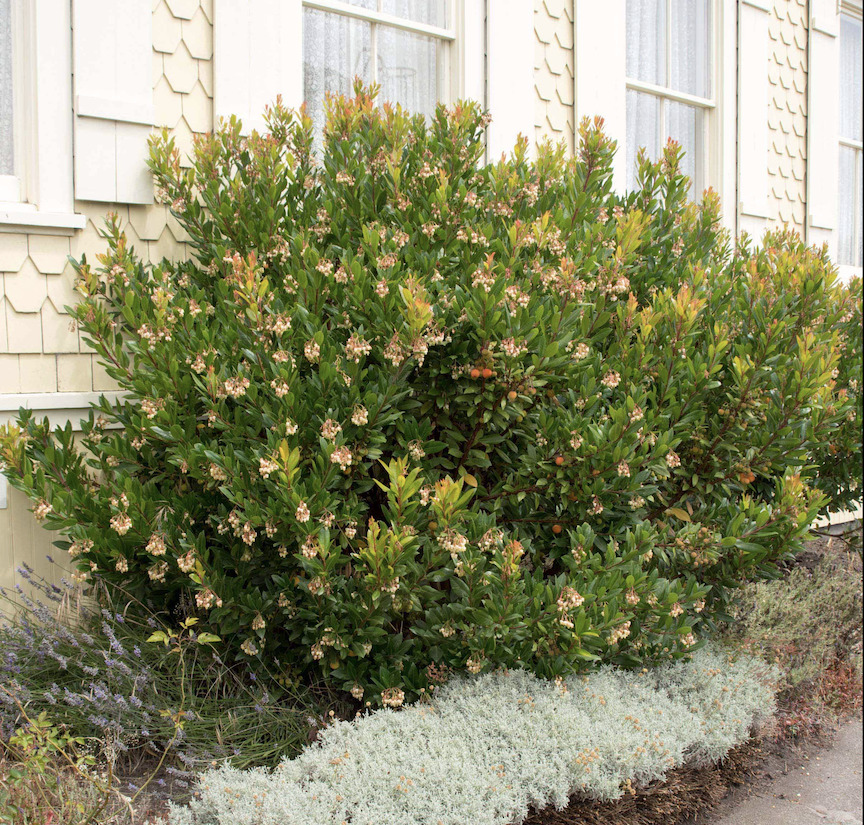
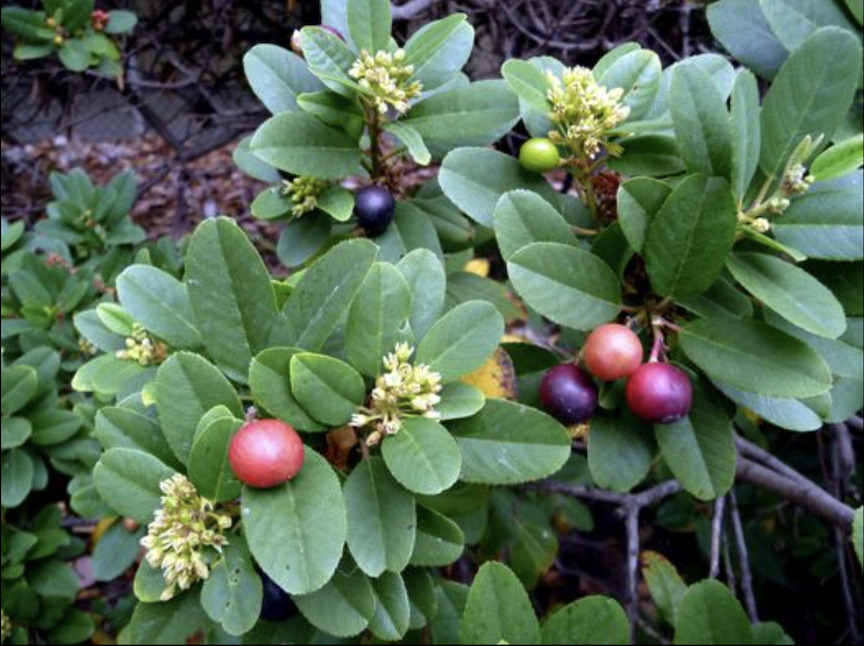
Coffeeberry (Rhamnus californica). This widespread California native is a large,
evergreen shrub that grows to 15 feet or more in the shade, with an open structure and shiny, dark leaves. Some cultivars are limited to 5 feet tall, while the type
specimen can be maintained to under 8 feet in height. (Credit – Shooting Star Nursery)
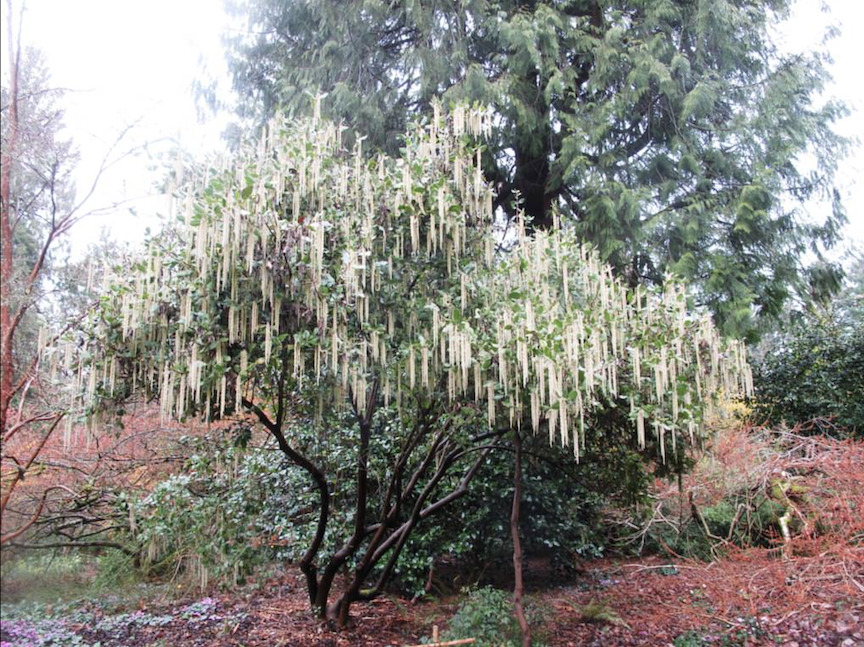
Silk tassel bush (Garrya elliptica). This native of California and southern Oregon has a multi-furcate branching structure yielding an almost spherical form. It can grow up to
8 feet tall and be maintained to 5 feet. (Credit – Debra Prinzing)
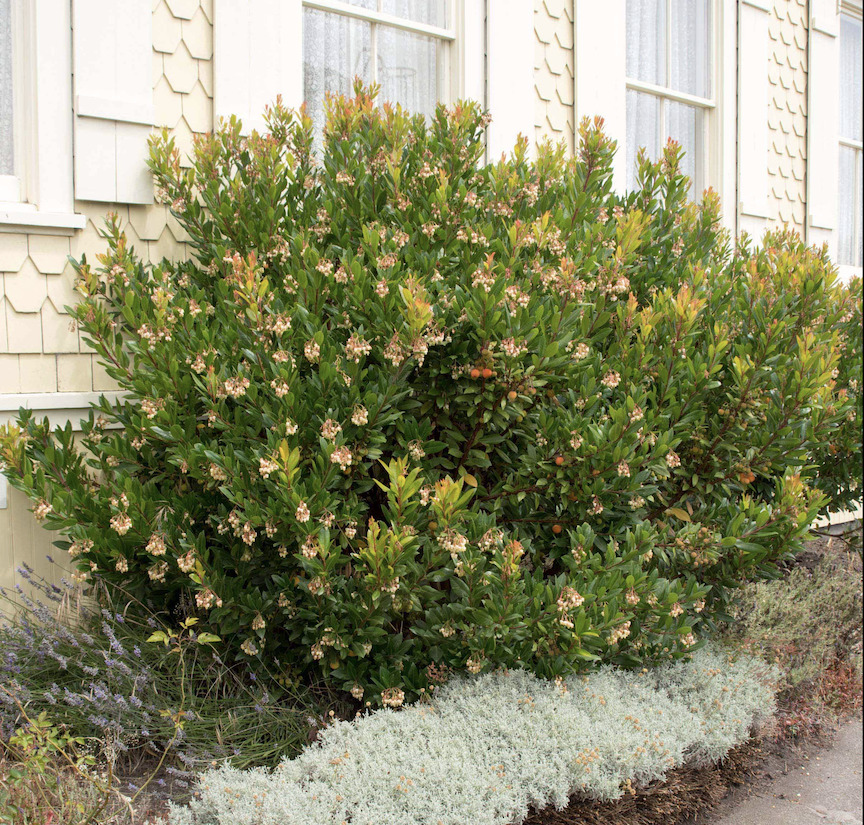
Strawberry tree (Arbutus unedo). A Mediterranean native, this small tree can exceed 20 feet in height but is easily maintained at under 7 feet tall. (Credit – Robert Perry)
Show Caption
1 of 3
Coffeeberry (Rhamnus californica). This widespread California native is a large,
evergreen shrub that grows to 15 feet or more in the shade, with an open structure and shiny, dark leaves. Some cultivars are limited to 5 feet tall, while the type
specimen can be maintained to under 8 feet in height. (Credit – Shooting Star Nursery)
Expand
We now continue our overview of using artificial intelligence to support residential gardening. Our previous focus was on many gardeners’ common tasks: identifying plants and diagnosing plants’ diseases, pest damage and cultivation issues. That column is available in the Sentinel’s archive (see below).
Our current topic concerns ways a gardener can use AI to answer questions and solve problems in their garden. The emphasis is not on generic gardening issues, but on the gardeners’ unique, current priorities.
The expanding universe of AI tools includes a wide and growing range of specialized applications.
Today’s image gallery
AI recommended several alternatives to a shrub in my garden and provided the three genuine images included in this column’s gallery.
AI applications for gardening questions and problems
Here are two widely available and popular tools for answering questions and solving problems:
OpenAI’s ChatGPT 5, available at use.ai/chat.
Google’s Gemini 3, available at gemini.google/us/about/?hl=en.
Both apps are currently free for occasional use. Upgraded versions and more frequent, large-scale usages require various subscription rates.
Their websites summarize how each app can be used for more than answering questions and solving problems.
Guidelines for prompts
When prompting AI to answer a question or solve a problem, write the prompt to clarify your desired outcome. For example, when asking about a plant, include its botanical name (best) or common name. When asking about a plant problem, describe the issue and ideally include a close-up photograph. For a prompt about a landscaping goal, describe the garden situation.
If you feel that AI’s response to your prompt is incomplete or insufficient, refine the prompt and input it a second time. Additional trials might be constructive.
You can also customize AI’s response by adding instructions for the response. Options include asking for brevity, practical actions or friendliness. You can even call for personalization of the response. For example, “Respond as a middle-aged female gardener with solid gardening experience.”
When you have extensive goals for garden issues, such as landscape design, long-term maintenance or renovation, include a profile of your garden. The profile can include the site’s location and climate context, site microclimates, soil conditions, the irrigation system and schedule, maintenance level, environmental priorities, any recurring problems and your gardening goals. As preparation, prompt AI to “Provide a garden profile worksheet for my garden.” Once you have filled in the worksheet, save it and attach it to future prompts related to landscaping or other broad issues.
Exercises for responses to garden issues
While walking through your garden, you can identify plants or situations that you want to change. You can prompt AI to recommend ways to correct problems or solve situations. As demonstrations, see my following prompts to ChatGPT about current issues in my garden, and summaries of AI’s responses.
Replacing a misplaced hydrangea
Several years ago, I planted an oakleaf hydrangea that grew well in my garden and looked satisfactory, but it is native to the southeastern United States and disrupts my garden’s Mediterranean climate theme. My prompt: “What Mediterranean climate plant would replace a mature, 5-by-5 feet. Hydrangea quercifolia?”
ChatGPT recommended six replacement shrubs and also invited me to provide information about sun exposure, soil type and design context.
I had not yet produced a garden profile worksheet, so here’s my follow-up prompt: “The Hydrangea quercifolia is under a large tree, so it receives only a few hours of sunlight each day.”
ChatGPT then recommended the following five replacement plants:
• Coffeeberry (Rhamnus californica). This was the top recommendation, noting that it grows to 5 to 8 feet in part shade, and handles root competition better than most ornamentals.
• Silk tassel bush (Garrya elliptica).
• Strawberry tree (Arbutus unedo).
• Aucuba japonica.
• Mahonia (Berberis aquifolium).
Each of these recommendations meets my criteria. Details about these plants are available online. When searching for a plant by its botanical name, include “-.com” to avoid sales pitches. I will search for a coffeeberry in at least one-gallon size.
Renovating an overgrown rose
My garden includes several roses that complement — but do not disrupt — the Mediterranean climate theme. One rose has grown without proper pruning to well over 6 feet tall and is leggy. I haven’t included a photo of this plant.
My prompt to ChatGPT: “My rose ‘America’ has grown too large for its space. Can it be pruned heavily to renovate, or should it be replaced?”
AI’s response began with, “When (the rose) overwhelms its space, that’s usually due to age plus accumulated old wood, not because the plant is inherently unsuitable.”
The response recommended renovation, rather than replacement, if the plant is healthy because ‘America’ responds very well to hard pruning, will generate new basal growth and develop a cleaner structure within one season.
The response specified the process for renovating the rose, included several reasons why replacement might make sense, and suggested a middle option: renovating the plant while planting a replacement rose of a better scale.
I am persuaded by AI’s recommendation and will put my saw and clippers to work.
Choosing a plant for a specific container
I have been grouping patio plants in blue and green ceramic pots, and clay pots, and I have an attractive, empty container of a different color. Seeking a use for this unused resource, I prompted ChatGPT: “Recommend a plant that would look good in a 10-inch glossy black ceramic container.”
In response to my simple prompt, AI recommended eight plant options, in categories:
• Stand-alone specimens (single plant focus): Fiddle leaf fig (Ficus lyrata), snake plant ‘Moonshine’ (Sansevieria), purple heart (Tradescantia pallida ‘Purpurea’) and ZZ plant (Zamioculcas zamiifolia).
• Dramatic foliage choices: Rex begonia mix and calathea ‘Orbifolia.’
• Mixed or layered container: Option A: Tropical contrast and Option B: Modern succulent palette, with recommendations for thriller, spiller and filler for each option.
• Flowering accent picks: African violet (Saintpaulia) and cyclamen (seasonal).
That response provided many possibilities to consider, with details about each option. Interested readers can search the internet for information on each plant suggestion.
ChatGPT added “Tips for best visual impact”: color contrast, texture play, height balance and maintenance fit.
I already have a snake plant in a blue container, where it doesn’t look right. This African native plant, also called mother-in-law tongue for unknown reasons, is a Dracaena trifasciata, previously known as Sansevieria trifasciata.
I will move my snake plant from the blue container into the black container, where, according to AI, “its dark foliage harmonizes with black for sleek minimalism.” Assuming that’s successful, I will need a plan for the blue container.
This week in the garden
Always a good idea, walk your garden to spot plants or areas that you want to improve. Then, use artificial intelligence to find an answer to your garden question or a solution to your garden’s problem.
AI responses can be off target, incorrect or even “hallucinatory,” so review the responses with your own knowledge and experience, or other trusted sources, before accepting them as truth.
As I previously wrote, garden-related and other nature issues are less prone to AI technology’s hazards than, for example, political topics. It’s still best to rely on common sense.
In future columns, we will explore other ways you can use AI in the garden.
Tom Karwin is a past president of Friends of the UC Santa Cruz Arboretum and the Monterey Bay Iris Society, a past president and lifetime member of the Monterey Bay Area Cactus and Succulent Society, a Lifetime UC Master Gardener (certified 1999-2009), past board member of the Santa Cruz Hostel Society and a current member of the Pacific Horticultural Society and other garden-related societies. To review the archive of recent On Gardening columns, visit santacruzsentinel.com and search “Karwin.” Visit ongardening.com to review columns from 2012-2020 (and eventually) from the following years. Please send comments or questions to gardening@karwin.com.
Comments are closed.