

Four nights a week, in a building perched atop a cliff overlooking the Chesapeake Bay in Betterton Beach, Maryland, Paul Edward welcomes eight guests to his chef’s counter for a twelve-course meal that tells the story of the Eastern Shore. Sassafras—named for the river that meets the Bay just in front of the restaurant—opened last spring, after Edward left the Bluebird, a popular cocktails and seasonal bites spot he created in Baltimore.
“I go to the farmers’ market on Saturdays with my family, and I shop for the restaurant as well,” he says. With that haul, he crafts a seasonal menu starring all local ingredients. There might be dry-aged rockfish crudo with cameo apple and rhubarb juice topped with toasted black walnut crumble, or catfish ricotta and raviolo pasta made with eggs from his own chickens, or a tempura course featuring Maryland rice ground on a stone mill just before the guests arrive and served with lobster sauce made from Ocean City lobsters. (Each course gets its own music pairing, too; one featuring the invasive fish snakehead is served as Johnny Cash sings “Bridge Over Troubled Water.”) In the winter, it’s all capped off with the chef’s take on traditional Appalachian vinegar pie.
“We want what we do to be simple and elegant and clean, and we’re using the depth of the Chesapeake region to accomplish that,” Edward says. Below, we caught up with Edward on why he’s keeping numbers so small, what ingredients he’s most excited about, and his love for his rural town.
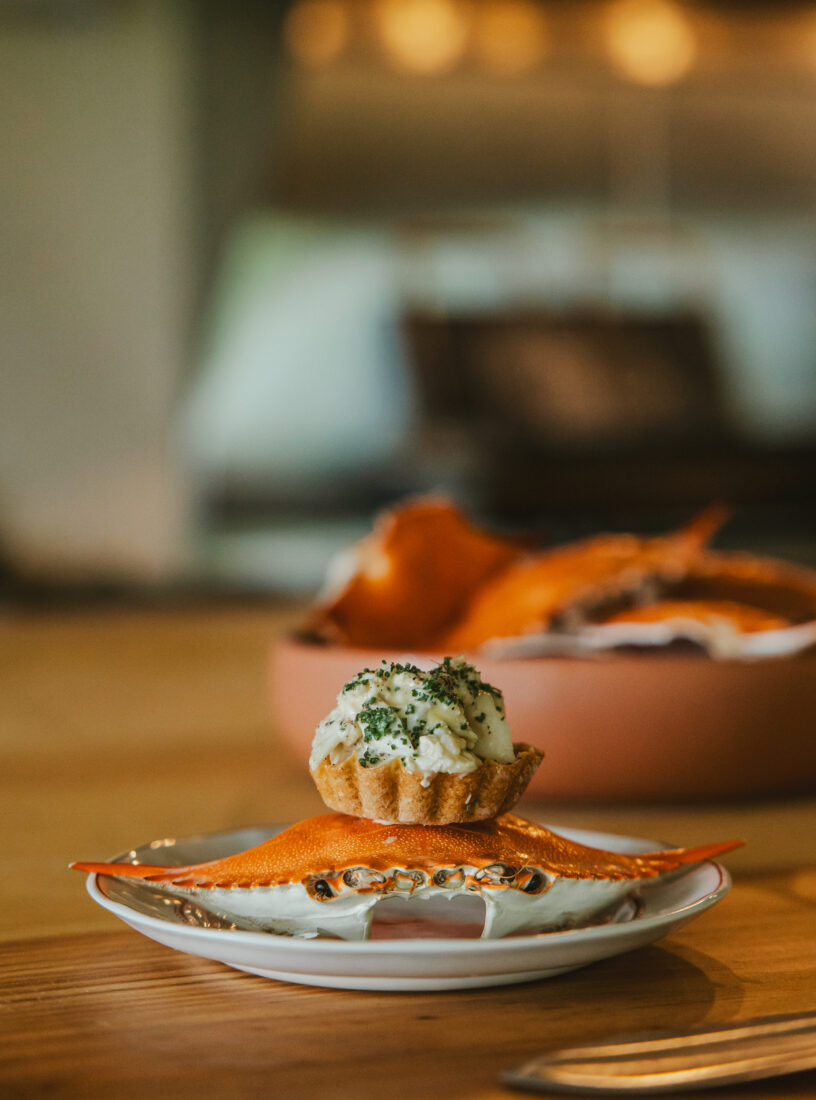
Photo: Caroline J. Philips
A cornmeal tart filled with crab, beef tallow, mayonnaise, and Granny Smith vinegar topped with lemon verbena jelly.
How did the idea for Sassafras come about?
Sassafras is a culmination of twenty years of work. For a long time I didn’t know there was something you could do outside of the big restaurant industry. What started to draw me in was working with people who have dedicated their lives to either their craft or what they’re growing, whether that’s farmers or watermen…I am drawn to people who are working with their soul, and that’s what Sassafras embodies. I wanted to dig deep and do something where I can show people how wonderful the world can be.
Why Betterton, Maryland?
The location is the number one question people ask when they come to dinner here. I live ten minutes down the road. Kent County is the least populated county in Maryland and it’s very rural, but it’s right on the bay and the rivers, and it’s a beautiful place with so much bounty. This is a concept all about the place.
How much is the menu changing?
I don’t have a specific date where everything changes seasonally. We have been having a tempura course—a little fried morsel of deliciousness—and that changes all the time. In the springtime we did morel mushrooms and ramps. As soon as those went out of season, softshell crabs were in season. When I run out of one thing and the next thing shows up, we make the change.

Photo: Caroline J. Philips
Rockfish crudo with chilled fresh rhubarb juice and toasted black walnuts.
What are some of the ingredients you get most excited about?
I work with very specific producers for specific things. I work with one single farm just for their blueberry honey. They are a fruit farm and the bees pollinated all of their blueberry brambles, and the honey has this amazing whisper of blueberry flavor. It’s the best honey I’ve ever had. Now that I’ve had it, I can’t use anyone else’s honey. I have the same thing with butter. I work with a lady who makes butter from her cows right down the road.
And I always feel good when I have good fish. I work with a really great purveyor named Top Hat because he always wears a top hat that has fish eyes on it. He lives on a boat in Cape May, and he works directly with the fishermen there.
I’m constantly changing the menu because I’m looking around for what’s best. It’s important to me because when we’re telling the story of this place and how amazing it is, I have to have the best ingredients.
Any dish you’re particularly proud of?
We’ve had bone broth on the menu from the beginning. We use pastured chicken necks and sometimes waterfowl. We also make a fish fumet from mostly rockfish, a classic Chesapeake fish, but it’s just a whole bunch of fish bones from the Chesapeake. The Japanese make something called katsuobushi. They take a small tuna and salt it and smoke it and age it to dry for several months, and they shave it into broth. We make that with a local fish—right now its Spanish mackerel from right off the coast—and shave some of it into the broth.
Then we take the various broths and we deglaze the pan and let them stew with fresh scallops so all that beautiful fond from the scallop caramelization goes into the broth. Then we clarify it and I add a little touch of soy sauce that comes from two friends of mine—Maryland grows so much soy. We put a few drops of that in the broth. It’s clarified so it becomes more of a consommé. It’s so deeply rich and so umami forward.

Photo: Caroline J. Philips
Inside the restaurant’s intimate dining room.
What about that catfish and caviar course?
We make pasta fresh daily and we take invasive blue catfish from the Chester River right down the road and smoke it. We add some whipped ricotta from a local ricotta maker. We put a raw egg yolk in the middle, and we cook these ravioli. When they’re done cooking, when you cut the pasta in half, the egg yolk runs and makes this beautiful, luscious sauce. We serve it with brown butter. And then there’s a dollop of Mississippi River hackleback sturgeon caviar. The whole dish is just this very high-brow/low-brow affair that is super rich and lovely.
What do you love about the Eastern Shore?
I love this kind of vast openness. I get into my pickup truck and I hit the road and I’m surrounded by quiet, just trees, nature, bald eagles. The Eastern Shore is filled with peace.
What would you recommend for someone coming to the area to visit?
Come on a Friday. Stay at one of the bed and breakfasts, like Great Oak Manor. Have dinner here or somewhere else, and go to the farmers’ market on Saturday morning, because it feels good to shop that way. We have lots of great little bakeries and cafes. Even if you’re just here for twenty-four hours, it’s enough to relax and to feel some quiet.
Lindsey Liles joined Garden & Gun in 2020 after completing a master’s in literature in Scotland and a Fulbright grant in Brazil. The Arkansas native is G&G’s digital reporter, covering all aspects of the South, and she especially enjoys putting her biology background to use by writing about wildlife and conservation. She lives on Johns Island, South Carolina.
Comments are closed.