
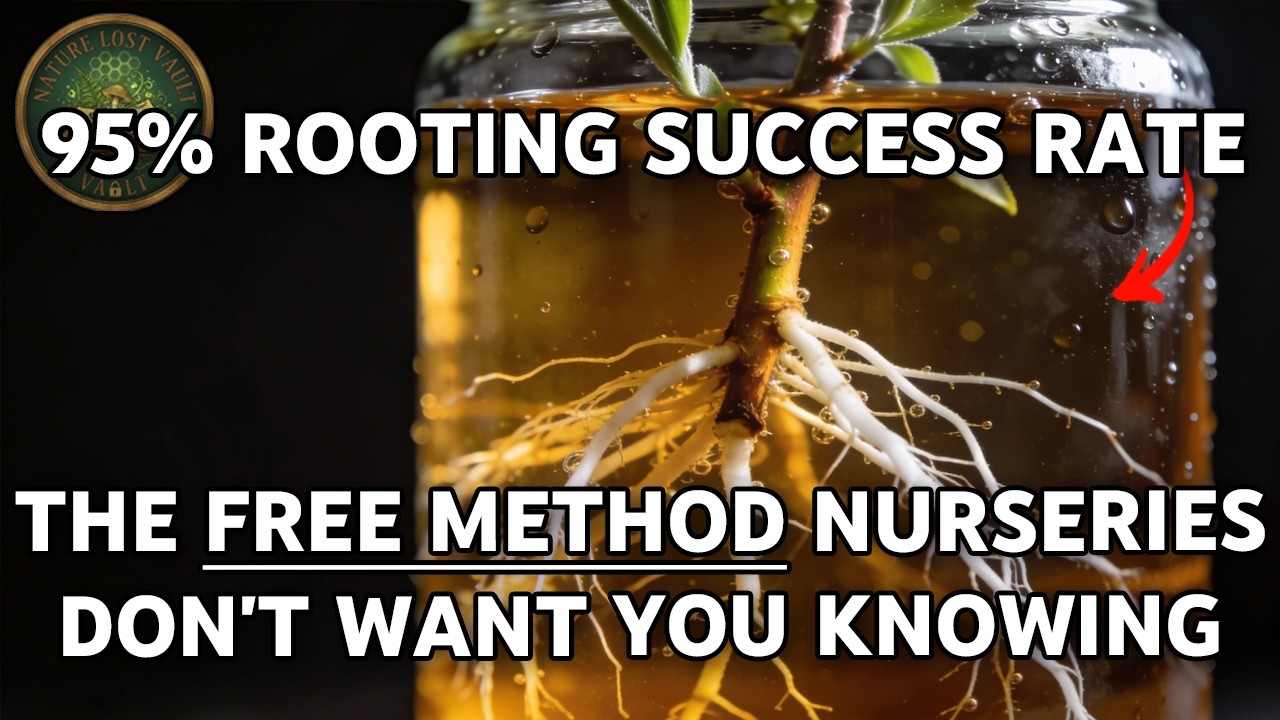
Plant Cuttings Root 90% Faster With This, Why Did It Vanish From Gardening Books?
Before 1935, European gardeners rooted cuttings with 90%+ success using nothing but water and willow branches. The method was documented in Victorian garden manuals, passed through generations, and cost nothing. Then synthetic auxins hit the market, and within two decades, willow water vanished from every major gardening publication—despite containing the same active compound garden centers now sell for $15-25 per bottle.
This is willow water: the natural rooting hormone free in your backyard for 2,000 years, and the garden chemical industry that made certain you never learned it.
🌿 WHAT IS WILLOW WATER?
Willow water is made by steeping young willow (Salix) branches in water 24-48 hours. For millennia, gardeners used this to stimulate root growth in plant cuttings. The method was standard in European, Asian, and indigenous North American horticulture. All 400+ Salix species work, though weeping willow, white willow, and pussy willow show highest hormone concentrations.
📊 THE LABORATORY PROOF
Willow contains indolebutyric acid (IBA)—the SAME compound in commercial rooting powders like Rootone, Garden Safe, and Hormex. Willow produces it naturally; garden centers synthesize it chemically for $15-25. It also contains salicylic acid, the natural fungicide and pain reliever Bayer isolated from willow bark in 1897 and commercialized as aspirin in 1899.
University studies document:
– 85-95% rooting success for softwood cuttings
– 70-85% for semi-hardwood cuttings
– Enhanced root density vs water-only controls
– Faster development: 7-10 days vs 14-21 days water-only
– Works on roses, hydrangeas, lavender, herbs, houseplants, fruit trees, grapes, berries
🚫 THE SYSTEMATIC ERASURE
1935: Chemical companies mass-produce synthetic IBA after laboratory isolation. Marketing positions it as “scientific” vs “old-fashioned” plant extracts.
1940s-50s: Garden chemical industry expands post-WWII. Companies fund agricultural extension research on synthetic products. Willow water—free and unpatentable—receives zero commercial backing.
1960s-70s: Major gardening publications shift to advertiser-friendly content. Nursery catalogs stop mentioning willow water. Garden books replace traditional methods with product recommendations.
1980s-Present: New gardeners learn only from garden centers stocking profitable synthetics. Willow water becomes “folk wisdom” despite identical active compounds.
The plant growth regulators market reached $4.89 billion in 2023, projecting $7.12 billion by 2030. Zero dollars teaches free alternatives.
📚 SOURCES
– Stone, E. (1763). “An Account of the Success of the Bark of the Willow in the Cure of Agues.” Philosophical Transactions of the Royal Society, 53: 195-200. First scientific documentation of willow’s medicinal compounds.
– Hoffmann, F. (1899). “Aspirin: Its History and Mode of Action.” Pharmaceutical Journal and Pharmacist. Bayer’s commercialization of salicylic acid from willow bark.
– Zimmerman, P.W. & Wilcoxon, F. (1935). “Several Chemical Growth Substances Which Cause Initiation of Roots and Other Responses in Plants.” Contributions from Boyce Thompson Institute, 7: 209-229. First synthetic auxin production.
– Hartmann, H.T., Kester, D.E., Davies, F.T. & Geneve, R.L. (2010). Hartmann & Kester’s Plant Propagation: Principles and Practices, 8th Edition. Pearson. Standard horticultural textbook documenting natural vs synthetic rooting methods.
– Liberty Hyde Bailey (1914). The Standard Cyclopedia of Horticulture. Macmillan. Pre-synthetic documentation of willow water propagation.
– Dirr, M.A. & Heuser, C.W. (2006). The Reference Manual of Woody Plant Propagation. Timber Press. Modern comparison of natural and synthetic rooting compounds.
– University of California Botanical Garden (2013). Plant Propagation Protocol Database. UC Davis documented trials comparing willow water to commercial hormones.
– Grand View Research (2023). Plant Growth Regulators Market Size, Share & Trends Analysis Report. Industry market analysis and projections.
🚨 WHY THEY STOPPED TEACHING IT
Garden centers profit from synthetic hormones. Extension services receive agrichemical funding. Garden magazines depend on product advertisers. Master Gardener programs use industry-partnered curricula. Free methods threaten billion-dollar supply chains. When everyone can make rooting hormone from park trees, nobody buys bottles. That’s why your grandmother knew this—and you didn’t.
💪 RECLAIM THIS
Subscribe for more suppressed agricultural wisdom. Turn on notifications.
#PlantPropagation #OrganicGardening #DIYGardening #SustainableGardening #AncientWisdom #GardenSecrets #FreeGardening
⚠️ DISCLAIMER: Educational purposes. Results vary by species, cutting condition, environment. For difficult species, commercial hormones may work better.
37 Comments
Chemistry doesn’t lie: IBA is IBA. The only difference between the bottle and the branch is who profits.
Hmm, I wonder if this would work for air layering trees for Bonsai 🤔
I may try soaking Sphagnum moss in Willow Water to try layering a tall Larix that I have! 👍
To be fair, vast numbers are Urban, an ever growing group even now. Living on estates to tower blocks. So rooting help in a bottle rather than made yourself was inevitable to be popular and used. Even now few would be bothered to DIY. If they could even identify a willow! Less commercial conspiracy and more public laziness and life changes.
O' I cannot thank you enough for opening my eyes to the dark side of agricultural industry
u can grow food in high houses, or turn golf areas food growing nd gym goers and homeless can pick berries and other
90pros people was farmers 1925
Thank you! ❤. I am adding crushed aspirin to my rooting hormone! I live in a hot climate and have no idea what willows grow here.
before aspirin sugar pills they ate plants for medicine, hemp, opium… rotten tooth is painful
same works with human cells, nazys tried cure death, science is mad
americans can only grow grass but now they gone mad about plastic grass
Fantastic video. Very interesting. Keep them coming.
The willow is a fantastic tree, roots cuttings and is good as a painkiller. I've been using it for years, and i've found that putting fresh soft branch tips in the spring, through a smoothy maker/food processor and chopping it very roughly, 2 second blasts then adding boiling water, and leaving it overnight makes a better tea. Once strained and bottled in dark brown glass or plastic bottles, it can last a year+ in the fridge or years if you make multiple smaller bottles and freeze it to use as and when needed.
Stand up pallets on filled earth. Shove, sharp, angle cut willow branches, down through the pallets middles, into the earth for mutual support. An almost instant foliage barrier. Line erected pallets up side to side, for parking, wind, privacy, etc.
I refuse to pay anything for any rooting products. I use aloe that I grow.
It's still chemicals – everything in the universe is made of chemicals. It's also impractical to scrape willow bark and soak it every time you want to root something, especially for commercial applications. This is nothing but anti-science, anti-technology propaganda.
Offgrid romanian family, thank you for the info, we didn't forget but led into oblivion, we want to reiterate our core message for the millions of viewers that get the lie we live in but carry on with enslaving city living, we have one option only to return to healthier small rural communities worldwide., courage is the absolute quality we collectively need to avoid total technological enslavement and potentially self-annihilation, millions of good people gather info doing nothing with it , so take ypur power , responsibility back , caring for a piece of damaged planet , encouraging others to do the same, for the sake of our children.
Which willow tree is best for rooting hormone? Thx
Thank you for interesting information but it is not secret at all, anyone interested in plants and gardening would know this. Why do you insist on all this "THEY don't want you to know…….." blah blah etc, it's BS. Truth is that people are lazy and would rather buy a bottle than cook something up themselves. It's no big conspiracy, all this information is out there if we want to find it. And when industrial quantities are needed then farmers probably find it more cost effective and far quicker to buy it in bulk from a chemical company.
Would you expect an orange juice manufacturer to explain to their customers how they could save money and make orange juice themselves by buying oranges and squeezing them? You may as well say it's a conspiracy to stop people from squeezing their own oranges.
But all this silly stuff fits with the poor-me victim consciousness ruining our politics….. THEY are always doing something to us! 😂 like creating the easiest most comfy lives that human beings have ever had ……..which is, for good or bad, is how the folks wanted it even though the paranoid moaning never stops now we got it so easy..
I don't have willow tree here. What can I use instead ?
Aspirin ???
Wonderful channel !
Been using it for years, and yes it works well 👍
Cattle love Willow. They woul eat it with preference over grass. Avocado Trees love Willow or Poplar mulch.
Willow bark and leaves contain acetyl salicylic acid the forebinger of aspirin which is known to improve rooting and is commonly used for the purpose
This is the BEST Channel on YouTube!!
I had a mate who rooted on the first night
Is this weeping willow or pussy willow? Seems they showed pictures of both. 💥
Also a tree that is essential for wild pollinators in early spring.
Salicylic acid….aka aspirin.
These hormones polluted entire water system.
Was still teached to me in school in early 2000.
This has neverr been a scret. Hate how this channel always has to pretent everything is hidden secret or forbiden.
My Grandmother planted several willows in our yard by sticking branches in the ground. The one is about 6 or 7 foot around. I will have to try this for my roses.
Marvelous! Thank you so much for sharing this wonderful information with me.🤗👍🌱🌱🌱🌱🌱🌿😊
Pure IBA Hormone won't expire, I have a bottle of 99% pure IBA in the fridge, also 9BAP, IAA, NAA and other hormones.
Sure it's more expensive, but pure hormones kept right, is a long term investment for usage for tissue culture
Muchas gracias por este gran aporte de sabiduría de los antiguos.
Es increíble como la naturaleza nos brinda sus secretos. ❤ Gracias infinitas.
As soon as I see the words “that XXX doesn’t want you to know about,” I immediately mark that the site for non-inclusion. It’s nothing but sales hype. Thanks, but no thanks. Ever.