
A Canadian woman with unconventional beliefs about nature and gardening is claiming violations of freedom of expression and religion to try to stop the city from demolishing her garden.
Karen Barnes has spent the last ten years cultivating a naturalized garden in the front and back yards of her home in Burlington, a city in the Greater Toronto Area.
She spreads wildflower seeds, allows natural species to spring up and avoids mowing her plants in a bid to draw wildlife such as monarch butterflies, which feed on the aster flowers she nurtures.
Barnes identifies as an animist, according to an affidavit she filed as part of the city’s case against her, which means she has religious beliefs that identify ‘personhood’ in all forms of life.
Those beliefs mean she sees manicuring her lawn as a kind of violence. ‘As I started to implement the natural garden, I formed relationships with the plants who grew there, and felt that it would be sacrilegious to harm them,’ her affidavit said.
For years, the Burlington government has been trying to tame Barnes’s garden, showing up at her home many times to address neighbors’ complaints and even forcibly mowing the lawn on two occasions.
The city has bylaws that dictate how the exterior of properties should be maintained, stating that ‘every owner shall cut all vegetative growth on the lot of their property whenever the growth exceeds 20 centimeters in height or length.’
Since Barnes has gone against that bylaw for a decade now, the Burlington government issued her $400,000 in fines, which the animist is currently fighting in court.
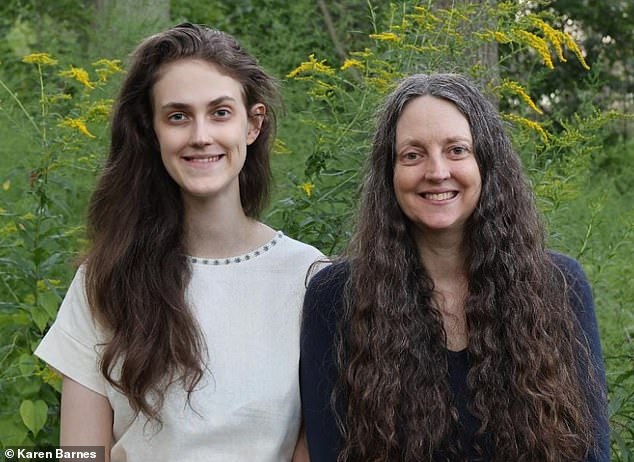
Karen Barnes (pictured, right, with her daughter, left) has spent the last ten years cultivating a naturalized garden in the front and back yards of her home in Burlington, Canada

She shared images of her garden on a fundraiser to protect it from being demolished by the city

She spreads wildflower seeds, allows natural species to spring up and avoids mowing her plants in a bid to draw wildlife such as monarch butterflies (pictured)

Barnes also plants milkweed, which is the only plant that monarch butterflies lay their eggs on and is also the only plant that the species’ caterpillars eat
She has created a legal defense fundraiser on the platform Small Change Fund, which is framed as a way to create a precedent to protect ‘Canadians’ rights to freedom of expression through gardening.’
The campaign has raised nearly $9,000 of its $30,000 goal as of Monday afternoon.
‘To me, it’s really absurd that the city would take me to court for growing a garden,’ Barnes told the Toronto Star.
‘It’s not just about me, but it’s about the wildlife that I’m trying to save,’ she added.
Barnes’s defense against the city rests on an exception to the bylaw for naturalized areas, which are defined as ‘an area or vegetation deliberately planted or cultivated with one or more species of wild flowers, shrubs, annuals, perennials, ornamental grasses, or combination of them, that is monitored and maintained by a person.’
The animist’s lawyer has argued that her yard falls under that definition and claims that city officials have not clearly explained or given evidence on how it does not.
In 2024, Burlington’s manager of bylaw enforcement, Adam Palmieri, asked the city’s supervisor of landscape architecture, Nick Pirzas, to join a visit to Barnes’s yard.
Pirzas identified just three species as ‘invasive’ or ‘aggressive,’ but simply offered suggestions to maintain them further rather than a mandate to remove them.

Barnes said that the fight to save her garden is also about saving the wildlife that lives in it. This picture from her fundraising campaign shows an insect feeding on one of her plants’ pollen

Burlington (pictured) authorities have forcibly mowed Barnes’s garden on two occasions and shown up at her house several times to address neighbors’ complaints

Barnes has created this fundraiser, which is framed as a way to create a precedent to protect ‘Canadians’ rights to freedom of expression through gardening’
‘Overall, most species noted are good (and native) for this type of application and some are fast growing so they may overtake the grass over time,’ he wrote.
In a follow-up report, he explicitly said the garden fell under the definition of a naturalized area, though it was not ‘meticulously maintained.’
But Barnes’s lawyer emphasized that the word ‘meticulous’ does not show up anywhere in the bylaw exception’s definition.
He also said that his client’s actions, such as installing wire fencing to contain the plants, removing fallen leaves and dead stalks and tying back vegetative growth, all fall under the requirement that a naturalized area be ‘monitored and maintained by a person.’
Barnes seems to believe that the objections to her garden stem from an issue of aesthetics rather than any legal or practical reasons.
‘Ecological gardeners will often garden for function rather than look,’ she told the Toronto Star.
In a statement, the city of Burlington told the publication that it ‘cannot comment on individual cases,’ though it added that it is ‘supportive of naturalized gardens.’
‘Naturalized gardens do not mean abandoning lawn maintenance altogether,’ the statement said.

Barnes nurtures aster flowers in her garden, which is a primary source of food for monarch butterflies

Monarch butterflies are endangered, and Barnes began her efforts to create a naturalized garden in large part to help the species
‘Leaving grass and other vegetation to grow naturally without any maintenance can be harmful to surrounding properties and the environment. It can result in the introduction of noxious or invasive weeds, bugs, and pests.’
The statement also noted that the harsh enforcement Barnes is currently facing only occurs ‘after all avenues are exhausted.’
The city also said it wasn’t aware of the pending $400,000 in fines and that the final determination on the financial penalty would take place in court.
The Daily Mail has reached out to the Burlington government for additional comment.
For her part, Barnes has said that she will not be backing down from her fight with the city.
Comments are closed.