
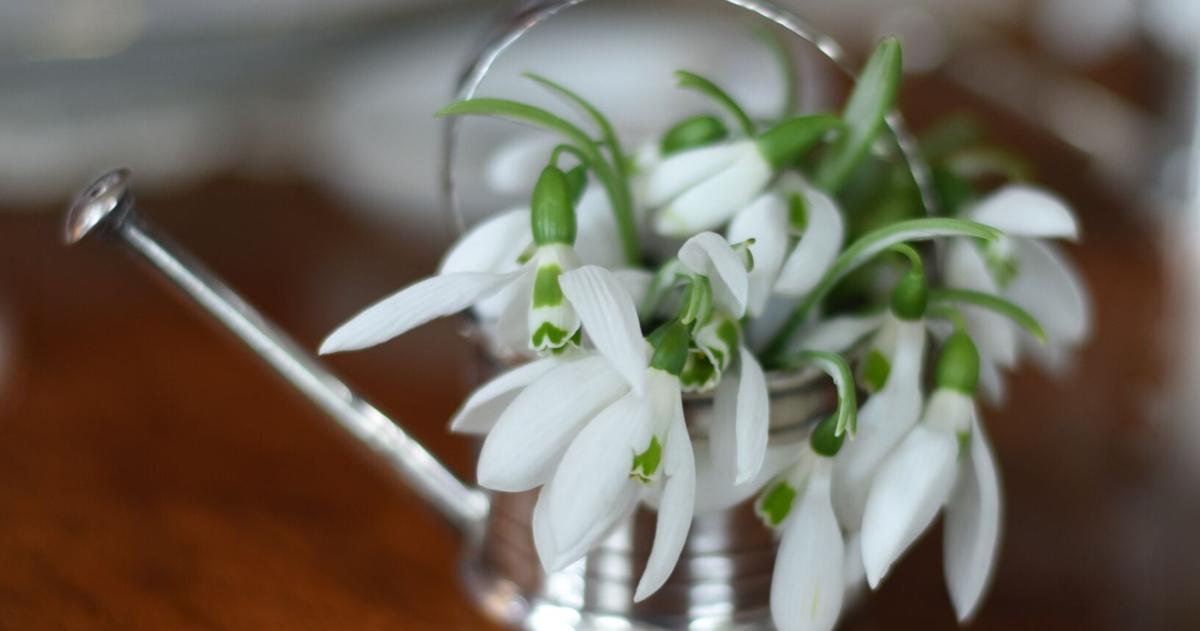
The sight of snowdrops poking bravely up through a carpet of soggy, fallen leaves brings cheer to us gardeners in the winter. These dainty little flowers are understated and refined. They are one of the winter garden’s greatest small miracles.
When most of the garden looks like it has given up and gone to sleep, these little white flowers show up uninvited, nodding politely as if to say, “Good morning. Yes, we know it’s freezing.” The sweeping clumps of dazzling, white, bell-shaped blooms begin flowering in my garden as early as November and keep going until late February, long after my enthusiasm for winter has worn thin.
Snowdrops (Galanthus) are dainty, but tough. Their dreamy flowers have green-tipped inner segments that stand out sharply against the brown leaves and gray winter landscape. Each bulb produces two to three narrow green leaves that grow about 4-6 inches tall. They are small plants, but what they lack in size they more than make up for in charm. Seeing them in bloom feels like discovering that winter has a secret sense of humor after all.

My first true encounter with them came later, in the garden of Nancy Goodwin in Hillsboro, N.C. Nancy had drifts — no, seas, of snowdrops.
Betty Montgomery/Provided
Growing up, my mother had a lovely garden. Though not very large, it was magnificent in my eyes. She grew many different bulbs that bloomed in late winter and spring, but for reasons unknown she did not grow snowdrops. My first true encounter with them came later, in the garden of Nancy Goodwin in Hillsboro, N.C. Nancy had drifts — no, seas, of snowdrops. Thousands of them. Walking through her garden felt like stepping into an enchanted woodland where winter had been politely overruled.
Nancy was well-known for this magical display. Over the years, she spent countless hours dividing bulbs and spreading them along a woodland path until the snowdrops formed a breathtaking river of white. Nancy once said she spent most of her gardening time in winter on her hands and knees, because many winter flowers are so small you have to get down low to appreciate them. Snowdrops teach patience, humility and the importance of knee pads.
Snowdrops are perennial plants that will multiply and spread over time, quietly and without drama. Deer and other wildlife avoid them completely, which immediately earns them a gold star in my garden. I have planted snowdrops in areas where deer regularly roam, and they have never been touched.
Snowdrops prefer cooler climates, light shade and rich humus soil, but they are surprisingly adaptable and tolerant of different soil types. Once planted, they require virtually no attention. They are the introverts of the bulb world: happy to be left alone and perfectly capable of thriving without fuss.
Their dreamy flowers have green-tipped inner segments that stand out sharply against the brown leaves and gray winter landscape.
Betty Montgomery/Provided
That said, if you want more snowdrops — and who wouldn’t — you can divide them. The other day, I dug up a clump that had bloomed in November and found about 30 small bulbs nestled together. I divided them and replanted them along a woodland path so they could be enjoyed in several places, just as Nancy had done. Spring is the best time to divide snowdrops, usually a month or two after flowering finishes. Gently separate the bulbs and replant them in fresh soil to maintain their vigor. You don’t have to do this, but it’s an easy way to spread the joy. The bulbs are small, need to be planted shallow and always cooperative — rare traits in gardening.
Snowdrops require some cold weather in order to bloom, which is why you don’t see them much in the Deep South. These bulbs are offered in catalogues for fall planting, just like when tulips and daffodils are offered. Because these bulbs only have to be planted 2-3 inches deep, and 3-5 inches apart, they are easy to plant. Because they are short plants, they make the biggest impact when planted in groups of at least 25. A lone snowdrop is charming; a crowd is magical. They look especially lovely planted along garden paths, in woodland settings or in rock gardens where the conditions are just right.
These woodland treasures are herbaceous perennial plants that grow from bulbs and prefer humus-rich, well-drained soil. If your soil is heavy clay, mix in organic material to improve drainage, especially during their dormant season. Snowdrops do not like wet feet at any time.
Spring is the best time to divide snowdrops, usually a month or two after flowering finishes.
Betty Montgomery/Provided
Native to Europe and the Middle East, snowdrops are wildly popular in England and Scotland. Entire gardens are devoted to them, and visitors flock to see naturalized carpets of white blooms. There are even snowdrop festivals — proof that gardeners can celebrate absolutely anything if flowers are involved. Fortunately, you don’t need to travel overseas to enjoy them. Notable collections can be found at the Chicago Botanic Garden, Montrose Garden in Hillsboro, N.C. and the Winterthur Garden in Delaware.
Snowdrops are often confused with snowflakes (Leucojum), but they are different plants. Snowflakes bloom later, are larger and usually have five or six flowers per stem, while snowdrops typically have just one bloom per bulb. Snowflakes are also more common in the South. Both are wonderful, but if you want a flower that blooms in the dead of winter, snowdrops are the clear winners.
There are 19 known species of snowdrops and about 500 named forms. The most common and easiest to find are Galanthus nivalis, the common European snowdrop, and Galanthus elwesii, a Mediterranean species. Both are delightful, and I am grateful I discovered them. They are available from summer through fall at specialty bulb importers such as Brent and Becky’s Bulbs and John Scheepers, whose catalogs are as beautiful as they are dangerous to one’s budget.
Snowdrops will cheer you up on cold, gray, bleak winter days and gently remind you that even in the quietest season, the garden is still very much alive — and plotting something wonderful.
Comments are closed.