

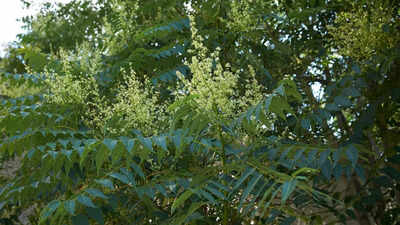
 Tree of heaven, Ailanthus altissima, is often noticed only after it has begun to dominate a space. In domestic settings, it may appear as a volunteer sapling emerging beside a wall, shed, or compost area, growing faster than surrounding shrubs and trees. Its speed of growth and apparent toughness can give the impression of a useful garden tree, particularly in areas with compacted soil or poor drainage. Its presence has increased alongside urban redevelopment, infill housing, and transport infrastructure. Scientific attention has followed this spread, not because of visual impact, but because repeated observations link the species to persistent ecological, structural, and health-related effects around homes.
How can the tree of heaven be identified and located
Ailanthus altissima is a deciduous tree with a straight trunk and an open crown that becomes broader with age. Mature trees commonly reach 20 metres and can exceed this height under favourable conditions. The leaves are among its most distinctive features. Each leaf is pinnate and can be more than half a metre long, composed of numerous oval leaflets arranged along a central stem. Near the base of each leaflet are small glandular lobes that exude chemical compounds. When the foliage is bruised or crushed, these compounds produce a strong odour that is widely reported in urban surveys.The bark of young trees is smooth and pale grey, marked with lighter vertical lines. As the tree ages, the bark becomes darker and develops shallow fissures. Flowering takes place in early summer. Male and female flowers are usually borne on separate trees. Female trees produce dense clusters of winged seeds, each seed encased in a papery structure that aids wind dispersal. These seed clusters often remain attached well into winter.Ailanthus is most commonly found in cities and towns rather than in rural woodland. Established populations are well documented in London, Greater London boroughs, and parts of the South East, with additional records in the Midlands, southern coastal towns, and industrial areas further north. It frequently colonises railway embankments, roadsides, canals, derelict land, and housing developments. Its ability to tolerate air pollution, heat, drought, and nutrient-poor soils supports survival in heavily modified environments where other tree species fail to persist.
What biological traits make the tree of heaven risky
Research into Ailanthus altissima has documented a set of biological traits that create long-term problems when the tree is deliberately planted near buildings or gardens. These traits have been recorded through field measurements, laboratory analysis, and long-term monitoring rather than assumption. A synthesis of this research, drawing together experimental and observational studies, is reported in peer-reviewed literature published in Plants.The tree of heaven exhibits the following features:It rapidly develops a vast root system that not only extends laterally far beyond the crown of the tree but also goes deep into the cracks, joints, and voids of the structures.It has a high potential for vegetative propagation, as roots can give rise to new shoots after the area is cut, pruned, or disturbed.Release of allelopathic chemicals such as quassinoids from leaves, bark, and roots has been shown to suppress germination and early growth of other plant species.Very high seed production by mature female trees, with large numbers of wind-dispersed seeds capable of travelling considerable distances.Strong regenerative response following mechanical damage, with repeated cutting associated with increased shoot emergence rather than decline.These features have been measured under controlled conditions and in urban field sites. They explain why the species persists and expands once established, particularly in confined residential plots.
How does the tree of heaven affect homes and gardens
The biological traits of ailanthus, when planted in a domestic environment, will eventually affect the buildings, soil, and neighbouring land. The effects are often delayed, becoming more evident as the tree matures and its root system expands. Observations from residential areas show that impacts may continue long after above-ground growth has been removed, due to the survival of underground structures.A tree of heaven affects homes and gardens in the following ways:The damage to patios, driveways, boundary walls, and drainage systems is generally associated with the penetration of roots and their subsequent pressure under hard surfaces.Repeated regrowth after removal, with dense clusters of suckers growing in lawns, flower beds, and along fences.Long-lasting alteration of soil conditions beneath and around the tree, with reduced establishment of replacement planting linked to residual chemical compounds.Spread beyond the original planting site through seed dispersal and root extension, leading to establishment on neighbouring properties and public land.While flowering, the tree emits pollen and volatile organic compounds, and some individuals may experience headaches, nausea, dermatitis, and respiratory irritation.These effects have been documented through site inspections, soil sampling, vegetation surveys, and health-related case reports. In small gardens and densely built neighbourhoods, the interaction between the species’ growth patterns and limited space intensifies these outcomes, leaving enduring physical and biological changes within the residential environment.Also Read | Is the air purifier in your home making you sick: 5 safety usage tips that no one talks about
Comments are closed.