
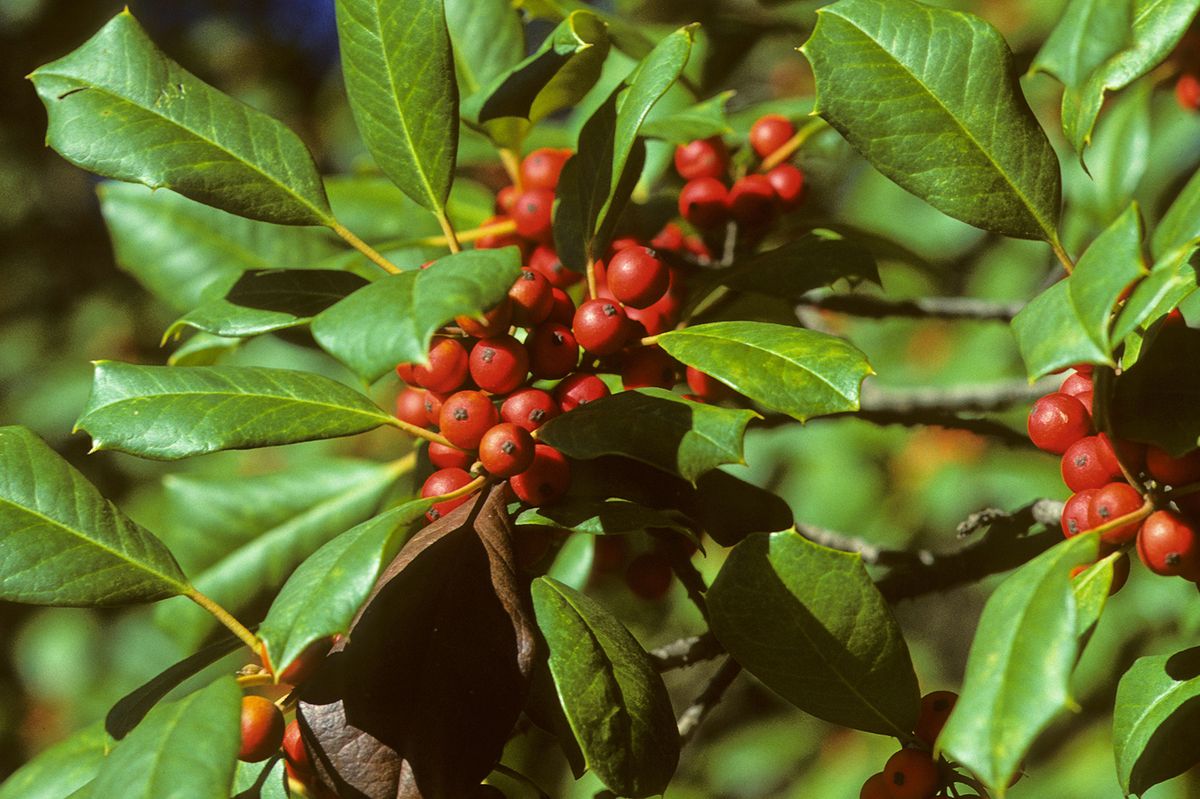
Native along the entire East Coast and west to Missouri and Texas, this slow-growing, pyramidical holly can reach 25-60 feet tall at maturity. Also known as Christmas holly, the spiny-leaved plants are hardy in zones 5-9, tolerating both sun and shade but requiring acidic, moist, well-draining sandy or loamy soil.
Blue holly (Ilex x meserveae)
Also called Meserve holly, this generally well-behaved European hybrid has blue-green spiny leaves and grows 2-8 feet tall and 6-8 feet wide, and larger in some climates. Suitable for zones 5-7 (possibly 8), the shrubby plants should be planted in full sun to part shade in well-draining, moist, acidic soil.
Winterberry holly (Ilex verticillata)
Unlike the other species on this list, verticillata is a deciduous, not evergreen, plant that loses its foliage in autumn. But don’t discount its winter interest. In fact, the absence of leaves while fruiting is one of its best features, allowing its profusion of red-orange berries to take center stage on bare, thin branches.
Native to the eastern U.S. and Canada, this slow grower tops out at 3-8 feet. Plant it in zones 3-9, in sun to shade and in well-draining, moist, acidic soil.
English or common holly (Ilex aquifolium)
Native to Europe, West Asia and North Africa, English holly is spreading into wild areas and choking out native vegetation from Vancouver to the Pacific Northwest and into California.
Ironically, the qualities that made it a desirable landscape plant when it was introduced to the U.S. in the 1800s — it’s tough as nails, long-lived, evergreen and quick-spreading — are what have led to its categorization as an invasive plant in those parts of the country and a “weed of concern” in many others.
Avoid its use in problematic regions and proceed with caution in others.
Damiano writes regularly about gardening for The Associated Press. She may be contacted at jessica@jessicadamiano.com.
Comments are closed.