
I sincerely hope you’ve all made some garden-related new year wishes! Mine has to be that I can cope better with gardening this year than in 2025, when I struggled after my knee replacement. Can you believe it?
2026 sees me start my ninth year of writing a gardening feature in the paper. From 2017, with a 400-word comment at the base of the gardening page each week and from June 2022, a full page of 800 words with images. That’s a lot of words and pictures over the years! Anyone interested in reading any of them can view them all on my website on the ‘my published writing’ page.
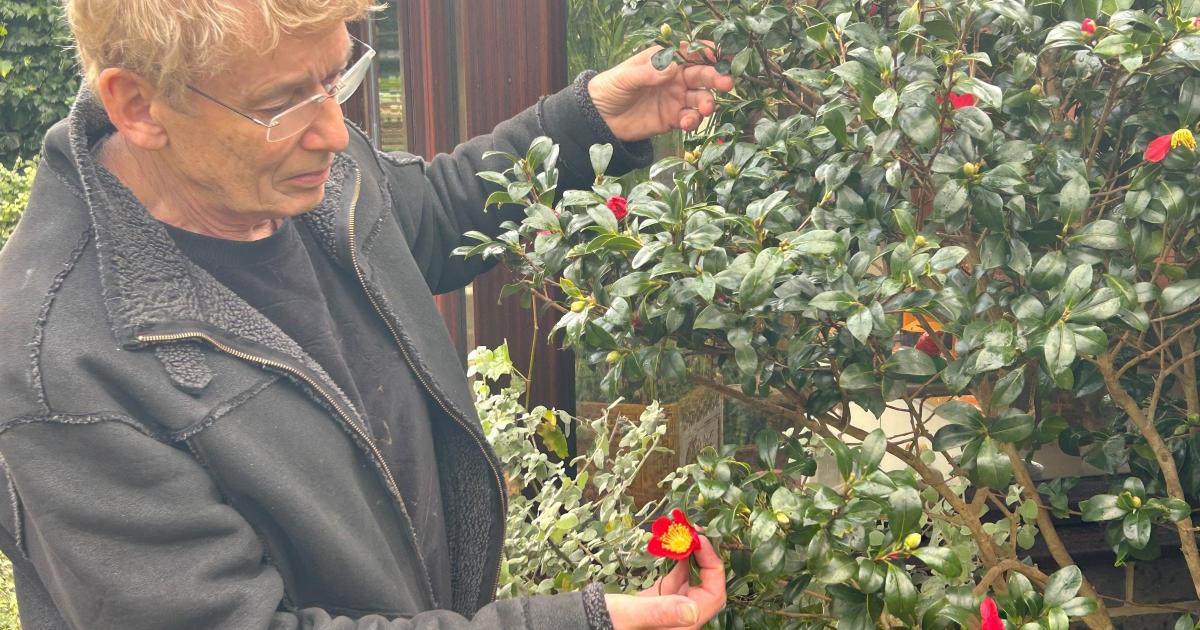
Starting to look good in my garden this week is the pretty camellia Yuletide, planted in a large container at the back of the house on a north-facing wall. You can see quite a few flowers already out, with many more to bloom.
Known to some as the ‘Christmas Camelia’ because it blooms from November to February, thereby adding its scarlet colour to the season both in your garden and as cut stems for a vase inside your home.
Flowers will flamboyantly cover the glossy, dark green foliage for up to four months and are further enhanced by a crown of golden stamen in the centre.The plant is native to China and Japan, sasanqua-type camellias were introduced to Europe in the early 1800s, becoming ever popular over the generations.
The flowers are smaller, yet equally as prolific as their cousins, camellia japonica, and form generous trees or shrubs, dependent upon variety and pruning, though their natural shape is pyramidal. ‘Yuletide’ will mature to a height of three metres, with a spread of 2.5 metres. It prefers to be planted in moist, well-drained soil of any kind except chalk based. I’ve had mine for 15 years now!
Another pretty bloomer at this time of year is the hellebore argutifolius that I mentioned before Christmas, there are many blooms appearing on the plants in the beach garden now.
A few years ago, I had three magnificent echium flowers in the front garden. Echiums are related to borage and share similar characteristics, such as hairy stems and leaves, and nectar-rich flowers which are loved by pollinating insects. There are around 40 species of echium that grow across Europe and Asia but mine were Echium pininana or tree echium, which can grow to around 5m.
The taller varieties originate from the Canary Islands, but can grow in milder, drier parts of the UK as long as the soil is free-draining and they receive plenty of sunlight. In the right conditions echiums will self-seed prolifically, colonising your garden if allowed to. Well, I did get quite a few seedlings appear and last winter, I covered them in situ, in the hope they would make it through the winter. Sadly, they did not, so last autumn I lifted two of the largest ones and potted them up and placed them in the heated greenhouse. So far, so good as you can see, they took well and hopefully will flourish again when I plant them out in the spring.
A few years ago, I purchased two new shrubs, Escallonia Pink Elle. From early summer the stem tips of this escallonia are crowded with clusters of tubular pink flowers that are larger than most cultivars. This neat, compact shrub has a pleasing rounded habit that makes a fine specimen for borders, and an attractive hedging plant.
The glossy green foliage tolerates salt-laden air making it an excellent choice for coastal gardens. Hardy and undemanding, escallonia is a fabulous low-maintenance shrub. Best grown in fertile, well-drained soil in full sun with shelter from cold, drying winds.
The plant pictured is growing in a raised bed and was getting just a tad too tall for me, so last autumn I gave it quite a severe pruning as you can see. I am now pleased to report that it has begun to produce new shoots, so it should look very pretty again this summer at a more manageable height.
The last few weeks have been either too wet, or dare I say too cold. To be honest, I’ve hardly spent any time outside. I’ve tended to appreciate the garden from my office window in the roof.
That said, on my frequent walks to the top of the plot, to check that the heated greenhouse is maintaining its minimum temperature of eight degrees, on the walk back I can see the grey but lovely view out to the sea, over the green garden gate. You can see there is still much pretty greenery on show too.
Read more of Geoff’s garden at www.driftwoodbysea.co.uk or follow him and the garden on social media.
Comments are closed.