
It is now six months since I had a mini-epiphany and decided that I must join a gym and do some aerobics. I hadn’t done aerobics, or “jumping around” as I like to call it, for probably ten years. Unfazed by this, and feeling more than a little smug at my newfound enthusiasm, I threw myself into various jumping around activities until, one day, I was walking down some stairs and my knee went on strike.
What does this have to do with gardening, you may wonder. Stay with me here, because this is key to my gardening resolutions. My knee involved several trips to physios who told me that, usually, they see this type of injury in January. People make a new year’s resolution to exercise more and throw themselves into it with no preparation until — wham! — something goes wrong. That’s a good description of how I approach garden projects. But not this time.
Almost all my resolutions this year involve the garden. I’ve been in my house for a year and it’s time, finally, for change. My instinct is, as ever, rush in at full tilt. My usual behaviour would be to create a planting plan, go to various garden centres, change the planting plan on the hoof (and not just once), come home with loads of plants, many of which are wrong for a variety of reasons. It’s a waste, really, and this time it’s going to be different.
Resolution 1: Be inspired by the greats
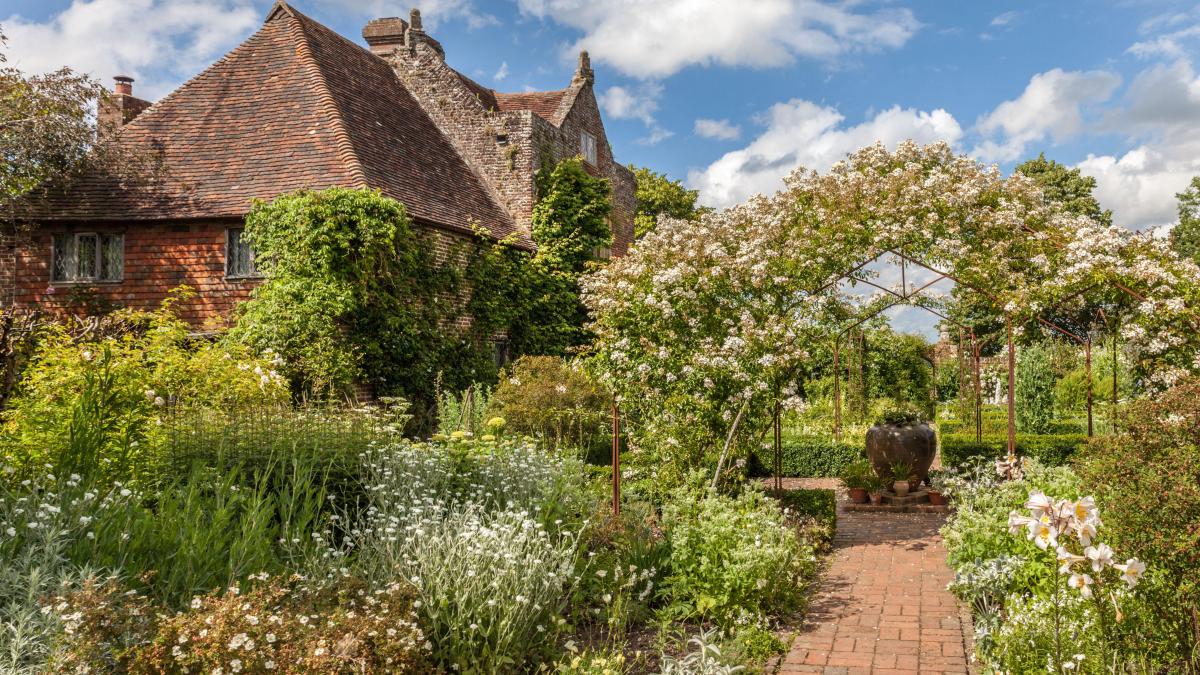
I wrote last year about how Vita Sackville-West devised her White Garden at Sissinghurst in Kent. In the dead of winter, in 1950, she allowed herself to imagine white, grey and green plant combinations and what they’d look like if she was sitting on the bench placed in front of a yew hedge. She wrote down specific plants and how they would look, flow, surprise. She imagined the scene, the atmosphere, the feeling. My little garden may not be Sissinghurst but we are all allowed, in the dead of winter, to sit on a virtual bench and imagine what our dream garden would look like and which plants would be part of it.
• My top 21 winter gardens to visit
Resolution 2: Be bold and go large
At a recent Gardener’s World Live Event, Monty Don was asked for his greatest garden lessons. One was to be bold when it came to design and plants. “You need height,” he said. “The show gardens are really good but one or two of them would be a lot better if they were a bit braver. Just add more height. Go for it. Have really big plants in there. In a small garden, you can do that.” He’s right, of course. Every garden needs height. We need to look up — from whatever we are doing — and remember that. When in doubt, go large.
Resolution 3: No crazy impulse buying
This is my one trait that scuppers so many well-laid plans. I seem to get bedazzled by a plant at a garden centre. For example, I go to buy plants for a shady corner and emerge with sun-loving salvias. There is a fine line with this resolution, though, because I don’t want to be too rigid. For instance, it would have been wonderful to find a magnificent fern (not on my planting plan) as that would have fitted well.
• Our expert’s pick of the gardening podcasts
Resolution 4: Have a garden adventure
I want to do something entirely new this year and so my final goal is to find a tulip in the wild. I was very taken with these smaller species tulips while researching bulbs last year. They grow mostly in mountainous central Asia. I might give Afghanistan a miss but there are plenty of other “stans” to consider. That trip will have to wait until spring — which is good, as my knee should be fully recovered by then.
Do feel free to send me your own gardening new year’s resolutions to gardenanswers@thetimes.co.uk
Gardener’s Question
Q. I would be grateful to know if there is any chance of saving a tree which has honey fungus that appeared in the autumn. They have been dug out but I read the bootlace roots of it may be beneath the tree.
Fiona MacMillan, Aberdeen
A. There is no guarantee that the fungus is in its roots just from seeing the mushrooms nearby, but if the tree also looks like it is in decline you could assume it is, says the RHS senior plant pathologist Jassy Drakovic. Ways to mount a defence against the pathogen include removing plant competition at the base and adding a mulch doughnut, possibly excavating the soil at the base if the tree is planted too deeply.
Comments are closed.