
Breadcrumb Trail Links
OpinionColumn
Published Dec 31, 2025 • Last updated 4 hours ago • 2 minute read
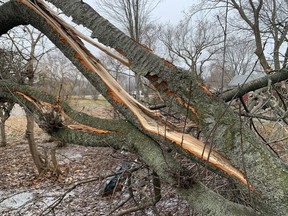 This cherry tree in Sarnia suffered damage during a recent ice storm. (John DeGroot) jpg, CA, apsmcArticle content
Ice storms show us that nature does what she wants to do.
Advertisement 2
This advertisement has not loaded yet, but your article continues below.
Article content
We can look after our trees with care, prune when necessary, fertilize when we want to improve growth and add water when dry. But despite our best efforts, an ice storm can quickly wipe out trees with little respect for the homeowner.
Article content
Recommended Videos
Article content
An ice storm in late December brought down so many power lines that power was lost for a short time almost everywhere in Sarnia. Broken and fallen limbs were everywhere.
We can be thankful that because the ground was frozen, trees were not uprooted.
In my yard, a few limbs of the white pine broke and fell due to weight of ice on its weak limbs.
My neighbour’s yard did not fare as well, with the loss of a substantial sweet cherry tree along with a mature Manitoba maple broken in half.
Trees that have sustained considerable damage should be handled with caution, with the repair job left to professionals.
Advertisement 3
This advertisement has not loaded yet, but your article continues below.
Article content
Using certified arborists assures you that the job is done professionally with adequate insurance in place. If there is no immediate danger, allow ice to thaw naturally before taking action.
If damage is minimal and you are hesitant to hire an arborist, take the time to inspect the tree for split trunks or branches that have been broken and have not yet fallen.
Prune broken limbs back so they are nearly flush with the main larger stem. Be sure to gear up with safety googles, boots and gloves. Don’t climb a ladder unless you have a spotter.
If less than 50 per cent of your tree’s crown is still intact, your tree might be salvageable. It may be helpful to do some additional pruning in the tree to achieve balance and restore strength.
Advertisement 4
This advertisement has not loaded yet, but your article continues below.
Article content
Weak wooded trees such as poplars, silver and Manitoba maples and willows will sustain most damage after an ice storm, often with many small broken limbs that require cleanup. Evergreens will usually fare okay, as their branches are quite pliable.
Bent trees should be left alone after an ice storm. I have seen straight white pine trees buckle over to the shape of a horseshoe, only to recover in spring.
If your evergreen has a damaged top, prune above the next set of limbs and your tree will form a new central leader.
Recovery and regrowth of trees damaged by ice is dependent on the tree’s health and on pruning and care of the tree.
Trees are resilient. If all goes well, within a season or two the tree will produce enough new growth for the tree to fully recover.
Article content
Share this article in your social network
Comments are closed.