
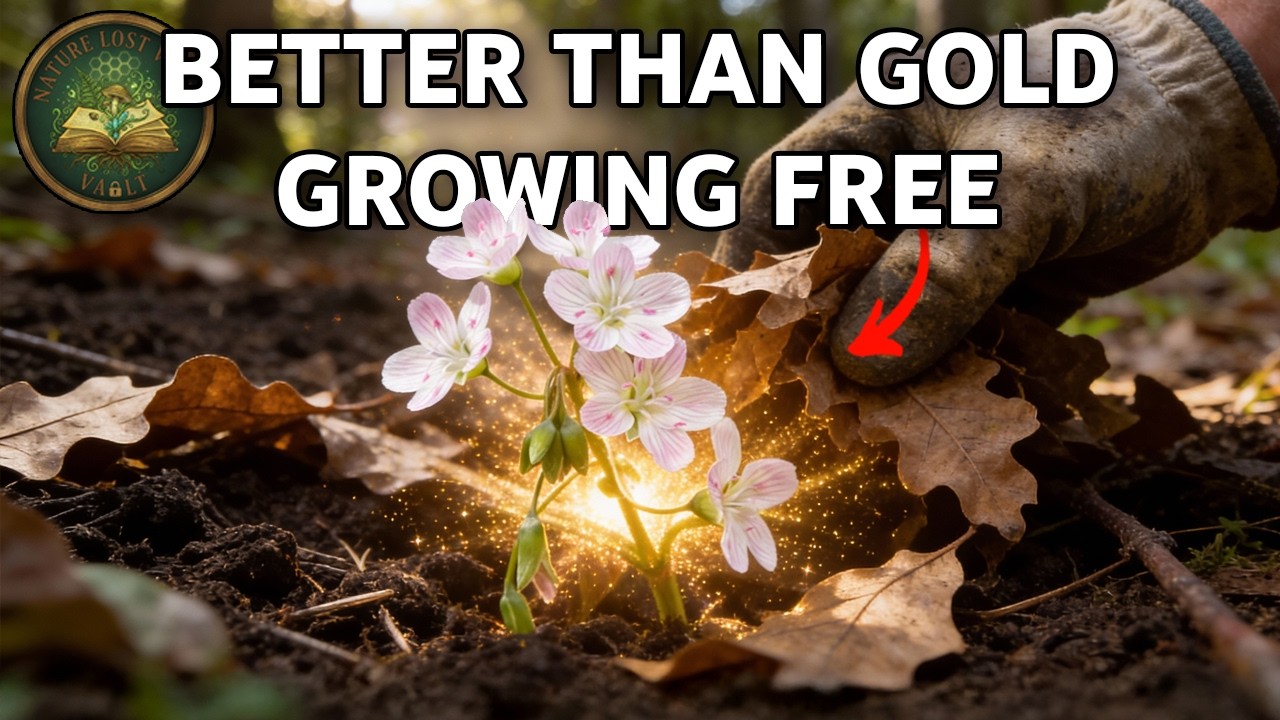
The Potato That Tastes Like Candy. Why Can’t You Buy It?
There is a potato growing wild across eastern North America right now that tastes better than anything you will find in a grocery store. Native American children called it “underground candy.” Gold rush miners credited it with saving their lives. And legendary forager Euell Gibbons ate it twice daily, claiming it was sweeter and better than any cultivated variety.
So why isn’t it sold in stores?
This is the story of Spring Beauty (Claytonia virginica)—the “Fairy Spud” that we abandoned for the Irish Potato.
The answer has nothing to do with taste and everything to do with control. In this episode of Nature’s Lost Vault, we uncover the history of a 10,000-year-old food system that valued wild abundance, and how it was replaced by an industrial model that demands uniformity. We explore the nutritional data that shows Spring Beauty contains double the digestible sugars of modern potatoes, and we ask the uncomfortable question:
Why are we spending billions to genetically engineer “climate-resilient” crops when the perfect potato is already growing wild beneath our feet?
📚 SOURCES & FURTHER READING:
– Yanovsky, E. & Kingsbury, R.M. (1938). “Analyses of Some Indian Food Plants.” Journal of the Association of Official Agricultural Chemists, 21(4), 648-665. (Source for the reducing sugar/starch data).
– Gibbons, Euell. (1962). Stalking the Wild Asparagus. David McKay Company.
– Moerman, Daniel E. (1998). Native American Ethnobotany. Timber Press. (Details Iroquois and Algonquin usage).
– Kinder, D.H., et al. (2017). “Nutritional Quality of the Wild Potato Solanum jamesii.” Journal of Food Composition and Analysis.
– Balenquah, Lyle. (Hopi Archaeologist). “The Potato of the Four Corners.” (Commentary on intellectual cultural property).
⚠️ DISCLAIMER: This video is for educational and historical purposes only. Always properly identify plants before consuming. Spring Beauty is a small, slow-growing perennial; foraging should be done sustainably and only where populations are abundant and legal to harvest.
🔔 SUBSCRIBE for more forgotten plants that industrial agriculture tried to bury.
#SpringBeauty #Foraging #FoodHistory #NativePlants #Permaculture #WildFood #NatureLostVault
29 Comments
❤😊 How far north can this plant be found ??
❤❤❤❤❤thank you for the knowledge and teaching of food that is truly nutritional and healthy
It is easy to understand why the potato won out. More flesh per individual unit, less cleaning needed, easier to harvest larger volumes.
He says "a skilled forager can collect a double handful in an hour."
Compare that to
In a good potato patch an unskilled doofus can collect three to four bushels in an hour.
yeah, yeah, but why can’t I find it as a starter plant or seeds or whatever….
They are the size of a finger tip and when harvested don't grow back easily
Irish Potato?
They came from Peru to Ireland.
This Plant is not found here in India (Sikkim)
Gibble Euings used to hang out here and party in the 70s. E TN mountains…over in Unicoi County
No way we can't come up with a way to mechanically harvest these things! We gave up too fast.
Thank you again for this amazing information, I’m shocked! 😊
I have a front yard full of these every spring! Can't wait to taste some; I had no idea!
1:09 "the Irish potato"? wth is an Irish potato?
They are called yams
YOUR KNOWLEGE LAVEL IS NEXT
❤11.11❤😊
“Irish” potatoes are American. The Irish did not have potatoes prior to the European settlement of the Americas.
Whatever those flowering plants are, they are not potatoes. They are some sort of tuber or root, but definitely not potatoes.
First time that I have run across your videos. Excellent, interesting work. I'm so glad that I watched this because it reminded me of the works of someone I read as a 12 year old, Eull Gibbons. That man's book amazed me & forced my family to endure many wild plant experiments. Dandelions were my favorite ingredients. Thank you for the memory key. ☺️
FYI: Golf rush was NOT in eastern U.S.
I wonder if there could be grown hydroponicly?
I wonder what kind of fries these mini spuds would make?
Irish potatoes? All potatoes were indigenous only to the Americas, along with numerous others…peppers, tomatoes, corn, squash, beans…just to name a few.
🥰🥰🥰🥰🥰
Technically all real potatoes originate in the Americas.
It's in the south too we have it here in Arkansas everywhere
They're not practical for sustenance in a modern setting because we don't have time to forage and process them. Good for a treat but not daily menus.
IM HERE TO CORRECT AN ERROR, THEY WERE "EUROPEAN IMMIGRANTS" YOU CAN'T SETTLE A LAND THAT WAS ALREADY INHABITED. YOU COULD IMMIGRANTS COMING TO AMERICA TODAY WOULD ALSO HAVE TO BE CALLED "SETTLERS" .
I just checked and couldn't find any seed for any plants describeyd in this video in Oklahoma. (Although I may have a line on ground nuts.)
I got these growing and spreading in my yard. Need to try them out this spring.
I wonder if you burn too many calories harvesting them, though. Would be interesting to try growing these in garden soil and see what the harvest looks like.