
Botanical plants and natives sit together comfortably, with the style, he said, representing a development from a Mediterranean garden. Some natives favoured by Wyer include species such as banksia integrifolia, lomandra, casuarina “Cousin It”, pandanus, agaves, dragon trees.
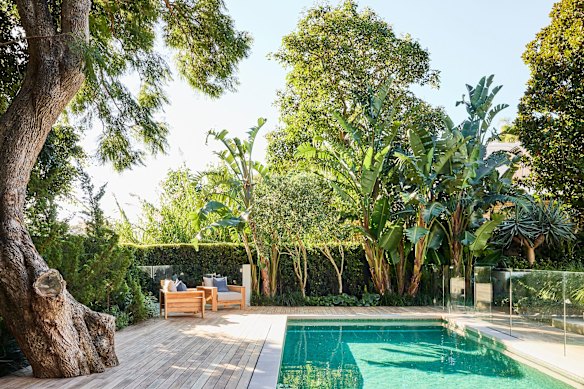
Jacaranda House in Rose Bay – botanical plants and natives sit together comfortably.Credit: Pablo Veiga
“The design is for it to have impact, shades of colour going through it, accent plants … have grasses in that move with the wind,” Wyer says of the two gardens.
Loading
“Beautiful, feature trees that have impact [in the] day, and also when it’s lit up at night. Sydney-style garden is a real vibe, a relaxed vibe.”
Still, there are differences between the two gardens.
Modern Classic has a clear architectural framework and a richly layered planting palette. It contains spaces designed to be used every day, Wyer says. Jacaranda House is leafy and “intentionally relaxed”, he says, with a variety of botanicals. It was one of Wyer’s earlier incarnations of the “Sydney style”.
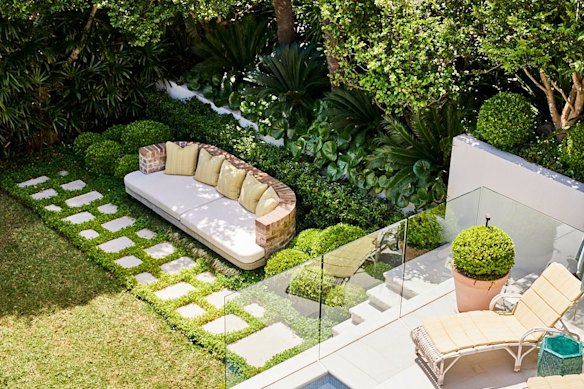
Modern Classic in Vaucluse is an example of a Sydney-style garden.Credit: Pablo Veiga
While Jacaranda House and Modern Classic are a walk away from the harbour, another garden in the book, Cove Garden in Point Piper, is harbourside.
The garden, also in the eastern suburbs, has a “beautiful aspect” and is on a “good-sized block”, Wyer says. The plantings include olive trees, camellias, bougainvillea and buxus balls.
“It’s a Sydney-style garden, leaning more towards the botanical side of things,” he says. “It has colour spread through it.”
Uniting Wyer’s designs is an intention to highlight a unique or standout feature of the space. For those living near the harbour, this may be a water view. But elements of the “Sydney style” can also be emulated further from the coast.
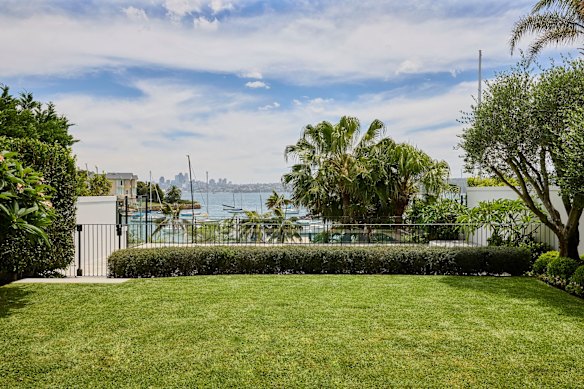
Cove Garden in Point Piper has a view of the harbour.Credit: Pablo Veiga
“All those principles stay the same,” Wyer says. “But quite often with a garden that doesn’t have that view… you’re trying to create privacy and you create rooms within an area. You’re looking for connection from outside to inside.”
For Wyer, planning the space comes first, underpinned by the practical consideration of how the garden will be used.
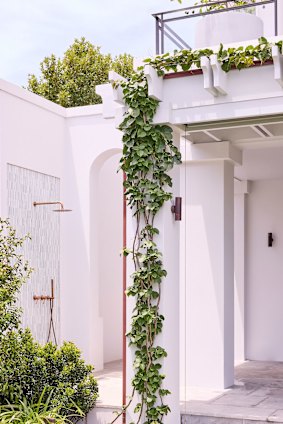
Cove garden.Credit: Pablo Veiga
Some examples of Wyer’s spatial planning include framing views rather than blocking them, using canopy trees or mass planting which creates screening but still lets light in. Layering foliage and level changes can help with a feeling of shelter.
For those wanting to incorporate a “Sydney style” into their own gardens, Wyer recommends layering the planting via a canopy, mid-storey and using ground cover, which he says creates “softness and depth”.
Choosing natural materials including weathered stone, timber and textured materials is another technique. Creating a flow between indoors and outdoors is one of Wyer’s favoured techniques. He says this works even in smaller spaces. A sliding door can make the garden like an extension of the home.
While the book Harbourside Gardens is a snapshot in time as Wyer evolved his “Sydney style” in exclusive postcodes, the designer is working on new ideas.
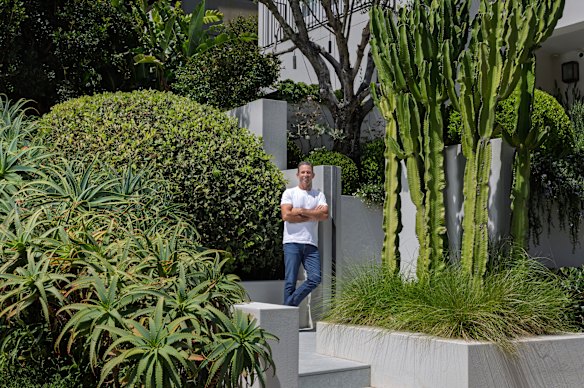
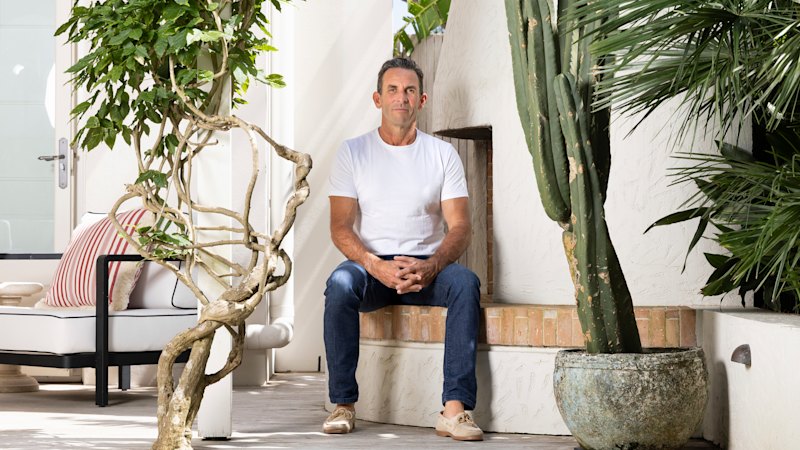
Wyer is use more native plants in his design.Credit: Sitthixay Ditthavong
He is using more natives, with planting styles spanning tropical, dry and formal native gardens.
“There’s more things at our fingertips to use … you’ve got to always push the boundaries,” Wyer says. As his mentor, landscape designer William Dangar advised, there is always the possibility of another book.
Harbourside Gardens is published by Thames & Hudson, RRP $100.00
Comments are closed.