
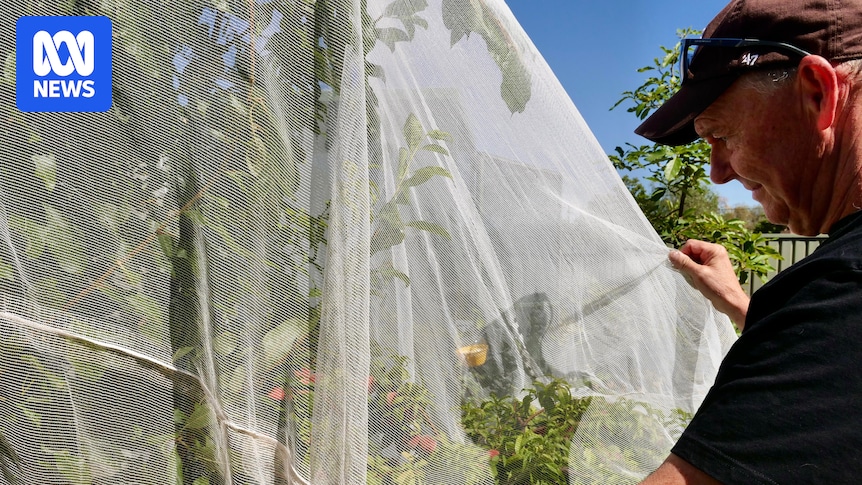
When Pat and Ann Hoare moved into their home on the north side of Broken Hill in far west New South Wales, there was almost no garden to speak of.
Over three decades, they planted about 30 trees, bushes and vines, growing everything from figs, tomatoes and olives to mangoes, nectarines and cherries.

Ann Hoare, along with her husband, has lovingly tended to their garden for decades. (ABC Broken Hill: Kristina Rosengren)
Last year, they decided to remove most of the garden at the front of their house, in large part due to an infestation of Queensland fruit fly, also known as Qfly.
“This is about the fourth year that we have chopped all the trees back to stumps … because of the fruit fly problem,” Ms Hoare said.Where did the fruit fly come from?
Entomologist Andrew Jessup said Broken Hill had no fruit fly population 20 years ago.
“It’s gone from pretty much zero to the point where you can’t even grow a peach or a tomato that doesn’t have fruit fly in it,” he said.
“It’s caused a lot of anger and anguish with the growers, particularly home gardeners, where you can’t even have a nice tomato from your own garden without covering it with a net or putting pesticides on it.”

Fruit flies lay between two and 13 eggs, causing damage to the crop whether they become adults or not. (ABC Rural: Eden Hynninen)
Mr Jessup said the pest’s increase in population was a result of some toxic pesticides being banned and changes in the weather.
“There has been more rain in the summertime in this sort of area, every now and then during La Niña events, than normal,” he said.
“Those conditions create a lot of weed growth, humidity, moisture and relative coolness compared to what it should be, and that’s paradise for fruit flies.”
Broken Hill gardener David De Franceschi has seen his fair share of fruit fly, particularly during summer.

The Queensland fruit fly is about 8 millimetres long and has a wasp-like shape. (Supplied: Peter Rowland)
“It’s not unusual to be bagging fruit, even though you’ve applied some kind of measures, because you’ve just missed one week or you’ve missed a tree,” he said.
“It’s amazing what a problem there is in Broken Hill.
“You wouldn’t think so, being kind of hot and being away from everywhere, but it’s here, and it’s a little bit out of control.”
Keeping the fly out
Queensland fruit fly can be found in New South Wales, Queensland, Victoria and the Northern Territory, and there are active outbreaks in South Australia.
Females sting fruit crops to lay a clutch of eggs just below the surface, with the larvae hatching after two to three days, and in seven to 10 days, they emerge from the fruit to fall to the soil to pupate.

Ryset traps can be loaded with a liquid lure as part of a control strategy, though this one needs to be refreshed. (ABC Broken Hill: Kristina Rosengren)
Damaged crops often appear with small sting marks, with the fruit sometimes softening or rotting around entry and exit points.
There are several ways to try to prevent fruit fly damage, including pesticides, hanging baits, netting and/or bagging individual fruit.
This year, local gardener Darren Hurley has opted for netting and believes it has been working so far.

Darren Hurley is covering his fruit tree in a net for the first time, in the hope of keeping fruit fly out. (ABC Broken Hill: Kristina Rosengren)
His problem with fruit fly started two years ago, when his daughter bit into a peach and discovered a wriggling surprise.
“I was really looking forward to the first fruit to come on the tree, and I was down there having a look at it, and then I noticed it had fruit fly,” Mr Hurley said.
“So for two years now we haven’t had a crop.”
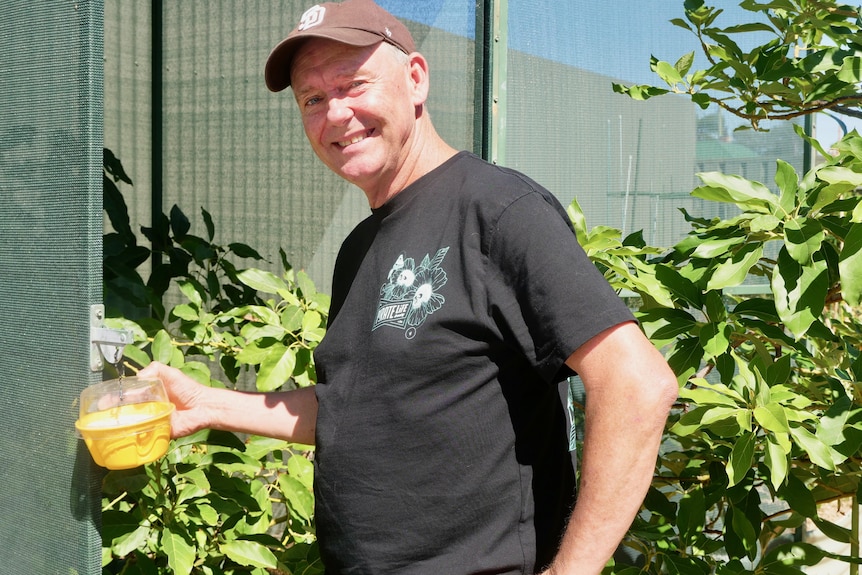
With no fruit fly found in his trap so far, Darren Hurley is hoping he has gotten rid of the pest in his garden. (ABC Broken Hill: Kristina Rosengren)
Mr Hurley has a second property in town with peach trees, but he was too slow with the netting to save the crop this year.
“I think if everyone does their part in Broken Hill, we’re never going to eradicate it, but we can always control it so we can enjoy the fruits.”
Comments are closed.