

How are sculptures born in a city? Everything begins with a question: why do we need it today?
Ukrainian investment company Dovgiy Family Office is implementing the Sophia Park Residents project, revitalizing buildings in the very heart of Kyiv. A key focal point is an evergreen garden, featuring a sculpture dedicated to one of the most influential Ukrainian graphic artists – Heorhii Narbut.
JOIN US ON TELEGRAM
Follow our coverage of the war on the @Kyivpost_official.
Kyiv Post spoke exclusively with Nazar Bilyk – author of the sculptural composition forming the pearl of the space.
Known to Kyiv residents for Rain on Landscape Alley, Bilyk explores through his projects the the connection between humans and nature and the urban environment, working with counter-form and the visualization of space around an object.
Bilyk’s works have been exhibited in Ukraine and are part of collections in France, Germany, the US, Switzerland, Italy, Belgium, China, and Austria. The artist has also become a laureate of a number of international art competitions and festivals.
Kyiv Post (KP): In public spaces, there can be pressure for sculptures to conform to a set of expectations or to have universal appeal. How did you navigate that?
Nazar Bilyk (NB): Indeed, in such projects, a set of expectations appears immediately: to be solemn, to please everyone, or to correspond to an official image. There is a risk therefore of turning into a master who simply fulfills the will of the client. Personally, I never take commissioned works, but this was an exception.
Other Topics of Interest
Defending the Creation
We are the heirs of a generation who built a new world from disaster. This Christmas and New Year are a good time to reflect on their project and commit to advancing it in Ukraine and beyond.
Sculptors are people who work with history. Therefore, my answer is this: it’s less about creating something “so that everyone likes it,” and more honest dialogue with the city and the person. In this case, the Dovgiy Family Office did an important thing: they gave me the freedom to think and search for solutions. This made it possible to preserve my method and honesty.
KP: Where for you lies the point of compromise between a commission and the artist’s vision?
“Compromises are possible in the detail, but not as part of the overall essence.”
NB: There is enormous pressure to protect the essence of the work. For me, as a third-generation sculptor, it is important to preserve and crystallize my approach and to create this dialogue between the image I’m working on and my stylistic vision.
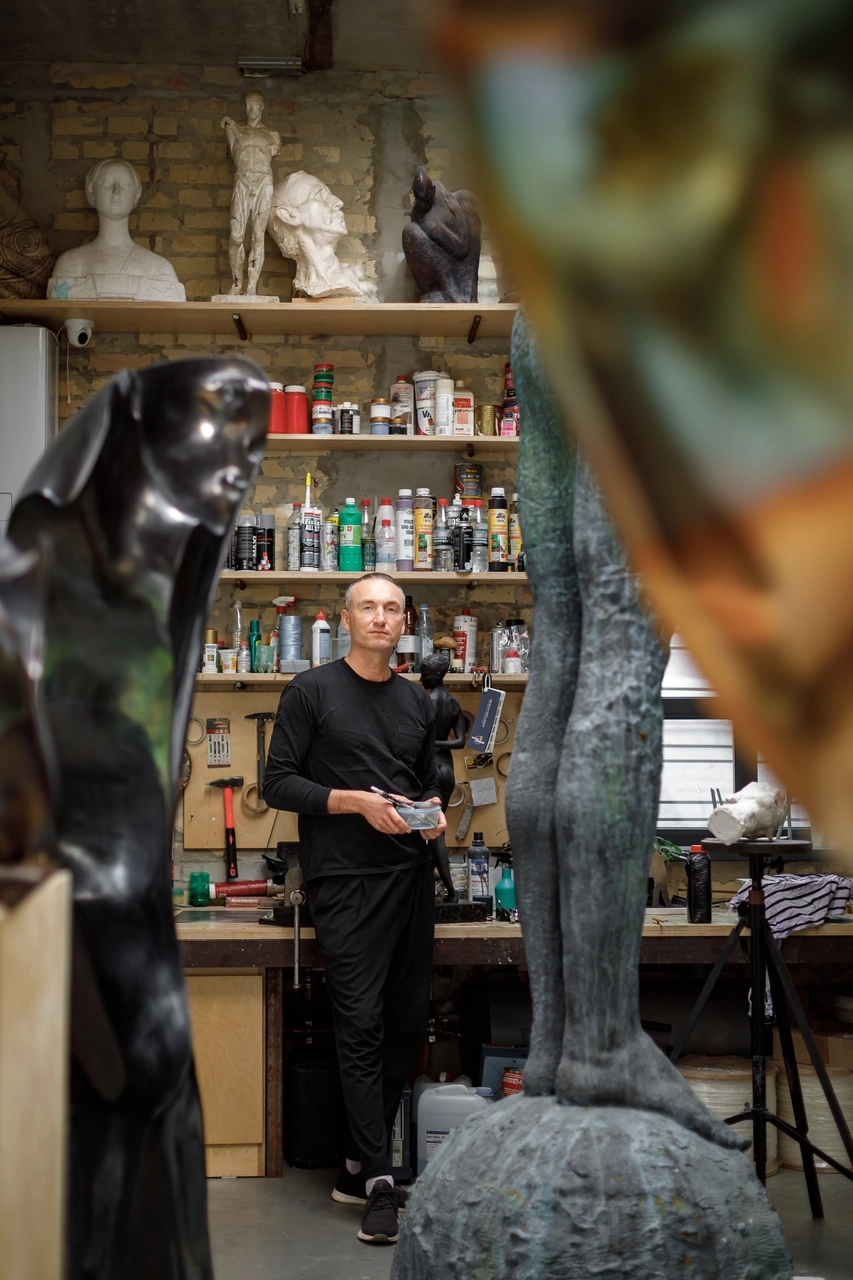 Ukrainian sculptor Nazar Bilyk in Kyiv. (Photo courtesy of Nazar Bilyk)
KP: Why have you chosen Heorhii Narbut as the hero of your new work?
NB: Narbut was an artist who shaped the visual style of the formation of Ukrainian statehood. He drew nourishment from folk art – not by copying it but by translating it into the language of his time. That is why we recognize his works as “our own.” Imagine what a responsibility it is is to work with an artist of such a level. I spent a year studying Narbut’s work – texts and images. And I spent this time in such creative doubts.
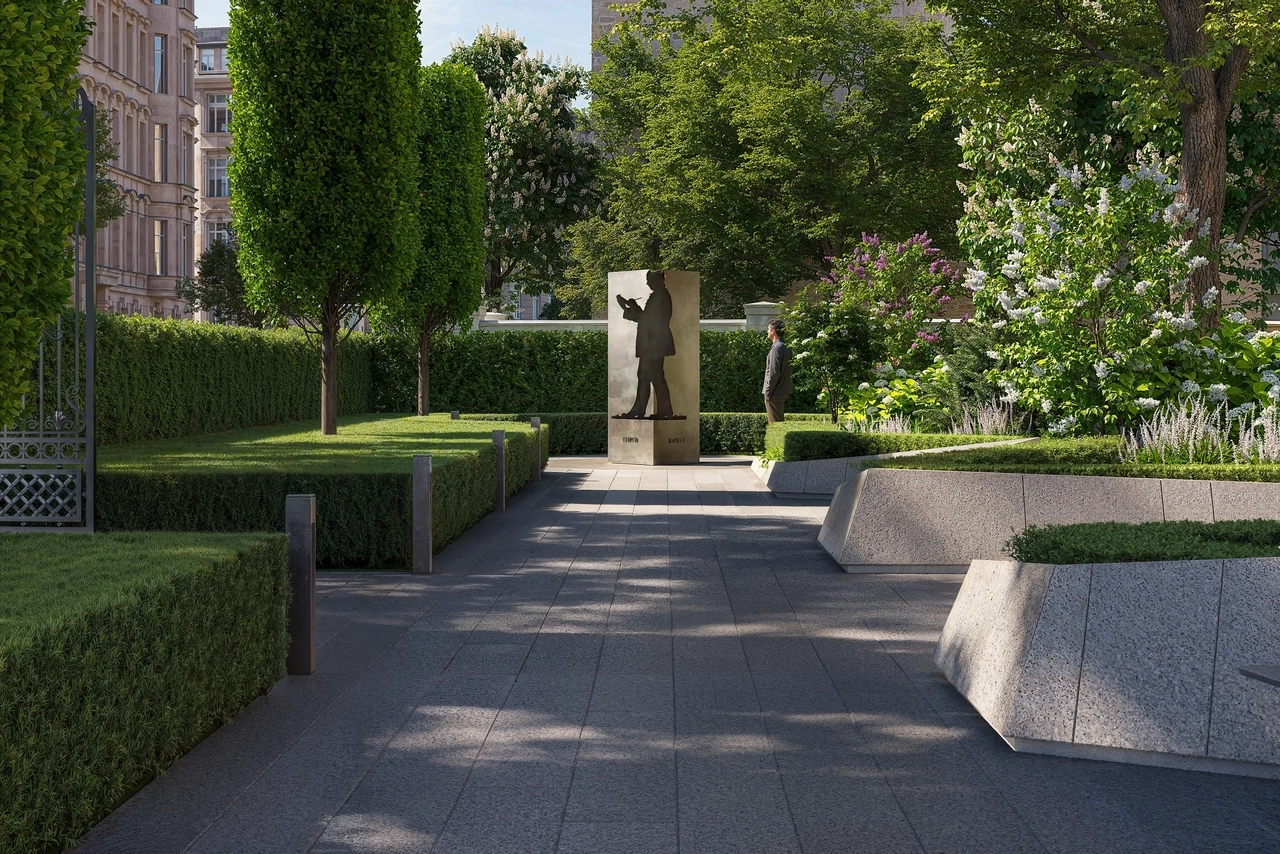 Meta-garden featuring the sculpture of Heorhii Narbut. (Photo courtesy of Sophia Park Residence)
KP: Was this the client’s initiative or your own?
NB: Dovgiy Family Office invited me and gave me freedom in choosing the approach. The decision of what the commemorative marker would look like in honor of Narbut was my conscious choice.
KP: Why Reitarska Street?
NB: This particular street is marked by culture. Narbut lived and worked nearby, his studio was here, and he helped students who worked next to him when the Academy of Arts was closed. Today, Reitarska Street is a living cultural space with galleries and studios.
So, this space already holds within it the memory of Narbut. My task was to make his presence tangible – both for those who know his work well and for those who happen to find themselves here by chance.
KP: The project is called the “Narbut Garden.” Was this also part of your idea?
NB: Yes, a sculptural marker cannot exist in a space on its own: it’s important to create a meaningful space for it. In the dense city center, a “garden” is an invitation to a place of calm and concentration. The name itself appeared early and held the initial impulse: this should be a space where one wants to stay and think.
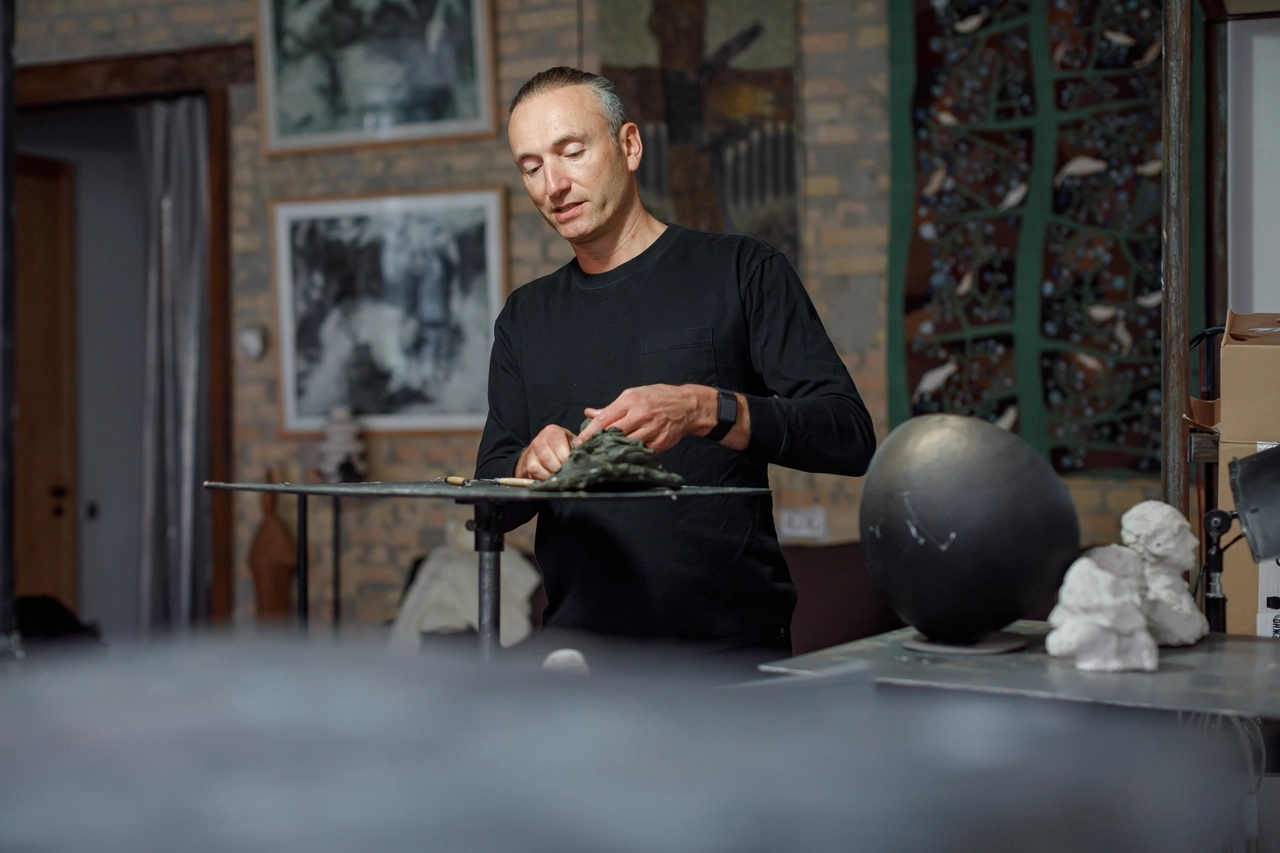 Ukrainian sculptor Nazar Bilyk in Kyiv. (Photo courtesy of Nazar Bilyk)
KP: You said that you worked on the monument for almost a year. Can you say a bit more about the creative challenges you faced?
NB: I wanted to combine things that are practically impossible to combine: Narbut himself and my creative method; also to make him contemporary and at the same time speak in 2025 about a person who has been gone for a hundred years.
Honestly, I broke a sweat while searching for this solution. For a long time, I thought about two options drawn from Narbut’s creative legacy – a stylized flower and a silhouette. In the end, I abandoned direct references to his work since they narrow him down to a “set of techniques.” I wanted to say something about Narbut’s personality, to help him embody himself. I became fascinated by his silhouette drawings where he is together with his family, and how he, as an artist, saw himself. And thus the monument was born, which we presented to the community.
KP: In the images, it is visible that you do not use a pedestal. Is this a “European” approach?
NB: On the contrary. Often in European practice, a monument stands “above” people thanks to a pedestal. And I wanted to open up the figure of the artist. I think this is also a reference to the essence of Ukrainian identity: not to look at the great ones from below upward, but to create a shared, equal space of communication – equality among equals, a new urban reality.
KP: Why did you decide to “shape” Narbut out of emptiness? One can even pass a hand through his figure.
NB: And I insist that people do this – to interact with him and to create him in their imagination. This is important. Plus, take a closer look at the image: from the front, you see a whole silhouette; take a step to the side and it falls apart into “pages,” like the edge of a book. This is not accidental. Narbut created Ukrainian book graphics, so the “book effect” is a bridge to his work. You move, and you “finish drawing” the image yourself. It’s like your own co-creation with me and with Narbut.
KP: Before the interview, you called the Narbut Garden a “meta-garden.” What does that mean in simple words?
NB: It is a new philosophy of interaction – where there is a garden, plus a sculpture, plus you, plus the country. So it’s a shared space of memory. If there are no people in the garden, there can be “no Narbut”; but when we come, move and interact – he is “there.”
The image lives thanks to the presence of the community, which is fundamental. And this is what a meta-garden is. Dovgiy Family Office supported precisely this approach: a space of co-creation “on equal terms,” which, under a memorandum with the community, will be gifted to the city.
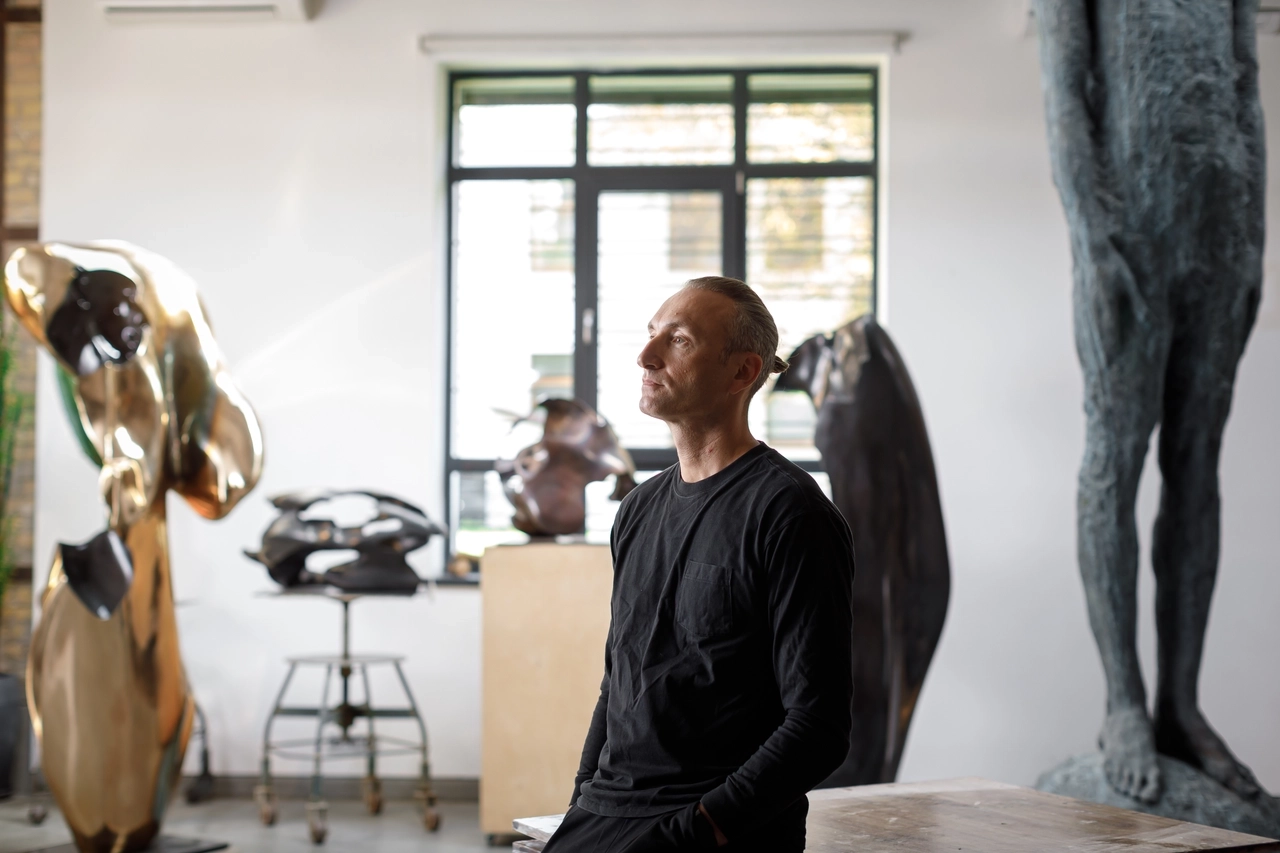 Ukrainian sculptor Nazar Bilyk in Kyiv. (Photo courtesy of Nazar Bilyk)
KP: What is the role of the community here?
NB: Decisive. Without the community’s attention and movement, the image does not appear. This is a monument to Narbut – and to our joint effort. Right now, the space of independent Ukraine has matured to the point where the figure of Narbut is central to it. The surrounding space manifests Narbut and gives him life. Our maturity and our ability to realize the need for his presence gives birth to him for us. We all create him together and we are this space. The space of the garden, the space of Kyiv, the space of our community. This is the whole philosophy.
KP: What do you think will survive over the years from this story and journey?
NB: The ability of the city to see its own people. We live in an independent Ukraine that has matured to not only remember its cultural heritage, but also to begin to see it, to return it to public space. In the case of Narbut, our joint actions work to create that space around him that gives birth to him and manifests him.
The form will endure and the routes may change, but the main thing is that we are creating Kyiv together.
This, by the way is also a dedication to the efforts of Kyiv’s residents – its community and businesses. It may be less obvious, but it is present.
Comments are closed.