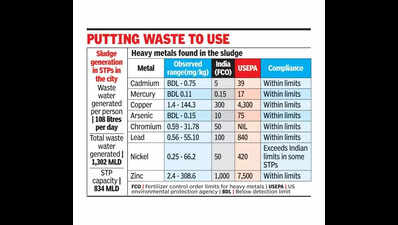
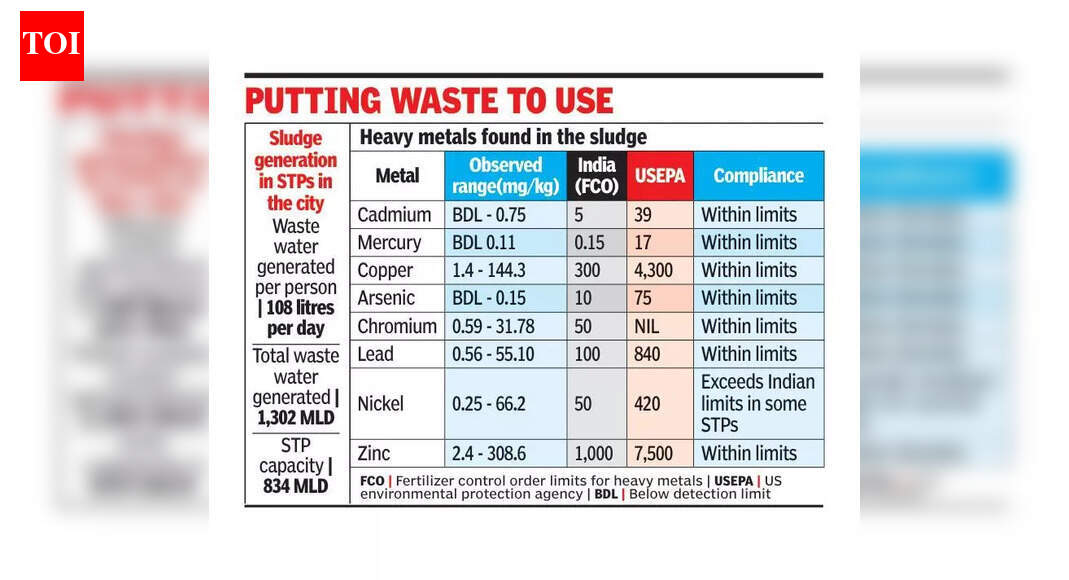
 Chennai: Can we reuse for gardening or agriculture the sludge generated by sewage treatment plants (STPs) in the city? A recent study by researchers from the College of Engineering, Guindy (CEG), says it can be used for non-food agriculture, including gardening and landscaping, after heat treatment to kill pathogens. But the presence of heavy metals, though within acceptable limits, meant it shouldn’t be used for food crops. Researchers from the Centre for Environmental Studies and Centre for Climate Change and Disaster Management at CEG studied the sludge generated by seven STPs, including those at Nesapakkam, Kodungaiyur, and Perungudi. The 14 STPs in the city receive 469 million litres a day (MLD) of wastewater and generate 15 tonnes to 18 tonnes of sludge every day. “The prevailing assumption in Chennai and other cities is that heavy metals are the primary barrier to sludge reuse. Our study overturned the perception as heavy metals such as lead, nickel, chromium, zinc, cadmium, mercury, copper, and arsenic comply with Indian and international standards,” said S Kanmani, head, department of civil engineering, CEG, one of the authors of the study.”Despite acceptable faecal coliform levels, Salmonella species and helminth eggs far exceed permissible limits, making untreated sludge unsafe for agricultural reuse,” said K Saranya, one of the researchers. To bring down the pathogen contamination, researchers suggested methods such as thermophilic composting, lime stabilization, or thermal drying for safe and regulated reuse. “If untreated sludge is used for agriculture or landscaping, it can pollute groundwater and soil. Even after treating the sludge, reuse as fertilizer is not recommended as the accumulation of heavy metals could pose a threat,” Saranya added. The study was published in ‘Environmental Monitoring and Assessment,’ a peer-reviewed scientific journal published by Springer Nature.

Comments are closed.