

Stevie Holland knows exactly what she wants, why she wants it and where she wants it to be.
Such certainty goes for Holland’s voice, a clarion-clear, sultry soprano with a cunningly pointed punctuation that never wants for poise, poignancy and passion is its nuanced delivery. She presents this readily, whether singing through her jazziest songs or her most theatrically directed pieces.
 Even in conversation there’s a happy pithiness to her vocal tone. And though well-heeled in the old school classics of jazz, Broadway show tunes and Tin Pan Alley (she did play Mrs. Cole Porter, in Holland’s self-penned Love, Linda musical), the majority of her most cutting moments are those she’s written with producer-orchestrator-husband Gary William Friedman, with an understanding of what exactly goes where and when. Which is how much of her newest, vine-ripened album Talk to Your Tomatoes (150 Music) came into being.
Thoroughly Modern, Wonderfully Weird
Holland is a thoroughly modern singer and cosmopolitan music-maker who just happens to have a foot in the past. “I’m an old soul,” she says with a broad, loud laugh while alluding to her family — a sax-playing “gardening nut” of a father who taught her Ben Webster solos, an uncle who worked with Fred Astaire — and the thorough inspiration of the first ladies of jazz.
“As a young girl, I listened to Sassy for fun and play, Ella for clarity and beauty, Carmen for her direct approach and [June] and Anita for this other vibe, the wit and witticism of them, to say nothing of their ability to swing,” says Holland of Ladies Vaughan, Fitzgerald, McRae, Christy and O’Day. “You know, the classicists, the wits and the swinging chicks.”
Once Holland ages out of being a kid, studies drama at NYU’s Tisch School, books jazz and cabaret dates and commences to write her own theatre pieces — with and without saxophone-playing Friedman, himself a lion of experimental musicals — is where things get weird. Wonderfully and sophisticatedly weird.
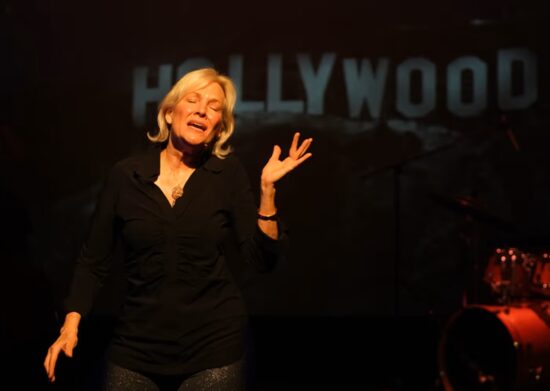 Stevie Holland in Platinum Dreams. Photo Credit: Carol Rosegg
For all the things she refers to herself as — lyricist, playwright, jazz vocalist, a “Viking Italian” due to her twin heritage — focusing on being an artist with a feminist-forward drive is what sticks out furthest. “Look at Love, Linda, which was all about how Linda Thompson opened all of the doors for her husband and his fame,” she says. “That’s fascinating to me. Look, I’ve written so many love songs. A lot of love songs. Too many love songs. Being a writer for theater is almost easier because the focus of its book, its narratives — those characters are clearer.”
As someone who loves Porter, Arlen and Berlin as much as she loves the ’70s singing-songwriters era of Joni Mitchell and James Taylor, there’s something earthen to the twinkling, clear evening’s starshine of her songs.
Her voice? It’s free, wild yet erudite.
“I started off in cabaret and was offered opportunities in opera, but I evolved into jazz,” says Holland. “Jazz was much more natural for me, as a vocalist — the feeling, the accompaniment.”
The Feeling of Jazz
Quickly, she reminds me that along with having worked with David “Fathead” Newman and Nicholas Payton in the past, her newest works such as Talk to Your Tomatoes feature pianist Chris Davis and one old friend, spacey guitarist Ben Monder, whose résumé includes working with Paul Motian, Maria Schneider and David Bowie on his final album, Blackstar, with pals such as Donny McCaslin.
Holland discusses her lifelong friendship with Monder: “I have a producer I worked with, and anytime I mentioned using Ben, [this person] didn’t think we made sense together… that it was antithetical. But I’ve known Ben since he was a senior and I was a freshman, together in a youth group. It was totally cool, not religious, non-denominational, and Ben was such a sweetheart. He’s very well-versed in and loves theater.” Now that they appear together on three songs across the divide of Talk to Your Tomatoes, it is the lost-highway sound of Thelonious Monk’s “Round Midnight” where Monder’s moaning tones “sound otherworldly.”
Returning to the topic of knowing what-works-best-when, we return to the writing, hunting and gathering of songs for Talk to Your Tomatoes. “Several tunes, like ‘You Pull Through,’ came from this long-intended animated musical that Gary and I were working on, Barn Song,” the singer-writer says, knowingly.
With so many projects written by and between them, and the prep for a new album stalled by Covid, Holland resourcefully reused and reconstructed several Tomatoes songs before they nearly died on the vine. Change a few lyrics about a rooster feeling guilty for his freedom while his buddies are left behind in a Brooklyn abattoir, and “You Pull Through” becomes a song about the mysteries of life and the strength required to survive — a funny, whimsical, even philosophical song that centers Holland’s wit.
Like Bob Dorough, Jon Hendricks and even her heroes Johnny Mercer and Cole Porter, Holland is humorous as a lyricist without any rubber chicken hitting you over the head. “How do I do ‘funny’ comfortably,” she asks, repeating my question with a laugh. “I don’t know. I grew up in a zany wacky family. My husband’s a funny Brooklyn guy who grew up in the Woody Allen tradition — he’s got a few more pratfalls in him than I do. What can I say? We need humor. We could use a few laughs. You go through enough lies and enough terror, and you realize just how much we need some levity.” JT
Comments are closed.