
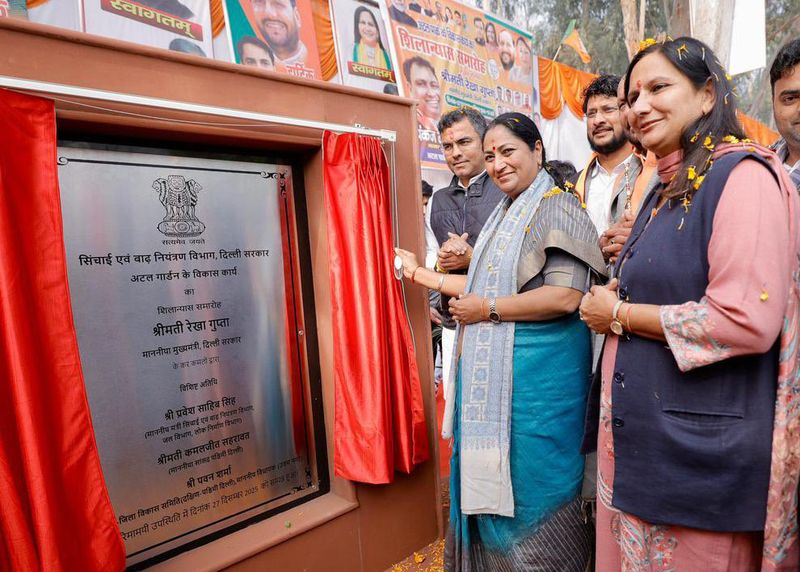
Delhi Chief Minister Rekha Gupta on Saturday laid the foundation stone for Atal Garden, a major public infrastructure project to be developed along the Najafgarh drain in West Delhi’s Uttam Nagar constituency. The project is being implemented by the Irrigation and Flood Control Department.
Named after former Prime Minister Atal Bihari Vajpayee, the garden will have a 12-feet statue of the veteran BJP leader to commemorate his legacy.
Envisioned as a green hub for one of the most densely populated parts of the Capital, the garden aims to enhance green cover, curb pollution and provide residents with a safe, well-planned public space equipped with modern civic amenities.
Addressing a gathering of local residents and public representatives, the CM said the garden would serve as a “lifeline” for Uttam Nagar. The project will feature a pond, two dedicated Chhath ghats, an amphitheatre, open gym, fountain, food court, walking tracks, seating areas and facilities for children, youth and senior citizens.
Emphasising environmental sustainability, Gupta said that indigenous tree species would be planted across the garden. “Over 6,000 saplings, including Amaltas, Neem, Siris, Gulmohar and Mango, will be planted as part of the project, while nearly 50 acres will be developed with lawns and green spaces,” the CM added.
She recalled that the idea for the garden was conceived during an inspection of the Najafgarh drain, one of the largest drains flowing into the Yamuna. She said years of neglect had led to the deterioration of the drain, and her government had resolved to undertake its rejuvenation.
“Alongside this, roads will be developed on both sides of the drain to improve connectivity between nearby localities. Work is also underway on the central verge beneath the metro corridor from Uttam Nagar to Dwarka Mor,” she added.
Cabinet Minister Pravesh Sahib Singh said that Uttam Nagar had always lacked major development works and residents had been demanding a well-developed public park for years. He said work was progressing at a rapid pace, adding that within the next four months, the area would transform into a major recreational hub with modern walkways, water bodies, sports and fitness facilities, cultural spaces and public amenities.
Comments are closed.