
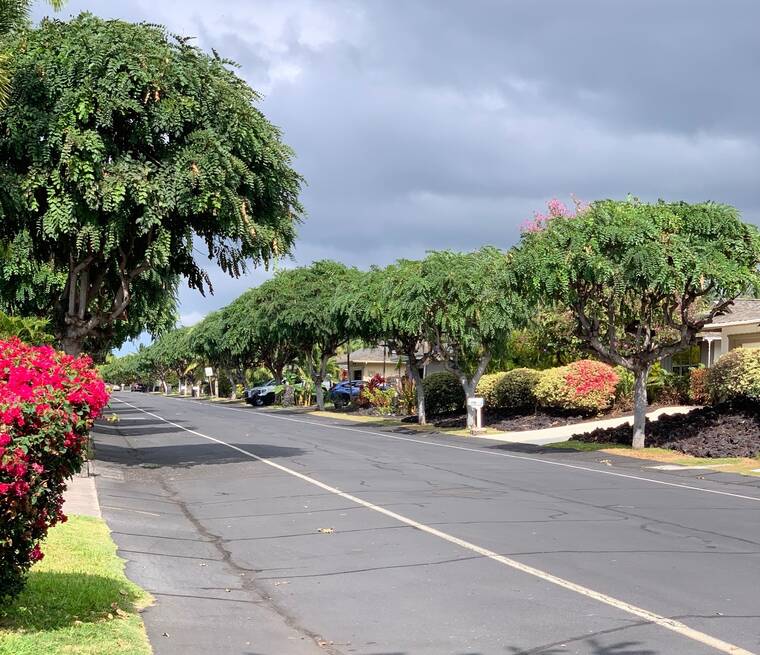
If you are the kind of person who makes New Year’s resolutions but never follows through, then maybe they are resolutions just too big to achieve. Start by keeping it manageable like planting one tree. You can do that on the first day of 2026!
Since you have achieved your goal, then hopefully you will want to plant more. Remember, every tree you plant and every tree you save being cut down helps remove carbon dioxide and adds oxygen to the atmosphere. You are making this a better world for future generations.
Since you will feel a sense of achievement, you can relax and do some mind adjustments exercises. You can start by recognizing we are one race, and that is the human race. There are no truly black people, yellow people, red people or white. There are just shades from dark to light. There are different cultures, subcultures, ethnicities, nationalities and tribes, if you wish to put folks into boxes. There are those that are privileged and those that are not. There are the rich and the poor. As long as we separate ourselves from one another, we are subject to the disease referred to as xenophobia or prejudice and hatred of anyone different than us. Once we are truly aware of core of our malcontent, we can begin to heal.
Have you noticed that a walk in the forest or time spent in the garden brings a sense of peace? It is a way to get back to our natural roots. Seriously, hugging a tree can help one feel a sense of connection with all the Earth.
Most folks say they hope for “Peace on Earth,” especially during this season when that message is loud and clear. Many also wish for a happy new year. The question is what is happy and what is peace? To some, having more material wealth is what apparently makes them happy.
Spending time traveling leads to the realization that being at peace and happy has little to do with material wealth. You can meet many folks who would be considered poor but don’t see themselves that way. It is more about having a strong spiritual foundation, family and community connections.
Most folks in Asia, for example, believe in the teachings of Buddha that are in many ways comparable to the teachings of Jesus. The rich Hindu prince Siddhartha gave up his wealth and meditated for years until he reached “Enlightenment” under the shade of a bo tree or Ficus religiosa. He gave up his material wealth. This is reminiscent of the teachings of Jesus quoted in the new testament chapters of Mark and Luke going something like this: I tell you the truth. It is hard for a rich man to enter the kingdom of Heaven. Again I tell you, it is easier for a camel to go through the eye of a needle than for a rich man to enter the kingdom of God.
However, the concept is repeated in the Babylonian Talmud, Quran, Old Testament and basically all the major religions. In more modern times, some have promoted the concept that the richer one becomes is proof of God’s blessings.
Unfortunately, it seems that the more they have, the more they desire. There is an old adage that money is the root of all evil, but it is more accurate to say that the worship of money is the true root of all evil. How many billions of dollars does it take to buy happiness?
Perhaps the key to peace and happiness is that it should be coupled with faith, hope and the greatest power of all, aloha. The world’s great religions place the importance of loving one another, our creator and creation itself. There are those who distort the message for political, economic, power or control. Some even place themselves and their group above others and this leads to unresolvable conflict and misery.
The question is, can aloha help us to have ethnicity without ethnocentricity? Can we appreciate that we are unique without putting down someone else? It is so easy to fall into the “us and them” mode of thinking. Instead, we may expand that connection to all living things. One way to practice is by noting our attitudes about other inhabitants of our global ecosystem.
For example, let’s take a look at our beautiful Hawaiian gardens. They are composed of plants from all over the world. Some of these plants arrived long ago transported by ocean currents, winds and birds. Hundreds of varieties were brought here by the first human inhabitants. These include kukui, coconut, ti, breadfruit, banana, sweet potato and many others. Later, each group brought the plants associated with their culture.
When it comes to our gardens, we may then see things differently. We see that it is essential to protect what is unique to Hawaii, but simply labeling life forms as native versus alien and then to infer that one is good and thus the other must be bad is a disservice to all. Our gardens give us opportunity to do our mental push-ups and acknowledge the value of each of the diverse life forms including insects, lizards, frogs and birds.
Most non-native plants introduced purposely have benefited man. With diversified agriculture essential for our economic survival, it is important we don’t hamstring ourselves so that we are unable to grow a crop that is of benefit to our community and economy by maligning all non native species.
Our responsibility is to recognize that our communities include many other life forms, most of which are unique and need our special protection, and at the same time to recognize the need for non native species including those introduced by the Polynesians and other ethnic groups. The message for our future is that it is time for all members of our island community, including environmental groups, agricultural interests, visitor industry, politicians and others to work together on plans that focus on good management of our resources.
It is not a time to be confrontational. We can learn to manage our polarities if we can shift our patterns of thinking. There is a lesson to be learned in how we treat all the varied life forms in our island gardens. Maybe if we learn that garden lesson, we will treat one another better!
It is the essence of aloha.
Norman Bezona is professor emeritus, University of Hawaii College of Tropical Agriculture and Human Resources.
Comments are closed.