
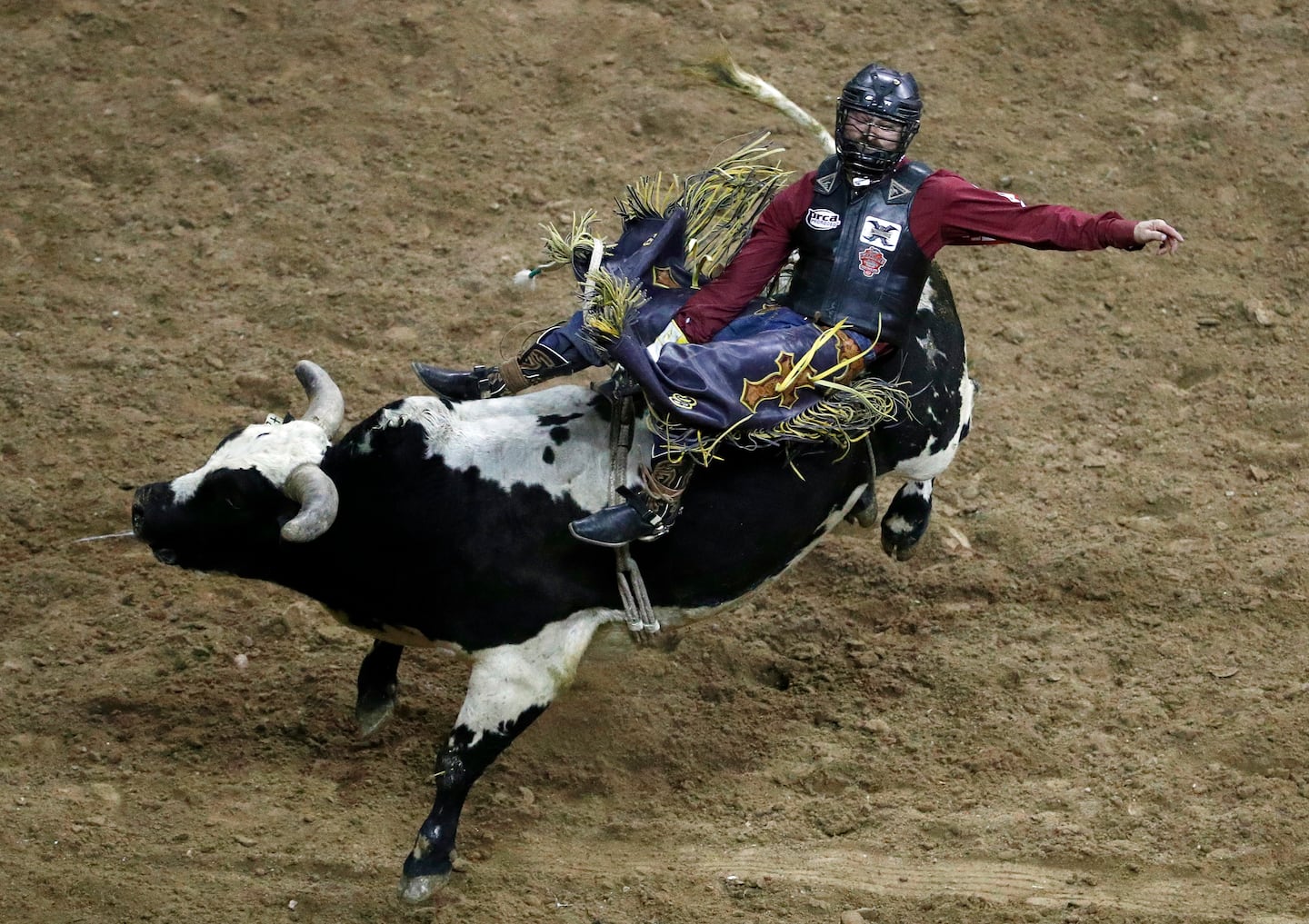
By Rebello’s trained eye, the PBR’s got its dirt together, and he’s counting on the 30-year-old building passing white glove inspection once the show high-tails it out of town.
Get Starting Point
A guide through the most important stories of the morning, delivered Monday through Friday.
The first rider goes up Friday night, but all the dirt begins to fly just hours after a New Year’s Eve comedy show wraps up late Wednesday. The Garden bull gang will shoo the last laugh out the door by midnight, then cover the ice surface with their standard collection of boards, only this time adding an extra layer of plastic sheeting.
Then comes the dirt. Per Bo Davis, the PBR arena manager who directs all of the tour’s 32 setups and teardowns across the country each year, it will take 40-plus huge dump trucks, each lugging around 20,000 pounds of dirt up the Garden’s ramp, to get the job done.
“Good dirt’s usually got some clay in it,” explained Davis, 59, who grew up outside San Antonio. “We might use the same dirt, actually, that we just used at our show in Manchester [N.H.]. It’s clean. Nothing contaminates it. We have a contractor who’ll take care of it — dirt’s all he does — and he’ll find a pile somewhere, no problem. It’s not like Florida.”
Dirt in the Sunshine State, noted Davis, typically contains an excessive amount of sand, not a good mix when an angry 1,600-pound bull, intent on shaking the typical 140-pound rider off his back, is trying to hunker down to his business of launching bodies.
Rule No. 1: A professional bull wants to know he’s on terra firma. He has eight seconds to try to bounce the cowboy off his back. If he fails, he’s got to explain it to the boss back at the ranch.
“That Florida sand is real shifty,” lamented Davis. “It has no binding agent, so the animals can’t push off and buck very good.”
In Davis’s opinion, the best seats in the house are right up close, three or four rows above the top rail of steel fencing that his crew will attach atop the hockey boards that ring the rink. Unlike watching hockey, where the preferred view is usually higher up in the arena, Davis believes closer is the way to go.
“Low’s best, so you’re right in the action,” noted Davis. “You literally can feel it down there, and sometimes all the dirt and everything gets kicked up into the stands. It can get kind of interesting.”
For those wondering if the bulls sometimes can get too close to the paying customer, not to worry, Davis said, because none of the bulls on the PBR tour ever has made a jailbreak.
The steel fencing atop the boards is 6 feet high and firmly locked in place. However, just as a cow may dream of jumping over the moon, there’s a bull now and then that entertains the idea of going for a meet and greet in the stands.
“You can kind of tell with an animal, with their movement, when they are thinking about trying to jump a fence,” noted Davis, dotting his observations with an uneasy laugh. “If you see one picking his nose up and looking at that top rail, kind of sizing it up … it’s, ‘Oh, [expletive].’ ”
A spectator might not know that look, said Davis, but a lifetime of being around livestock has taught him to spot when trouble is brewing.
“That’s when we get one of our safety riders down there,” he said, “to get a rope on him.”
It’s common for individual bulls, Rebelo learned, to have a fan following. He was surprised by that, along with the fact that shows he attended in Manchester and New York City attracted a ticket buyer that didn’t fit his preconceived notion.
“I was kind of expecting this whole Marlboro Man thing, right?,” he said. “You know, cowboy hat, cigarette, the whole 9 yards … a bunch of rowdy males.”
Instead, Rebelo said he saw a lot of moms and dads with their little kids, along with a lot of couples out on date night. The fans often rooted for the bulls as much as they were rooting for the riders.
“Interesting‚” he recalled thinking, “I thought, ‘OK, now this is kind of different.’ ”
According to Garden publicist Tricia McCorkle, the last live animal show rolled out of the building on Oct. 16, 2016, when the Ringling Bros. and Barnum & Bailey Circus rounded up its elephants for a final time on Causeway. She especially grew fond of the elephants’ visits over the years.
“I used to take them for a walk to the North End for lunch,” said McCorkle, recalling her promotional chores when the circus came to town. “No lie!”
Rebelo’s circus memories aren’t nearly as romantic. One of the building’s first events was a prolonged circus stay. The walls had yet to be painted in the back of the house where the lions, tigers, and bears were caged on the third floor.
“And the tigers, they can spray 15 feet,” recalled Rebello, gesturing toward a nearby cinderblock wall. “It gets in there, it won’t come out. We had to impregnate the wall with paint to kill the smell.”
Despite their celebrity and, shall we say, convincing nature, the bulls do not overnight at the Garden. According to Davis, they’ll be kept at a livestock facility in Littleton and hauled into the city on large trucks for each night’s performance.
Not all will appear in both shows. Once eight to 10 of the bulls have completed their runs, they’ll be loaded back into trucks and hauled back to Littleton and eventually to farms in Ohio, Pennsylvania, Georgia, and Florida.
The dirt, said Davis, will take approximately six hours to load up and haul out of town.
“It all usually goes back to where we got it, and then it’s good for the next bull riding show, or whatever,” said Davis. “We’re really just renting it.”
Kevin Paul Dupont can be reached at kevin.dupont@globe.com.
Comments are closed.