
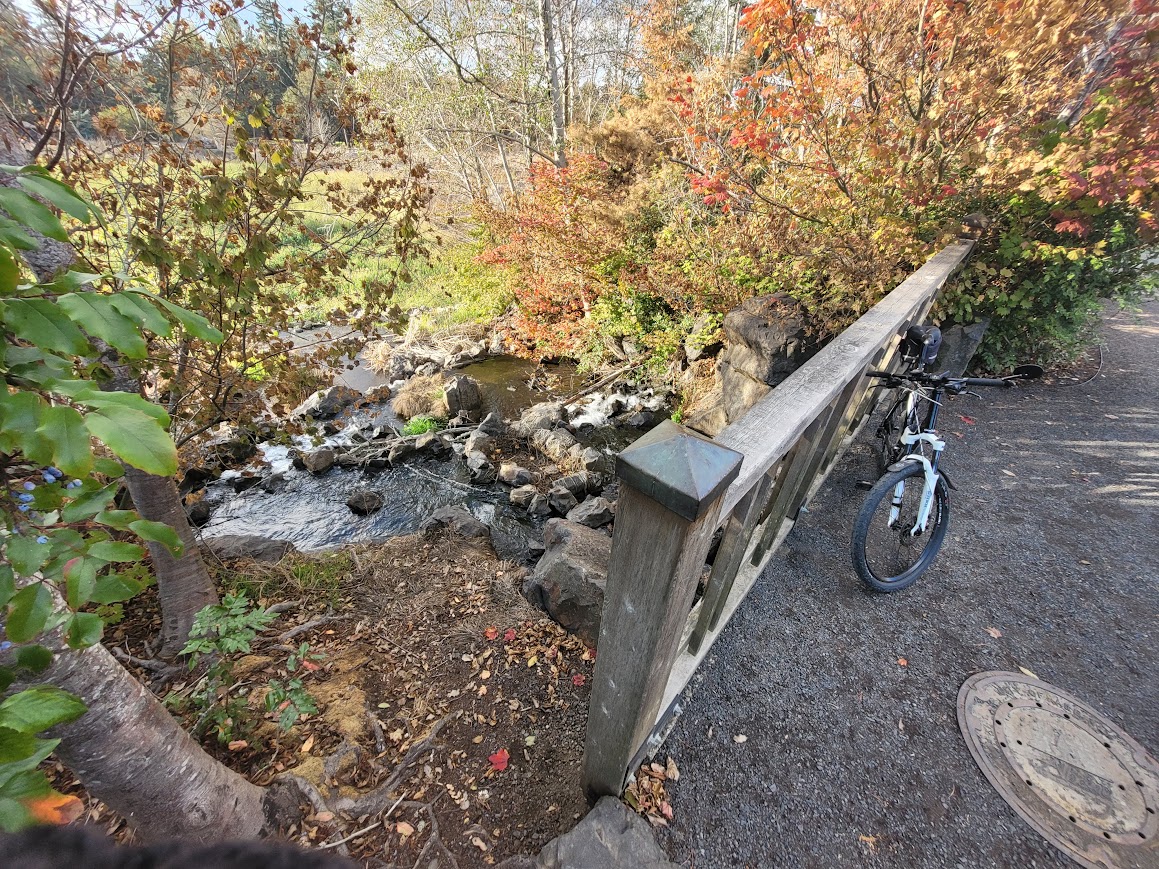
I took this photo when I last visited the Talking Water Gardens on my bike on Oct. 7, 2025.
Depending on the method that is eventually chosen, repairing the leaks from Albany’s Talking Water Gardens could cost as much as $126 million, according to the city’s latest filing in its long-running lawsuit against the wetlands’ engineers.
On Monday I spent some time at the Linn County Courthouse pouring over the digitized paperwork in Albany vs. CH2M Hill, which the city filed in 2017.
Just last week, the city’s lawyers filed their sixth amended complaint in the action, which blames CH2M engineers for the failure of the constructed wetlands, which opened in 2012.
The problem, discovered soon after the project was completed, is that the ponds holding treated wastewater leak into the ground and to surrounding creeks. One estimate cited in an earlier filing put the leakage at 425,000 gallons a day.
Under pressure from the state Department of Environmental Quality, the city shut down the Talking Water Gardens (TWG) a year ago. This past summer the city tried keeping some of the plants alive by pumping in water from Cox Creek.
In its latest amended complaint, filed Dec. 18, Albany says this about the costs of repairs:
“The estimated costs to repair the TWG wetlands to satisfy design objectives and legal compliance reasonably varies from approximately $39.1 million to $59.8 million for a high-density polyethylene flexible laminated waterproof material, or $82.5 to $126.1 million for the clay lining option, based on reasonably estimated costs at the time this amended complaint was filed.”
The lawsuit also seeks to recover the city’s costs in buying property for the project, building it, and then operating it from 2011 to 2024. That bill comes to $17.1 million.
The Water Gardens were intended mainly to cool treated wastewater from the Albany-Millersburg sewage treatment plant, even though the plant’s state discharge permit did not actually require this at the time.
The new permit just issued does limit the “heat load” the plant adds to the Willamette River. The city has not said whether this will require cooling the effluent, and if it does, how cooling could be accomplished, and what it would cost.
As for the pending lawsuit, the city has been demanding a jury trial. One entry in the file mentions a “final resolution conference” last July 24, but evidently no final resolution was achieved.
The city’s lead attorney is Kerry Shepherd, of the Markowitz Herbold firm in Portland. The lawyers for CH2M are in Los Angeles and Seattle. All together, I counted 14 lawyers involved in the case.
According to the file, the next hearing, before Circuit Judge Michael Wynhausen, is scheduled for an hour and a half starting at 10:30 a.m. on March 17, 2026. (hh)
Comments are closed.