

The Aratta Garden project by Palyan Architects has received an Honorable Mention from the international jury in the Future Projects category at the SHARE Architecture Awards, held on December 3–4 in Dornbirn, Austria.
Over the course of two days, the SHARE Architecture Awards brought together 250architects from 20countries of the Central and South-Eastern Europe, Central Asia, and the Caucasus, creating a unique platform to exchange ideas, challenges, and innovations, and to explore how diverse cultures influence architecture, space, and identity.
The SHARE Architecture Awards were held for the second year, with four architectural studios from Armenia selected for the Final List. Among them, Palyan Architects’ Aratta Garden project was recognized with an Honorable Mention award.

Tigran Palyan, Founder and CEO of Palyan Architects, traveled to Austria to personally present the Aratta Garden project. The project was developed by a multidisciplinary team of professionals, including architects Tigran Palyan, Vrezh Tamazyan, and Lilit Sukiasyan; interior designers Mary Palyan and Hasmik Karapetyan; exterior visualization by Gor Tamazyan; structural engineer VaspurakKarapetyan; and engineer Armen Grigoryan.
About the Aratta Garden Project
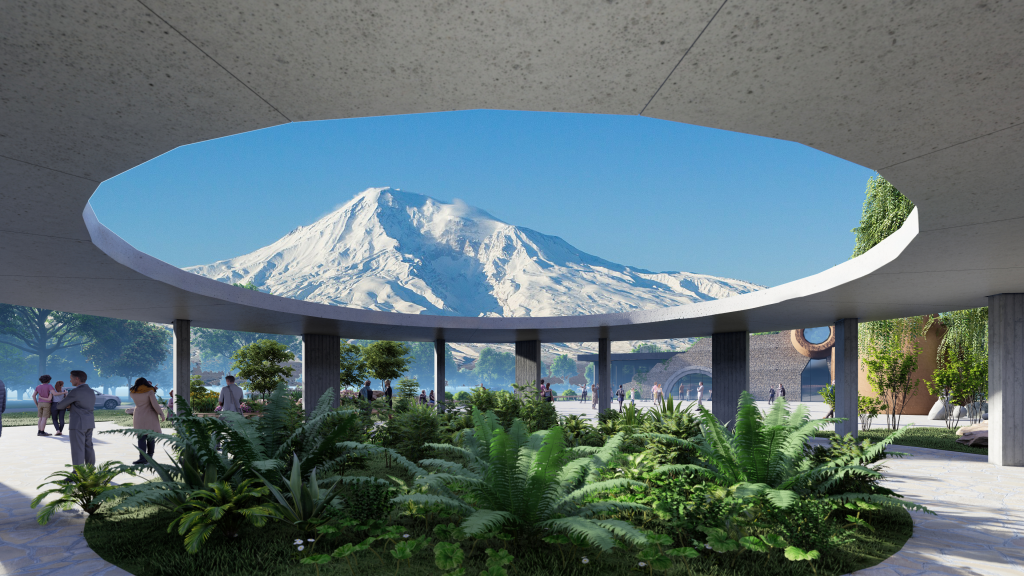
Aratta Garden is a cultural and architectural complex consisting of four distinct structures organized around a large open space designed to host festivals and attract tourists. The project’s core concept is to presentArmenian culture, traditions, and heritage through a contemporary architectural language.
The project, currently under construction, is located near the Khor Virap Monastery, the historic site associated with Armenia’s adoption of Christianity in 301, with Mount Ararat rising in the background—an iconic and sacred symbol of Armenian identity.
The four structures include:
A restaurant with an underground wine-tasting hall
A toneer / lavash bakery
A souvenir market
A public restroom.
While each building features a unique architectural expression, all are harmoniously integrated, forming a cohesive ensemble inspired by Armenian history and symbolism.
Cultural Inspiration and Design Elements
The lavash bakery draws inspiration from traditional Armenian clay salt sacks, symbolizing Anahit, the Armenian goddess of fertility and beauty. Its roof reinterprets the historic Hazarashen roofing technique through the use of clay materials and carefully designed lighting.
The souvenir market is inspired by the Armenian circular folk dance shoorjpar, where dancers move hand in hand and shoulder to shoulder as a symbol of unity. This concept is expressed architecturally through concrete columns that resemble dancers in motion.
To maintain visual harmony, the public restroom adopts circular forms inspired by the toneer and souvenir market, reinforcing the project’s unified design language.
The main restaurant building features a wine-tasting hall on its underground level. Its architectural form is inspired by a reclining wine vessel, symbolizing the pouring of wine and reflecting Armenia’s thousands-of-years-old winemaking tradition. The bar and lighting design echo the shapes of ancient wine vessels, with references to the historic Areni winery.
The project is named “Aratta,” after an ancient land mentioned in early Mesopotamian sources and associated with the Armenian Highlands.
At the heart of the complex is a large elliptical public square, designed to host national festivals, including wine tastings, dance and music performances, traditional food celebrations, and craft events—positioning Aratta Garden as a living cultural destination.
Comments are closed.