
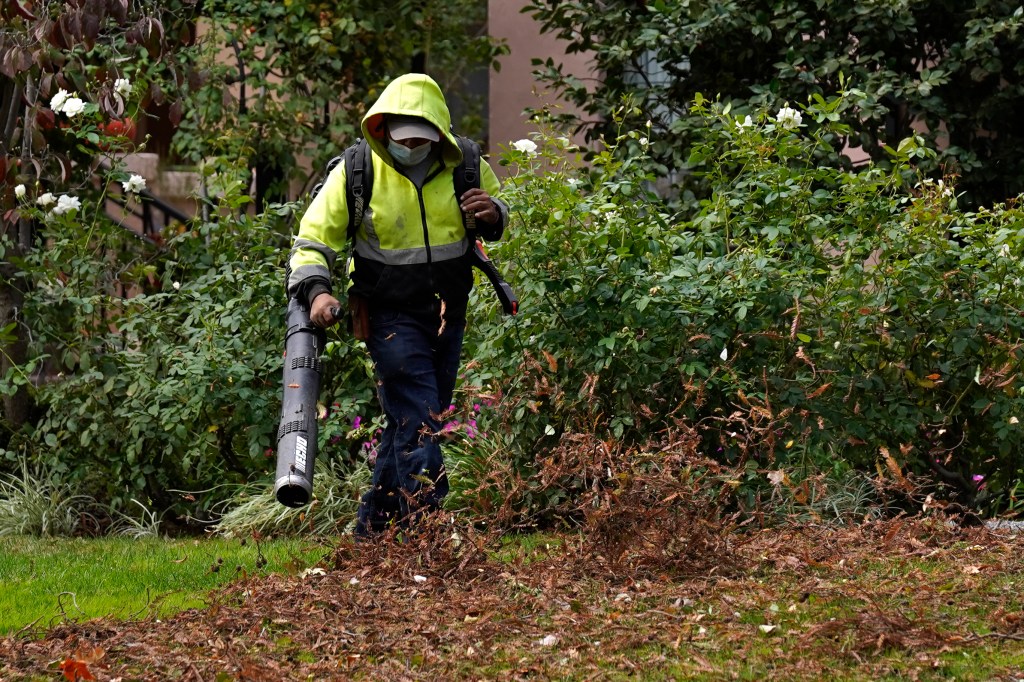
On a recent morning, I stepped into my backyard with the decibel reader on my phone and watched as the needle quivered between 92 and 96 dB, securely in the red “danger” zone (the equivalent of “gunshot” and “metal concert”). This was because a landscaping crew with gas-powered leaf blowers was clearing a yard two houses down from my own. It went on this way nonstop for more than two hours. Unable to sit comfortably in my own home and unwilling to walk my dog in the neighborhood, where two more crews were using their blowers, churning up pollutants and making the area sound like an airport tarmac, I grabbed the dog and fled to a trail in some nearby woods. Unfortunately, this proved no solution: There were leaf blowers there, too, at the houses that line the edges of the forest.
Sadly, this is not a one-off. If your neighborhood is like mine, over the past couple of years, you’ve noticed that essentially if it is daylight, you’ll hear leaf blowers. And this goes on for 10-11 months a year, basically without stop. At best, it is a distant droning whine. At worst, it means that you cannot be in your own yard — most maddening is that the worst of it coincides with those times of year when the weather is most beautiful — and even being inside with the windows closed does not solve the issue. It is far past time to do something about it. There is a reason, after all, that otherwise disparate municipalities across the state, such as Montgomery County and Baltimore City, have banned these noise and air pollution machines. But sadly, in Baltimore County, where I live, their presence continues to be a pernicious and constant fact of life. In fact, as incredible as it might seem, I am hearing one now as I write this: at 8:15 in the morning on a 20-degree day in mid-December.
The noise and air pollution these machines produce are well known, and the deleterious effects of both are well documented (increases in high blood pressure, rates of asthma, levels of stress and diminished ability to focus) to say nothing of the disastrous environmental effects. But there is a larger question inherent in the ever-increasing use of these machines. We should ask ourselves, quite simply, what kind of world we want to live in and how we will define our communities and our relationships to one another as neighbors. Are we really comfortable having whatever questionable “benefits” accrue to the individual or household (the clearance of leaves and grass clippings from one’s lawn or driveway) be at the expense of every single one of this same person’s neighbors? Ironically, the very same destructive effects of these machines also affect the user, and so the perceived benefits are, at best, a wash.
It’s another irony of leaf blowers that they completely obliterate the natural advantages that decaying leaves and grass bestow in carbon, as well as the scores of insects needed to maintain healthy lawns and shrubs. It’s more than a little bit foolish to blow away all of these benefits only to then replace them with chemicals that will inevitably wash away with rain and pollute our waterways. Far better to rake out leaves and then mow over them to mulch a lawn.
Opposition to gas leaf blower bans invariably comes in the form of advocacy for small landscaping businesses. No one wants these companies to go under, but the notion that their entire livelihood depends upon the use of gas-powered leaf blowers is a bit hard to believe — in municipalities that have instituted bans, the number of landscaping companies has simply not declined. In fact, multiple studies have shown that a switch to much quieter electric blowers pays for itself within three to nine months, depending on the savings on gas alone. Additionally, the purchase of these machines can be claimed as a business expense in tax reporting.
In the end, the “rights” of individuals and companies to use these horribly loud, destructive, pollution machines should simply not take precedence over the rights of residents to simply enjoy some peace and quiet in their own homes and on their own properties. Isn’t this the far preferable way to live?
Evan Balkan teaches writing at the Community College of Baltimore County. He lives in Towson.
Comments are closed.