

Listen to this article
Estimated 3 minutes
The audio version of this article is generated by AI-based technology. Mispronunciations can occur. We are working with our partners to continually review and improve the results.
Researchers at St. Francis Xavier University are studying the impact of warmer winters on Nova Scotia’s lady beetle population, with an eye to the potential cascading effects on local trees, plant life, farms and gardens.
Master’s student Yaseen Ginnab said that as winters get milder, beetle numbers may start to decline as they leave the dormant state too soon.
The early transition from asleep to awake means pests like aphids — which reach peak numbers in the spring and summer — won’t have natural predators around to control their numbers.
“So without these aphid predators and predators of other soft-bodied sap-sucking insects, then all these plants would just be decimated,” said Ginnab.
Ginnab is using two lady beetles, more commonly known as ladybugs, for his research.
One is called Adalia bipunctata, or the two-spot ladybug.
The other is Harmonia axyridis, or the Asian ladybug.
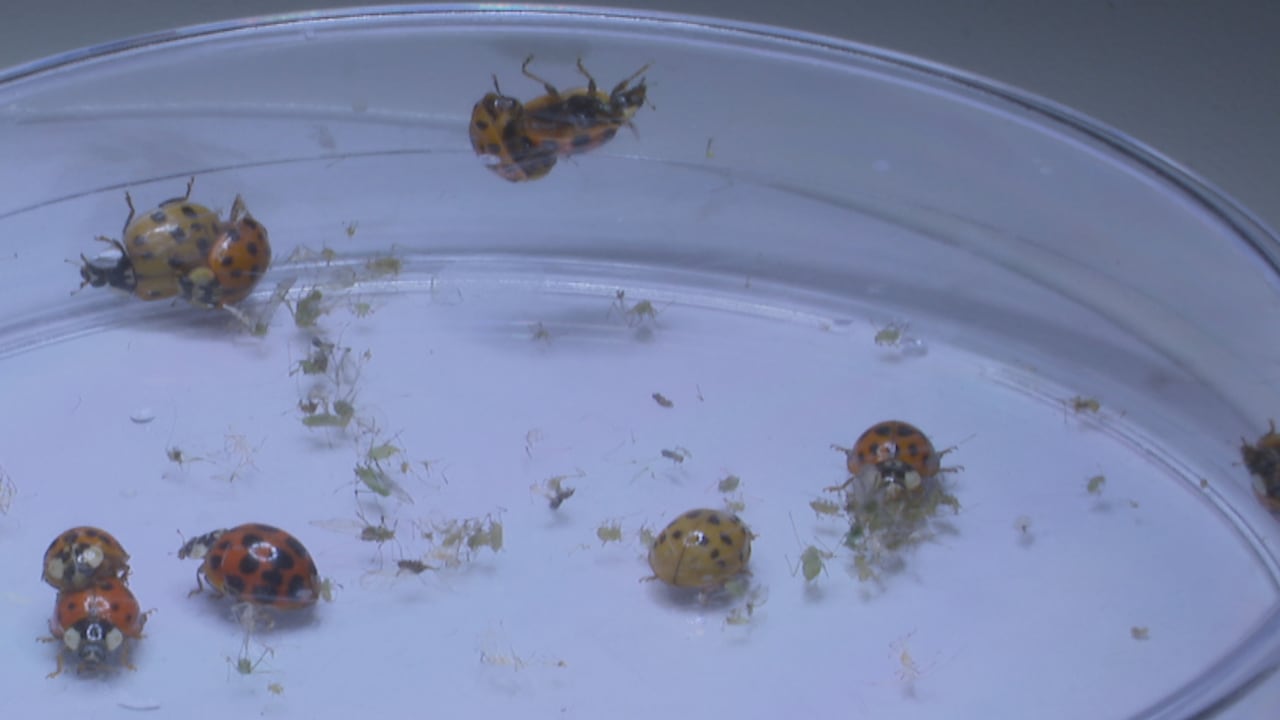 These are some of the lady beetles that are being observed for master’s student Yaseen Ginnab’s research. (Dave Laughlin/CBC)
Ginnab’s supervisor, Jennifer Perry, said many people regard the latter as no more than a pest, but she said it’s still an important part of Nova Scotia’s ecosystem.
“Harmonia, or the Asian ladybug, is a member of the family Coccinellidae, which is the scientific name for the ladybug family,” said Perry, an associate professor in the biology department at St. FX.
“It lives the same kind of life as other ladybugs. It’s a ladybug just like the other ones.”
Perry said the harmonia beetle was introduced here to help combat growing aphid numbers. It’s unpopular because of certain behaviours, like biting people.
She explained that the beetle’s population grows to match aphid numbers, which means they also quickly run out of food.
“So if you’re bitten by harmonia, it’s because that is a very hungry ladybug that is trying to bite anything in its environment in an effort to get food.”
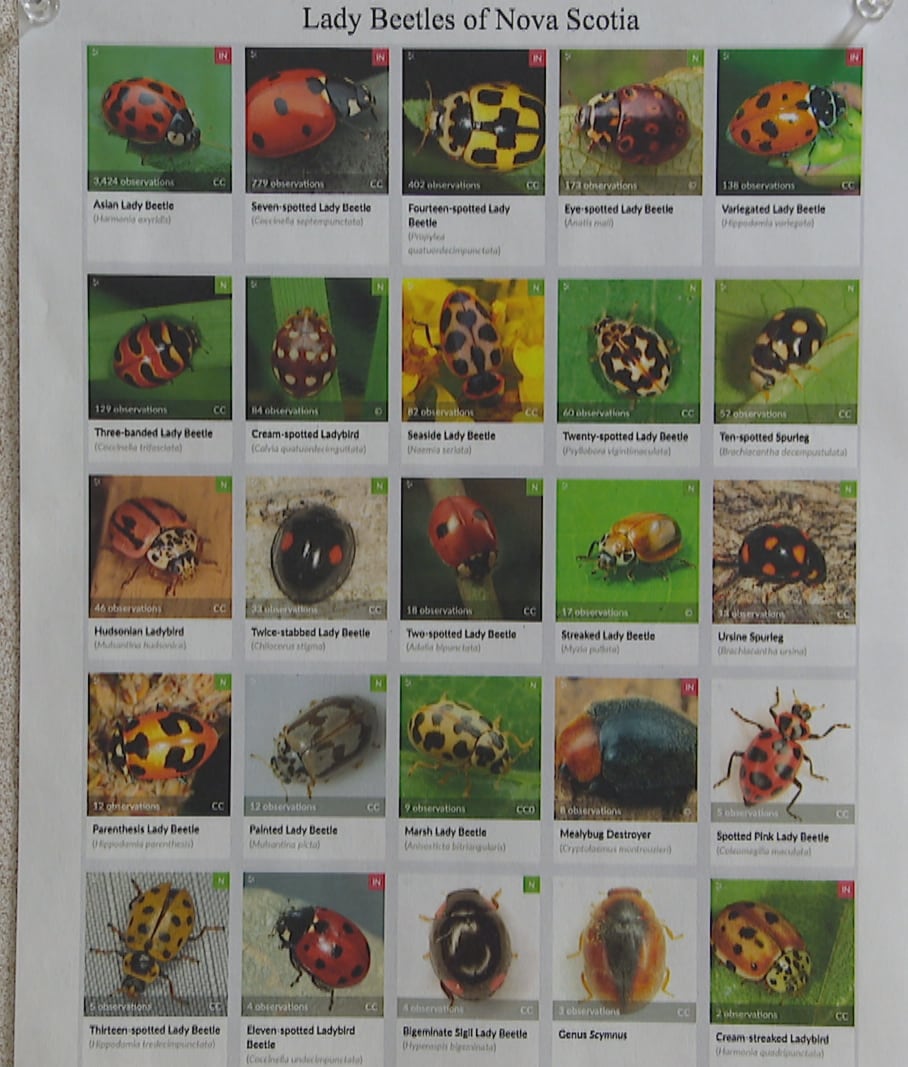 There are several kinds of ladybugs in Nova Scotia. (Dave Laughlin/CBC)
There are several different types of ladybugs in Nova Scotia, but Ginnab said it’s important to include the Asian lady beetle in his research because they’re so abundant.
Ginnab will be conducting experiments by simulating seasons for various groups of beetles.
The test subjects have already gone through the fall stage and are into about four weeks of winter, exposed to temperatures of about 2 C.
 Ginnab earned the Dr. Lloyd M. Dosdall Memorial Scholarship from the Entomological Society of Canada for his research. (Dave Laughlin/CBC)
The ladybugs have recently begun to experience a “heat wave” treatment, in which the simulated environment’s temperature will be raised above the winter average.
It’s not clear yet what temperature is too high and how long it would have to endure to affect the beetles’ reproduction process. But as our winters continue to become milder and temperatures fluctuate, it could have a drastic impact.
“As the climate warms, different insects start to come out at different times in the spring and then we have this possibility that ladybugs are mismatched with their aphid prey and they missed that window when there’s peak prey abundance,” said Perry.
“That will also affect their reproduction.”
Ginnab said this research is critical to understanding the impact one of the planet’s smallest inhabitants could have on the wider ecosystem.
“Insects in general, they’re like a cornerstone for so many ecosystems across the world,” he said.
“That’s why I believe it’s really important to look at how they’re affected by climate change.”
MORE TOP STORIES
Comments are closed.