
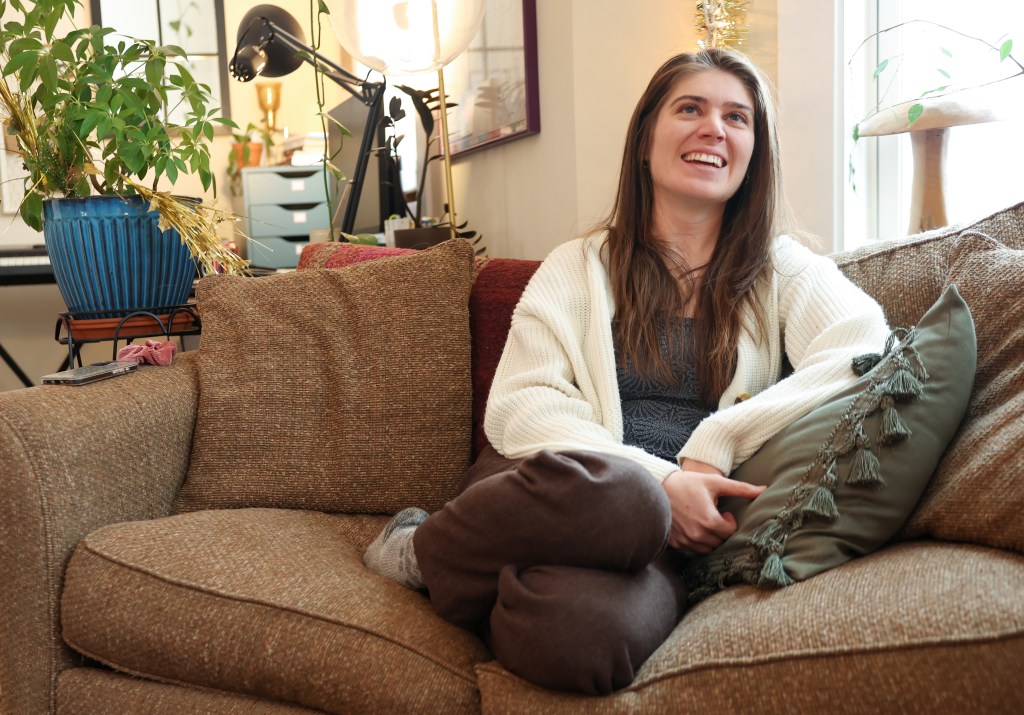
Joselyn Walsh was working from her Pilsen home last month when her phone began to ring. It was a special agent from the FBI, the caller said, and they needed to speak with her.
Unfamiliar with the number, the 31-year-old part-time researcher, part-time garden store worker dismissed the call as spam. But then her cell sounded again. This time, Walsh googled the 10 digits flashing up at her.
Sure enough, it was the FBI headquarters in Chicago. And they had a warrant out for her arrest.
“How is this possible?” Walsh wondered.
Walsh is among six protesters facing federal conspiracy charges in one of the most high-profile cases to emerge from Operation Midway Blitz, the Trump administration’s mass deportation mission in Chicago this fall. They are accused of conspiring to forcibly impede a federal immigration agent at a September protest at the U.S. Immigration and Customs Enforcement facility in Broadview.
Charged alongside four Democratic politicians and one political staffer, Walsh is arguably the least known of the group, known as the ‘Broadview Six.’ She said she doesn’t know her co-defendants and still doesn’t know why, among the hundreds that went to protest outside of the west suburban processing center during the two-month operation, she’s been singled out in federal court.
The case stands to test the impact and bounds of protest in the second Trump administration.
“I think (conviction),” said Steven Heyman, a law professor with the Chicago-Kent College of Law, “would send a real strong message that the government is capable of taking severe measures to suppress, I would say, legitimate dissent.”
Walsh remains confident in her innocence. But she’s keenly aware of what’s at stake.
“There’s the reality of wow, years in prison are on the line here,” she said. Still, the charges have also sharpened her resolve, spurring her to speak louder.
Weeks after her indictment, she continues to use her voice, often performing as part of a protest music collective and sometimes, returning to Broadview. Her co-defendants, by themselves and through attorneys, have denounced the charges as an attack on the First Amendment and maintained they will not be deterred. They’re not alone.
After an arraignment hearing in the case outside of the Dirksen U.S. Courthouse downtown just over a month ago, dozens of protesters gathered under the red sculpted arches of Federal Plaza.
“We support the Broadview Six!” they chanted.
Almost immediately after the Department of Homeland Security announced the launch of Operation Midway Blitz in early September, protests grew outside Broadview’s ICE processing center, where the federal government held detainees for days in what a class-action lawsuit described as dirty and unsafe conditions. The near daily confrontations brought tear gas, baton rounds and dozens of arrests.
The conspiracy charges against Walsh and her co-defendants stem from a protest outside the building nearly three months ago. Alongside Walsh, charged are congressional candidate Katherine “Kat” Abughazaleh, Cook County Board candidate Catherine “Cat” Sharp, 45th Ward Democratic Committeeman Michael Rabbit, Oak Park Trustee Brian Straw, and Andre Martin, who is Abughazaleh’s deputy campaign manager.
The group is accused of surrounding and damaging an ICE vehicle during a Broadview protest on the morning of Sept. 26. An 11-page indictment alleges the group “crowded together in the front and side of the Government Vehicle” and pushed against it “to hinder and impede its movement.”
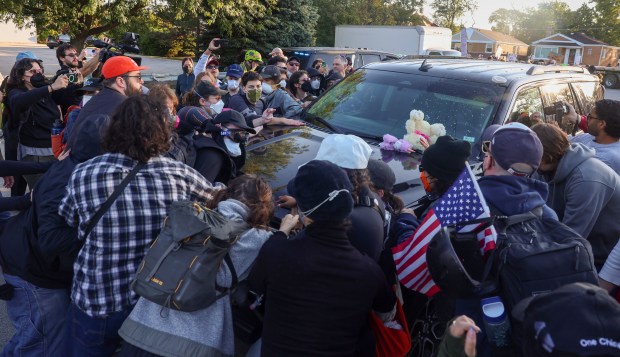 Protesters surround a federal SUV and try to prevent it from driving to the U.S. Immigration and Customs Enforcement facility in Broadview on Sept. 26, 2025. (Stacey Wescott/Chicago Tribune)
Prosecutors further allege protesters scratched the car’s body, broke a side mirror and a rear windshield wiper and etched the word “PIG” into the paint.
The indictment includes the conspiracy count — which carries a maximum sentence of six years in federal prison — as well as several other counts of impeding a federal officer, each punishable by up to one year in federal prison.
Walsh started protesting in Broadview early on into the blitz. She flocked to the facility to sing.
A lifelong musician from rural Missouri, Walsh said she’d often read about the goings-on in the world growing up. But she was inspired to start taking action after 18-year-old Michael Brown was killed by a police officer in Ferguson, Missouri, while she was at college in St. Louis.
“(It) was this moment of, I think, recognizing how … power and control works in our country and in our world,” she said.
Since moving to Chicago six years ago, Walsh has grown into her advocacy. After working at a food and farming nonprofit in the city — work Walsh says was, and still is, important to her — she found herself wanting to delve into community organizing. She hit her stride through music.
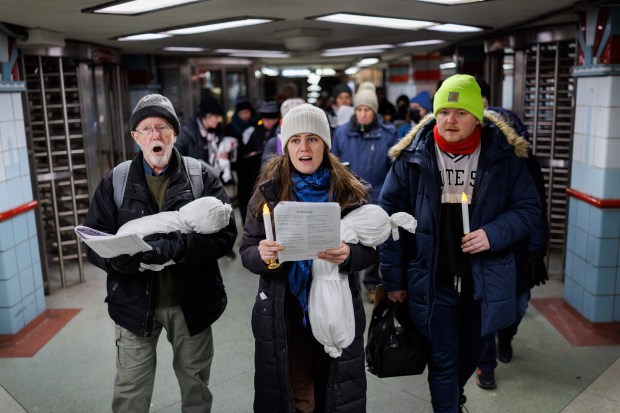 Dave Martin, from left, Joselyn Walsh and Joseph Ozment sing pro-Palestinian carols with other activists near the State/Lake CTA station, Dec. 14, 2025, in Chicago. In October, a federal grand jury indicted six people, including Walsh, on conspiracy charges stemming from a protest outside the Broadview Immigration and Customs Enforcement facility. (Armando L. Sanchez/Chicago Tribune)
For the past two years, Walsh has performed in a citywide collective of people working to bring “the power of music to protests,” she said. Called Songs for Liberation, the group includes musicians and non-musicians alike (even “shower singers,” Walsh noted). The group started as Songs for Ceasefire in support of Palestine but has grown to encompass a broader mission to dissent through song.
“Protests don’t necessarily have a lot of music,” Walsh said. “But (we think it’s) a really powerful thing.”
The collective often performs at events and protests, sometimes by invitation and sometimes just by members’ interest, with appearances ranging from marches outside the Democratic National Convention last year to caroling outside Christkindlmarket.
The Broadview protests, which became a flash point against the Trump administration’s crackdown, were a natural fit for the collective. For weeks through the blitz, and even still today as immigration enforcement continues, some amalgamation of members would travel out to the facility and through the clashes and commotion and force, perform.
“No human is illegal here,” Walsh sang with the collective one morning in Broadview, her performance captured in a video posted online. A gas mask hung around Walsh’s arm as she strummed a guitar. “We refuse to be controlled by fear.”
Andrew Walsh isn’t surprised by his daughter’s activism. While she was a shy kid, he recalled that she’s always been fiercely compassionate. And she’s long been privy to conversations about morality and politics. Her mother is a minister. Andrew is a religion professor at a small college in Missouri, whose research focuses on the intersection of religion and social issues.
Andrew said he’s proud of his daughter. And terrified.
“(But) we can’t simply submit in fear,” he said. “Because if we all submit in fear, we’ve seen in history how that turns out.”
Sept. 26 started out just like any other day of protesting and singing, Walsh recalled, but what did stick out to her was that it felt like “there was a whole other level of random impunity.” That morning, federal agents fired baton rounds, tear gas and other less-lethal ammunition at about 200 people gathered outside the Broadview processing center, the Tribune reported at the time.
Walsh remembered leaving early after a foam baton round struck and put a hole in her guitar.
“We’re just singing and then all of a sudden, I feel this impact,” she said. After a moment of disbelief, Walsh walked away, drank water, spoke with some friends and ultimately, went home.
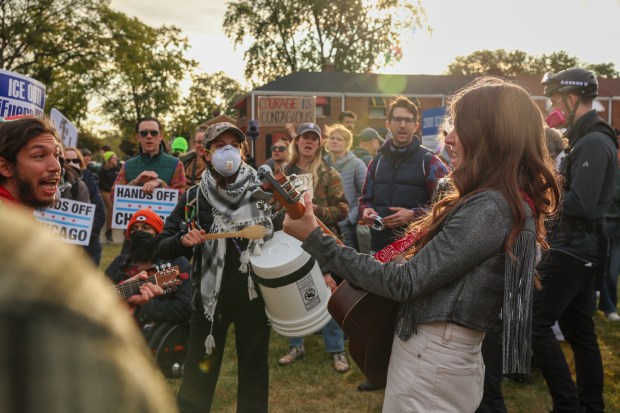 Joselyn Walsh, right, and other musicians play and sing in the protest area near the U.S. Immigration and Customs Enforcement holding facility on Oct. 10, 2025, in Broadview. (Stacey Wescott/Chicago Tribune)
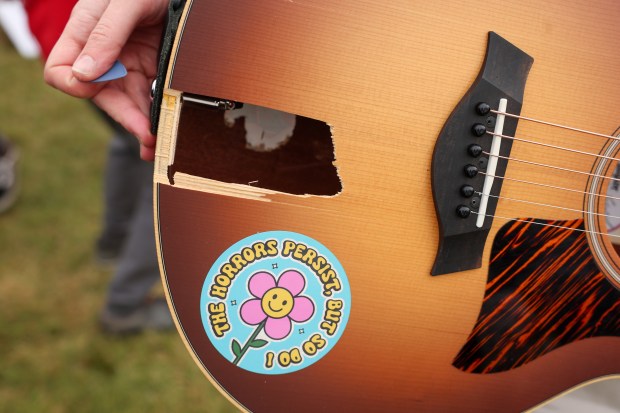 Joselyn Walsh holds her guitar on Oct. 10, 2025, near a hole she said was caused by federal agents shooting pepper balls and baton rounds at musicians, protesters and reporters near the Immigration and Customs Enforcement holding facility in Broadview. (Stacey Wescott/Chicago Tribune)
Walsh, on the advice of her attorney, couldn’t speak to the crux of the indictment, though she did call the government’s allegations “totally baseless.”
In a video of the confrontation cited by the Department of Justice, a black SUV is seen slowly rolling through a crowd of people as they chant, “up, up with liberation, down, down with deportation!” As the car inches forward, footage shows some protesters hitting the hood and windows as they try to block its movement. In another video that has circulated widely online, a guitar briefly flashes into frame.
A request for comment sent to the Department of Justice was forwarded to an assistant U.S. attorney in Chicago, who declined to comment because the case was pending.
“Federal agents perform dangerous, essential work every single day to enforce our immigration laws and keep our communities safe,” Deputy Attorney General Todd Blanche said in an October statement when charges were announced. “When individuals resort to force or intimidation to interfere with that mission, they attack not only the agents themselves but the rule of law they represent.”
The FBI called Walsh a month later. She’d been continuing to protest, while balancing her research job and taking shifts at a Humboldt Park garden store. Also due to get married in June, Walsh and her partner have been planning a wedding and had a tasting set for the day the FBI rang. They canceled their appointment.
The news of her arrest warrant left Walsh shocked and confused.
“I’m just sitting here, wracking my brain, like what possibly could have happened?” she said.
There’s been a growing trend in protests giving way to conspiracy charges.
Last year, San Francisco prosecutors charged 26 protesters with federal conspiracy after they allegedly blocked the Golden Gate Bridge for hours to demand a ceasefire in Gaza. Amid the immigration protests in Los Angeles this summer, an activist was indicted on a federal conspiracy charge after he was accused of handing out face shields during an anti-ICE demonstration, though the charges have since been dropped. In Washington, nine people are facing a federal conspiracy charge tied to an immigration protest outside a Spokane DHS office earlier this year.
The First Amendment protects individuals’ right to express their views on the government, said Heyman, the Chicago-Kent College of Law professor. Those protections do not extend to “true threats of violence” or false and defamatory statements — but they do extend to sharp criticism, Heyman said.
In his estimation, “most of the kinds of criticisms that these protesters are making about ICE and the Trump administration (are) 100% protected by the First Amendment,” Heyman said.
Where problems arise is that, generally, conduct is not constitutionally protected, he said.
“If they’re physically blocking an ICE vehicle and surrounding it and trying to prevent it from passing and so forth, basically that’s not protected under the First Amendment,” he said. Still, he said he believes that prosecuting the protesters for felonies, especially for conspiracy, is “an extreme overreaction.”
But with Walsh’s case, there’s also the matter that two criminal laws are at issue — impeding by force and conspiracy — and the burden is on the government to prove the statutes were violated, Heyman said.
Recent weeks have seen other cases out of the blitz fail to hold up in court. Last month, a federal judge dismissed charges against a woman shot by a Border Patrol agent after she allegedly rammed his vehicle in Brighton Park. And this month, a case was dismissed against Lakeview comedy club manager whom federal authorities had accused of slamming the door on the leg of a Border Patrol agent during an October immigration arrest.
For the higher charge against the Broadview protesters, prosecutors would have to show that they actually engaged in a conspiracy, Heyman said. That could be done in two ways, by demonstrating protesters had an outright agreement to conspire or had reached an implicit understanding they were going to commit a crime, according to Heyman. He noted the latter is vague and could be hard to prove.
Joshua Herman, who is representing Abughazaleh in the case, wrote in an email statement to the Tribune that the particular statute invoked by prosecutors in their conspiracy charge also does not require proof of an “overt act” — only an unlawful agreement.
“How these specific individuals,” he stated, “who were amongst a crowd of other (protesters) could spontaneously form such an unlawful agreement is a question the government will need to answer.”
He added that the statute cited is also rarely used and, to his knowledge, hasn’t been employed to prosecute protest activity in this way, despite it being on the books for well over a century.
Heyman said it’s unlikely Walsh and her co-defendants would receive the maximum sentence should they be convicted. But the case in itself, he added, conveys intimidation.
“The Trump administration is trying to send the message that they will tolerate no opposition to their immigration crackdown,” Heyman said.
He compared the case to prosecuting political opponents.
At a status hearing for the legal battle earlier this month, defense attorneys asked federal prosecutors to turn over White House communications related to a “selective prosecution” argument.
Brad Thomson, Walsh’s attorney, contends that with this case, the government is prosecuting people for protesting together.
“That’s a real danger,” he said, “when you’re trying to have a society that has a robust discourse about the actions of the government.”
When the indictment against Walsh came to light, “it definitely rocked our community,” said Jack Sundstrom, a musician who’s performed with Songs for Liberation for the past six months. Sundstrom, like Walsh, performed with the collective in Broadview.
“It’s scary and terrifying, and it would be a lie to say that this isn’t something that keeps me up at night sometimes,” the 25-year-old Glenview resident said. But in his circle, he went on, there’s also “very much a sense of we’re going to keep doing this work.” He especially intends to keep organizing through music.
“As the song goes, the people united will never be defeated,” he said. “So I am going to continue doing what I do for as long as I can.”
Walsh hopes this doesn’t keep people from speaking out.
For her and her fiancé Joseph Ozment, it’s been a surreal few weeks since her charges were unsealed. But while scary, it’s been motivating, said Ozment, who’s also involved with Songs for Liberation.
“If they’re angry at us for this,” he said, “I think it’s for a good cause.”
They’ve also been reconciling what they’re facing with what they’re fighting for.
“I get to sleep in a warm bed,” Ozment said. “I know that … I’m not going to be whisked away in the middle of the night, and my family aren’t going to know where I am.”
The parallel, Walsh said, has only emboldened her more.
“It’s great that some of us have these rights,” she said, “and it’s awful that not all of us do. We need to keep fighting for that.”
Comments are closed.