
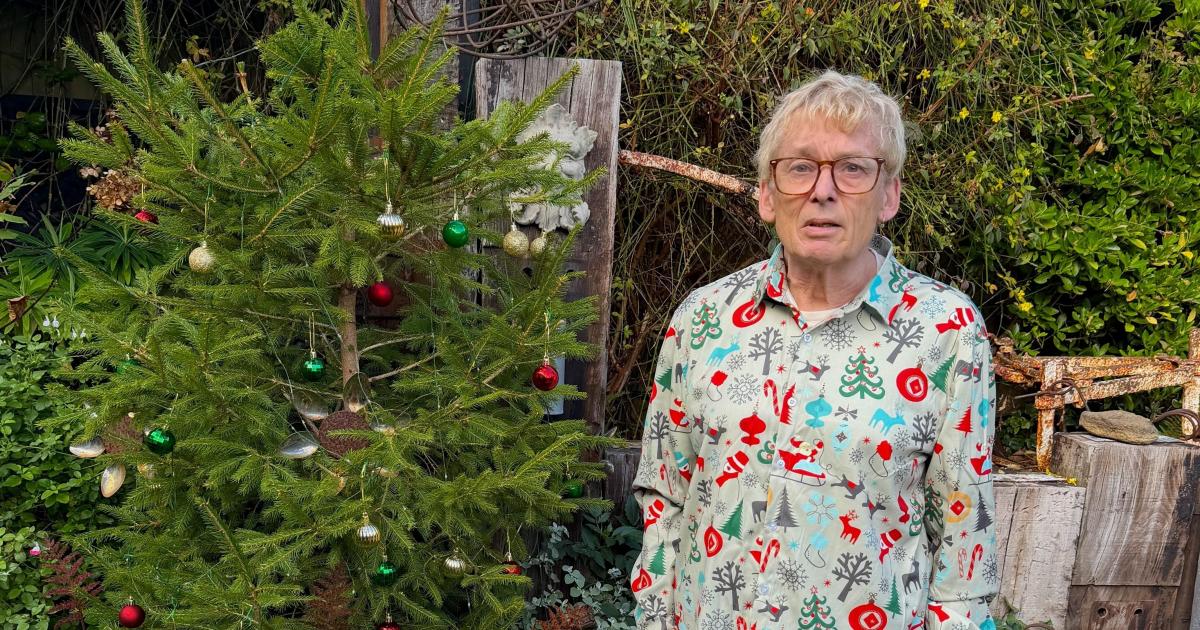
That said, I have been out and decorated the lovely Noordman Fir Christmas tree, growing in a large container on the back patio, just beyond the French windows of my garden room. You can see it looks especially pretty by night. I bought it as a potted tree four years ago and it was quite petite. According to the RHS website, Christmas trees need very little training when grown outdoors. Aim to maintain an attractive shape, removing any shoots that spoil the silhouette or any strong upright branches that compete with the leading stem. Prune away any dead, diseased or dying branches. Trees planted in pots will be limited in their size by the constraints of the pot. But if planted out in the garden, Christmas trees can get very large, reaching a height of about 15-20m) in twenty years, and possible eventual heights of about 40m, so beware. The smallest growing Christmas trees are probably Fraser firs, which reach about 7m after twenty years.
My tree was looking a little sad in a medium sized pot after last Christmas, so I invested in a rather large plastic container with two handles to drag it around if needed and the tree has almost doubled in size this year and filled out considerably too.
Just last week, we ventured out to Kent to step into a winter wonderland like no other. We were able to immerse ourselves in a new, reimagined trail at Bedgebury National Pinetum and Forest. Their world-leading collection of conifers were illuminated by millions of sparkling festive lights and alive with sounds of festive cheer, so that visitors can feel the magic of Christmas as they wander through this stunning setting. Marvel at new awe-inspiring installations such as the delicately enchanting ‘Light as a Feather’, the warming glow of ‘Floating Candles’, and the harmonious ‘Choir of Trees.’ Keep your eyes peeled for Father Christmas, as you can spot him on the trail! This year the Pinetum celebrates its 100th birthday. Open until 31st December, check their website for details
Back at Driftwood, a real favourite of mine at this time of the year too, is the beautiful helleborus argutifolius. Its flowers are the colour of ‘Granny Smith’ apples, set against spiny, evergreen foliage, they appear in winter, and remain on the plants for a long time. It’s perfect for growing in a shady border close to the house, where you can appreciate its late-winter beauty. That said all mine are in full sun in the south facing gravel garden at the front of the house. They dislike being moved once established, so should not be divided. Given the right conditions, it will self-seed quite sufficiently to provide replacements. Bowl-shaped, pendant, pale green flowers hang above leathery, prickly-edged, sea-green leaves from January to March. This popular evergreen, Corsican hellebore makes an architectural statement in the middle of a mixed or shrub border. It is best to cut the old leaves back down to the ground in January or February as this will show off the new emerging flowers to best effect.
I wonder how many readers have succumbed to the ever-popular poinsettia to add to their festive decorations this year? I love them and always have one at Christmas. Poinsettia (Euphorbia pulcherrima) is an attractive house plant with dark green leaves and leafy red ‘bracts’ that surround the green-yellow flowers in December and January. They’re commonly used to decorate the home at Christmas. Native to Mexico, poinsettias can be tricky to keep alive after Christmas and most are thrown away after the red bracts have faded and the festivities have ended. However, with a little care and attention it’s possible to keep your poinsettia alive throughout the year and even encourage red bracts and flowers to form in time for the following Christmas. Check mine out in the picture. It was a plant purchased last November and it flourished well over Christmas but was looking a bit sad by the end of January. Rather than throw it away, I cut it back, very severely, and left it in the same position in indirect sunlight but also quite dark on non-sunny days and it has thrived as you can see. I’ve even succeeded in getting the leaves to go red too. Poinsettia should be grown in a draught-free spot with bright, indirect light and a temperature of around 13-15°C. Water sparingly, typically when the surface of the compost has started to dry out. Mist the leaves and bracts regularly to increase humidity and keep the colourful bracts looking their best for longer.
Read more of Geoff’s garden at www.driftwoodbysea.co.uk or follow both him and the garden on social media.
Comments are closed.