
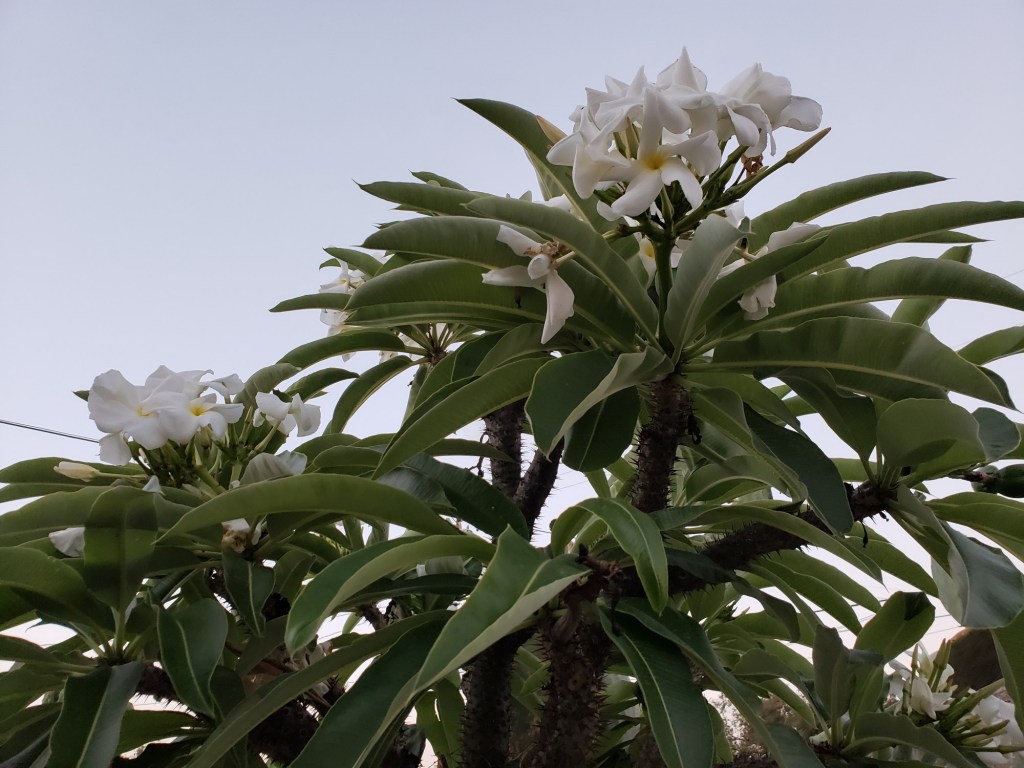
If you decide to make your backyard into a forest of succulent trees, you might not get much shade, but you will probably never need to worry about irrigation or pruning.
Moreover, you might eventually become a destination for succulent lovers — if you enjoy the company of plant enthusiasts — as the Huntington Desert Garden in San Marino, for example, has become.
Located on the grounds of the Huntington, the Desert Garden saw its first selections planted in 1907, and it has grown over the years into one of the preeminent succulent gardens in the world, with more than 2,000 species. A decade ago, a significant collection was added in the form of species found exclusively in Madagascar’s spiny forest, most of which can be grown in our area as well.
Madagascar is an island nation off the southeast coast of Africa, which is endemic to 11,000 species, meaning that is the only place on earth where they naturally occur. If there were a bucket list for plant lovers, Madagascar would be at the very top of it. Islands are commonly referred to as “hotspots of biodiversity,” since it is estimated that up to one-third of all endemics are found on islands despite constituting only 5% of the world’s landmass.
I was motivated to write about this island’s iconic spiny forest after receiving an email from Peggy Neiman, who wrote that Madagascar palm (Pachypodium lamerei) was one of her favorite trees. In truth, this slow-growing arboreal species is not a palm but a member of the dogbane family, which includes oleander, star jasmine, Natal plum, and plumeria. Its botanical name describes its form, having a thick (pachy in Greek) foot (podium in Latin). This foot or support is actually the trunk, and this is the plant’s dominant feature, as it displays a modest cluster of leaves at its apex.
The trunk, in the manner of succulent trees at large, is technically a caudex or thick-skinned water storage structure, which, in this case, is also the principal photosynthesizing or food-producing organ of the tree. In its habitat, the Madagascar palm grows to a height of 20 feet, and Neiman’s tree currently stands 12 feet tall. The caudex will only branch if cut; otherwise, it exhibits strictly vertical growth. Several Pachypoduim species are on display at the Huntington, where admission is free, with advance reservations, on the last Thursday of each month. For details, visit huntington.org.
Neiman succeeded in collecting and germinating seeds from her succulent tree as follows: “I placed origami (paper) bags over the seed pods to capture the seeds. I got about 100 seeds per pod. I grabbed a handful of seeds and placed them in a shallow Bonsai dish, just below the surface of regular potting soil. After the rains, a couple of dozen plants emerged.” As an incentive to grow this species, Neiman notes that the fragrance of its blooms is “many times stronger than plumeria’s,” whose own perfumed flower scent is legendary.
In the Huntingdon Desert Garden, the succulent octopus tree (Alluaudia procera) is named for its tentacles that may grow 50 feet into the air. I guess you could say that a massive octopus swimming on its back — something out of a science fiction fantasy — would resemble the look of this plant when young. Eventually, nearly all the tentacles disappear while a few of them coalesce into a single trunk.Succulents, including arboreal species, are full of surprises, as in the variegated leaves of many cultivars. For instance, there is a bright green and gold striped ponytail palm (Beaucarnea recurvata ‘Gold Star’) that provides astonishment at first glance after witnessing the common version of this species, whose ponytail foliage, although show-stopping as it sprouts from multiple branches, is dull green in color.
Despite its common name, ponytail palm has no relationship to palms either; it is also known as elephant’s foot due to its swollen “foot” or trunk base. It will eventually grow to a height of 15 feet, and in its dry forest Mexican habitat can live for several hundred years. Its trunk is designed to store water in the event of drought and the more you water your elephant’s foot, the more swollen its lower extremity becomes. Although of arid zone origins, it thrives in the tropics as well. This means that it is horticulturally apolitical and will grow happily in both conservatively and liberally watered gardens. It prefers full sun but can handle some shade, too. Grow it indoors next to a south-facing window.
Tree aloe (Aloidendron barberae) is the largest aloe species, rising up to more than 60 feet in its South African habitat, but only a third of that size locally. Aside from its presence in the Huntington Desert Garden, you can view it at the Getty Center cactus garden in Brentwood and at the Self-Realization Fellowship in Pacific Palisades. Giant saguaro (Carnegiea gigantea) is the most famous and charismatic of the tree cactuses. It reaches 60 feet tall and can live more than three centuries.
Susan Hazen-Hammond, author of “The Great Saguaro Book,” describes the edible bonus that comes from growing this plant: “Taste the sweet red pulp of the saguaro fruit, laced with thousands of tiny black seeds,” she writes, “and you will hunger the rest of your life for more.” You will need patience to enjoy the fruit; however, since flowers and fruit do not develop until the saguaro is at least 20 years old.
Blue saguaro (Pachycereus pringlei), while not growing as tall as giant saguaro, demonstrates the fastest growth rate of any cactus species and is a soothing blue-green in color. Old man cactus (Cephalocereus senilis) produces columns covered in white hairs and, although slow-growing, will eventually reach 40 feet tall. At maturity, the candelabra tree (Euphorbia ingens) displays a perfectly symmetrical dome, at 20 feet, of upright candelabrum branches. However, it will take years for it to look like this, and most people modify their expectations. settling to grow it in a container.
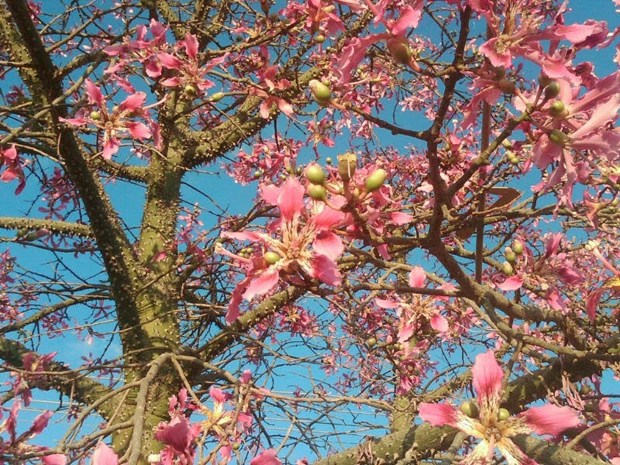 Floss silk tree Ceiba speciosa. (Photo by Joshua Siskin)
When we define any trunk that holds water as a caudex – thus classifying all trees with this capacity as succulents – it emerges that the floss silk tree (Ceiba/Chorisia) speciosa) has a thorny green caudex for a trunk and may be considered a succulent, too. This tree blooms late into the fall with large deep pink flowers followed by fluff-containing football-size fruits. Dragon tree (Dracaena draco), with its stout caudex and clusters of chalky blue leaves, is an unforgettable arboreal treasure occasionally seen in Los Angeles gardens. It has an extremely slow growth rate, but lives a long time. A famous specimen in the Canary Islands was estimated to be 6,000 years old when it fell over in a storm in 1868.
There is an exotic California native succulent known as Coreopsis gigantea. Growing up to 10 feet tall, I have seen it flourishing on cliffs along the Malibu coast. Its yellow flowers, which are three inches across with ferny foliage and a thick caudex, make it a most distinctive selection for a dry garden.
California native of the week: California or cobweb thistle (Cirsium occidentale var. Californicum), comes up easily from seed that may be planted now. This biennial plant grows to a height of six feet. In its first year, a rosette of spiny leaves forms is followed in year two, by flowers in the pink to deep red spectrum. It is highly attractive to wildlife, including many types of bees and swallowtail butterflies. Bracts beneath the flowers are wrapped in intriguing cobweb-like hairs. This plant is extremely drought-tolerant, and its seeds are available through Internet vendors.
Do you have an experience with a succulent tree? If so, please share it in an email to joshua@perfectplants.com. Your questions and comments as well as gardening conundrums and successes, are always welcome.
Comments are closed.