
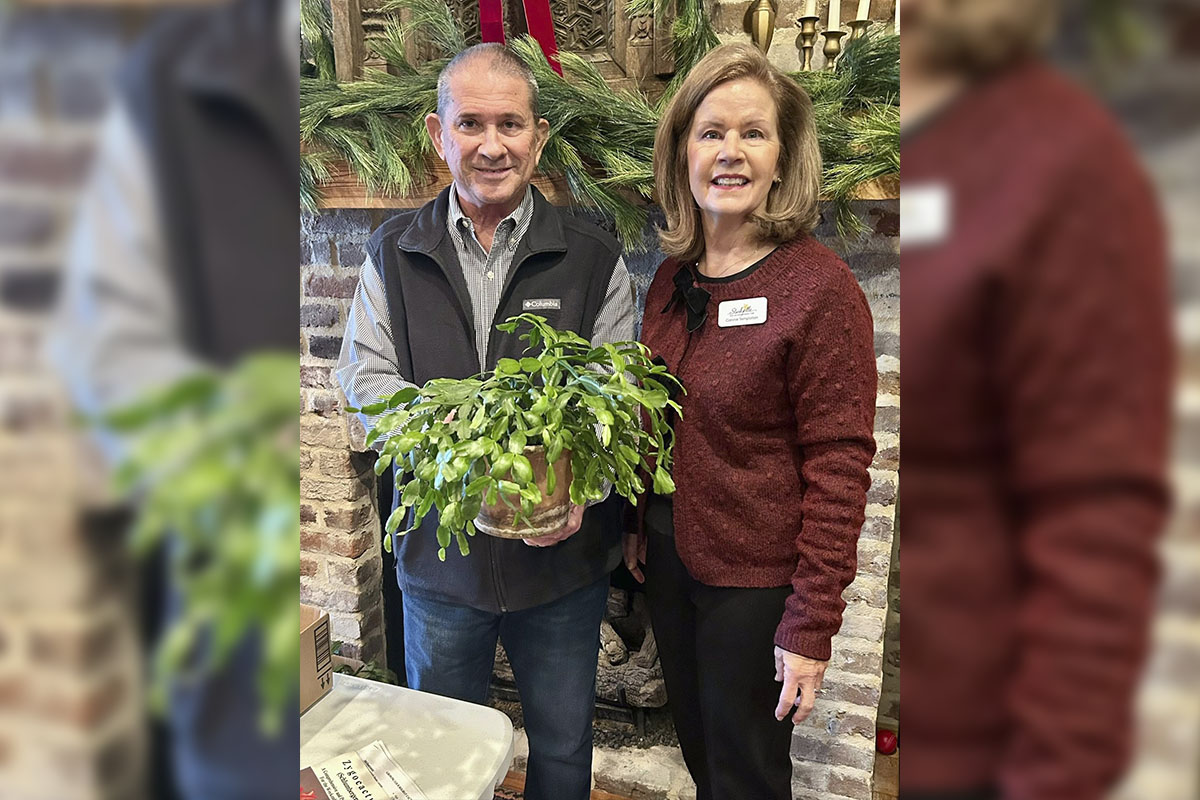
STARKVILLE – Dennis Reginelli, a retired regional Extension specialist with Mississippi State University, spoke to the Starkville Town and Country Garden Club on Dec. 4 about growing holiday cacti. The meeting was held at the home of Suzanne Lindley.
“Holiday cacti, such as the Thanksgiving and Christmas cacti, are in full bloom at this time of year; therefore, we thought it would be helpful to have Dr. Reginelli give us pointers for how to make our cacti bloom more and longer,” said Connie Templeton, vice president of the garden club. She also brought some of her own plants for Reginelli to diagnose.
Reginelli, who has grown holiday cacti for years, said the plants are sensitive to light and temperature and can be affected by a disease called streaking virus, which causes blooms to fade or bleach over time.
“If the plants receive more than 12 hours of light, they still think it is summer and will not bloom,” he said. “Even a night light can prevent blooming, so moving the plant to a different location can help.”
To help club members care for their plants, Reginelli provided a handout with these tips:
■ Soil: Holiday cacti require well-drained soil. He recommends a mix of 1 part orchid bark, 1 part perlite, and 2 parts potting soil.
■ Pots: Terra cotta pots with smaller bottoms and wider tops are ideal. Avoid pots with attached saucers, rocks, or coffee filters at the bottom.
■ Sunlight: Indirect sunlight is best. High light levels can stunt growth, yellow leaves, or cause purple coloration. He recommends 12 hours of uninterrupted darkness each night for five to six weeks before blooming.
■ Temperature: Optimal growth occurs between 65 and 85 degrees. To avoid bud drop, maintain 60 to 70 degrees.
■ Water: Allow soil to dry between waterings. Overwatering in winter can cause root rot.
■ Fertilization: Apply a high-quality, water-soluble fertilizer two to four times a year. Reginelli favors Scotts Super Bloom 12-55-5.
■ Bud drop: Plants require magnesium; he recommends Epsom salt mixed at 1 teaspoon per gallon of water, applied separately from fertilizer.
■ Pruning: Improves shape and branching for better blooms. Prune after the plant has finished blooming, usually in spring.
He added that unhealthy-looking plants often have root rot caused by a soil-borne fungus. These plants can be repotted in fresh soil and pruned to encourage growth.
Holiday cacti are currently available in nurseries and grocery stores, and Reginelli said buyers should inspect plants carefully for signs of streaking virus.
Reginelli shared that he first became interested in holiday cacti through his wife’s grandmother, who started a friendly plant-growing competition with him. Over the years, their collection grew to include varieties such as Peach Parfait, Jingle Bells, White Christmas, and Blush Pink.
A three-time alumnus of Mississippi State University, Reginelli earned a bachelor’s degree in agronomy in 1982, a master’s in 1989, and a Ph.D. in seed technology in 1993. He began his career as a research associate at MSU in 1985, transferred to MSU Extension in 1991 as a county agent, and retired in 2019 as a regional agronomy specialist. His wife, Deborah, also worked for MSU, and the couple now enjoy retirement in Starkville.
The Starkville Town and Country Garden Club promotes learning through monthly programs, regional workshops, and the sharing of information among club members and the community.
Posted in Community
Quality, in-depth journalism is essential to a healthy community. The Dispatch brings you the most complete reporting and insightful commentary in the Golden Triangle, but we need your help to continue our efforts. In the past week, our reporters have posted 34 articles to cdispatch.com. Please consider subscribing to our website for only $2.30 per week to help support local journalism and our community.
Comments are closed.