
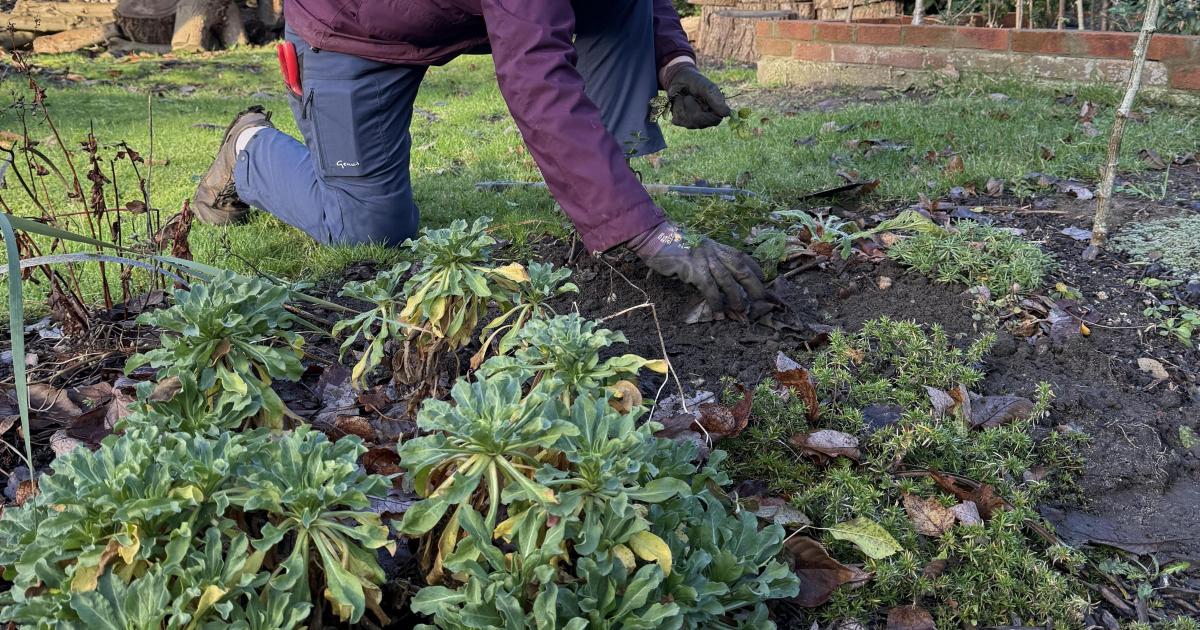
Enough frost to seem seasonal but some really mild temperatures too, and plenty of opportunity to get outside and get on with the long list of jobs.
We don’t believe in ‘putting the garden to bed’ for winter and are always surprised that there are still people who employ a gardener but tell them they aren’t needed from October to March.
There would be such a backlog of jobs to catch up on!
We hope to have done the last leaf rake this week, and it was dry enough to do what may prove to be a final mow of the grass, usefully chopping and gathering a few leaves in the process.
Malus ‘Evereste’ blossom with bee fly (Image: Supplied)
The grass borders outside our Rhino greenhouses have proved mainly resilient to the deer and rabbit population.
They leave most of the grasses alone and don’t like the rough stems of the Verbena bonariensis.
Other plants are clearly more to their taste and have not survived, but that has allowed the grasses to fill out, with lots of self-seeded Verbena in between and the mulching we did earlier in the year has paid off: there were very few weeds when we tidied these beds this week.
However the edges were a bit ragged, and we took the opportunity to recut them with a sharp edging iron.
The difference a clean edge makes is always impressive, and this was a reminder that this is one relatively small job which has a disproportionate impact on how tidy the garden looks.
The main job at the moment is moving shrubs.
When we arrived in our current location three years ago we overplanted some beds, knowing we would need to move plants around in the future, and this is the best time of year to be doing so, when shrubs are dormant.
Over the past few weeks we had been planning what to move where, what would be better in the winter border (the Callicarpa and winter flowering honeysuckle), what should be moved to the front of the shrub border (a dwarf Euonymus), what should be given away (one of four identical Ribes which has just got too big) and we have begun the process.
Cutting back perennials in December (Image: Supplied)
We have also earmarked several large clumps of Miscanthus for moving in the spring which is a better time to reposition grasses, once they are beginning to show signs of growth.
Finally, a little reminder of the perfect present for the gardener in your life: we offer personalised gift vouchers for any value you choose.
We can email them or put them in the post to reach you in time for Christmas. Let us know if you would like one!
Upcoming courses:
– Introduction to Garden Design – from 8 January
– Certificate in Practical Horticulture – from 9 January
– Advanced Practical Gardening – 14 January
– Chainsaw Use & Cross Cutting – 25 February
Malus ‘Evereste’ crab apples (Image: Supplied)
Plant of the Week
Malus ‘Evereste’ is a standout ornamental crab apple, prized for its exceptional year-round interest. In spring, it bursts into masses of fragrant white blossom, opening from deep pink buds that attract pollinators. In the summer it develops a neat, rounded crown with healthy, dark green foliage. By autumn, the tree produces abundant orange-red, bauble-like crab apples that persist well into winter, adding colour and feeding wildlife right through into the new year. Highly disease-resistant and tolerant of urban conditions, Malus ‘Evereste’ is an
excellent choice for gardens, streets, and public landscapes, offering reliable colour and interest in every season.
Contact us via www.norfolkschoolofgardening.co.uk or follow us on Instagram or Facebook.
Comments are closed.